Toyama Castle
富山城
富山市 · JP
The Floating Castle on the Jinzu River, retirement seat of the Maeda lords of Etchu Province
Built in 1543 in Marunouchi, Toyama, this moated flatland castle changed hands among the Jinbo, Uesugi, Sassa Narimasa, and the Maeda before becoming the Toyama Domain seat. Now listed in the Continued Top 100 Japanese Castles, it endures as Toyama Castle Park.
Best Season & Time
Cherry blossoms ring the moat and frame the donjon; petals drift across the water in the Ukijo style
★★★★★
Ginkgo and maple paint the ramparts in gold and crimson, and the park stays quiet for an unhurried stroll
★★★★☆
On clear days the snow-clad Tateyama range rises behind the donjon and a dusting of snow softens the walls
★★★☆☆
Evening illumination lights the donjon and the Matsukawa view, while the Toyama Festival brings the park alive
★★★☆☆
Top 3 Highlights
1.Replica Donjon and Toyama Municipal Folk Museum
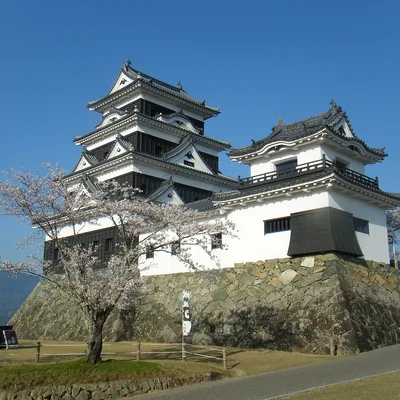
Erected in 1954 in reinforced concrete, the three-story replica donjon is the icon of Toyama Castle. It houses the Toyama Municipal Folk Museum, spanning the Sengoku era to the castle's abolition, and the top floor commands views of the Toyama plain and the Tateyama mountains.
Frontal shot from the lawn to the southeast, framed by cherry blossoms in early April
2.Chitose Gate, the only surviving original structure
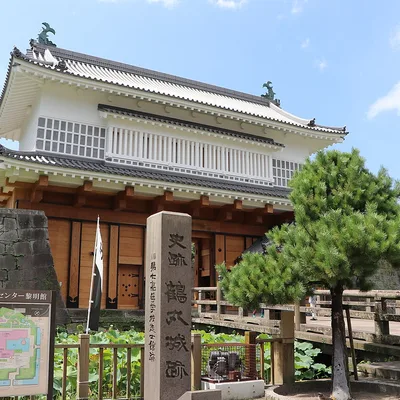
Built in 1849 by Maeda Toshiyasu, tenth lord of Toyama Domain, as the gate of his Chitose retirement palace, this rare keyaki-wood sanken-yakuimon was sold off in the Meiji abolition and finally returned to the castle in 2006-2008.
Head-on view capturing the kirizuma roof in red hongawara tiling and the solid keyaki frame
3.Honmaru stone walls and the inner moat
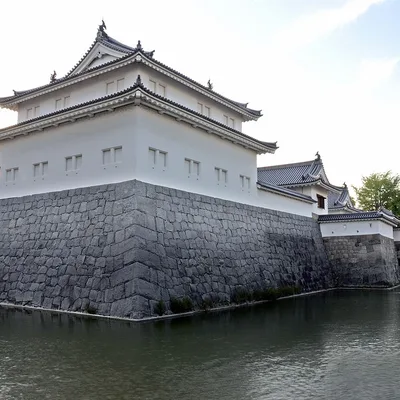
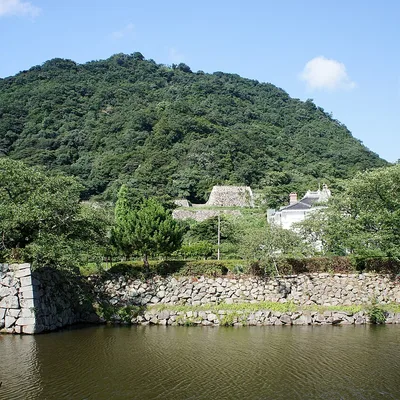
The mixed nozura-zumi and uchikomi-hagi masonry on the south honmaru face records successive remodels from Sassa Narimasa through the Maeda lords. Together with the water-filled inner moat, they preserve the watery silhouette that earned the castle its Ukijo nickname.
From the Matsukawa promenade on the south side, low morning light rakes the masonry across the water
Stories & Legends
Recommended For
Insider Tips
- 1.The Chitose Gate is a rare case of a Meiji-dispersed castle relic that was eventually repatriated to its original grounds in 2006-2008. Look closely at the pillar joints to spot the seams where the keyaki timbers were carefully rejoined.
- 2.Inside the replica donjon, the Toyama Municipal Folk Museum exhibits Edo-period domain maps and rare materials on the Hangontan medicine trade, the source of Toyama's enduring fame as a town of traveling herbal pharmacists.
- 3.The Matsukawa River along the south side of the park was once the main course of the Jinzu River and the very moat of the Floating Castle. In spring, the seasonal Matsukawa pleasure boat glides beneath the blossoms.
Visit Information
- Access
- From JR Toyama Station, walk south about 10 minutes, or alight at Kokusai-kaigijo-mae tram stop on the Toyama Chiho Railway city line and walk three minutes. By car, the castle is about 15 minutes from Toyama IC on the Hokuriku Expressway.
- Time Required
- About 1.5 to 2 hours for the park and the museum inside the replica donjon
- Budget Guide
- The park is free; museum admission is about 210 yen for adults (2024 reference; check official site). A half-day visit with light meals usually costs 2,000-3,000 yen.
Nearby Attractions
Five minutes' walk away, the free observation deck on Toyama City Hall offers panoramic views of the Tateyama range and the castle layout. Fifteen minutes on foot brings you to the Toyama Prefectural Museum of Art and the adjacent Fugan Canal Kansui Park. A 30-minute train ride reaches Takaoka Castle Park, where Maeda Toshinaga relocated in 1609.
Go Deeper
Deeper details for those with the time to read on.
Timeline
- 1543
Toyama Castle founded
Jinbo Nagamoto orders his retainer Mizukoshi Katsushige to build Toyama Castle at the Azumi locality on the east bank of the Jinzu River, a base for expanding into eastern Etchu.
- 1560
Uesugi Kenshin's Etchu invasion
Uesugi Kenshin invades Etchu in support of the Shiina clan, and Jinbo Nagamoto sets fire to Toyama Castle and flees to Masuyama Castle to continue his resistance.
- 1582
Sassa Narimasa becomes castellan
After a surprise Uesugi raid topples Jinbo Nagazumi, Oda Nobunaga installs his general Sassa Narimasa as lord of Toyama Castle, and Narimasa carries out major expansions.
- 1585
Toyama Campaign and demolition
Toyotomi Hideyoshi besieges Toyama Castle with a vast army and accepts Sassa Narimasa's surrender within a week. Hideyoshi enters the castle himself, has it dismantled, and withdraws from Etchu.
- ca. 1605
Maeda Toshinaga rebuilds the castle
After Sekigahara, Maeda Toshinaga, lord of the Kaga Domain, rebuilds Toyama Castle and moves in from Kanazawa Castle as his retirement seat.
- 1609
Major fire destroys the buildings
A major fire guts the main structures of Toyama Castle. Toshinaga builds the new Takaoka Castle instead, leaving his retainer Tsuda Yoshitada as castellan.
- 1639
Toyama Domain established
Maeda Toshitsune, third lord of the Kaga Domain, grants 100,000 koku to his second son Toshitsugu, formally creating the Toyama Domain as a junior branch of the Maeda.
- 1659
Castle becomes the domain seat
Through a territorial exchange with Kaga, Toyama Castle and its surrounding lands officially become part of the Toyama Domain and the residence of its lords.
- 1661
Full-scale restoration
With the shogunate's approval, Toyama Castle and its town undergo a full restoration. From then until the Meiji Restoration the castle serves as the seat of thirteen Toyama Maeda lords.
- 1858
Hietsu earthquake
The Hietsu earthquake devastates Toyama Castle, damaging the honmaru, ninomaru and sannomaru and collapsing sections of the stone walls.
- 1871
Castle abolished
The Meiji abolition of the han system formally decommissions Toyama Castle, and the following year most of its buildings are sold off or demolished.
- August 1945
Toyama Air Raid
During the Toyama Air Raid of August 2, 1945, the southeast corner of the castle ruins is set as the bombing aim point, devastating the castle town and the area around the castle.
- 1954
Replica donjon completed
A reinforced-concrete replica donjon is built on the honmaru for the Toyama Industrial Exhibition, opening that year as the Toyama Municipal Folk Museum.
- 2006-2008
Chitose Gate returns to the castle
The Chitose Gate, dispersed into private ownership after the Meiji abolition, is acquired and relocated to the east side of the castle park in a project spanning 2006 to 2008.
- 2017
Continued Top 100 Castles listing
Toyama Castle is selected as No.134 on the Continued Top 100 Japanese Castles list of the Japan Castle Foundation, raising its profile on the modern castle-tour circuit.
Detailed History
Toyama Castle was first raised in 1543 (Tenbun 12) by Jinbo Nagamoto, a Sengoku warlord seeking to expand into eastern Etchu Province and Niikawa District. He ordered his retainer Mizukoshi Katsushige to build the fortification at the Azumi locality on the east bank of the Jinzu River. Recent archaeology has uncovered remains from the earlier Muromachi period, suggesting some form of stronghold occupied the site even before that date. During the Sengoku era the shugo Hatakeyama lordship was nominal, and the western Jinbo and eastern Shiina clans waged constant war over the province. In 1560 (Eiroku 3), Uesugi Kenshin invaded in support of the Shiina, forcing Jinbo Nagamoto to put his own castle to the torch and flee to Masuyama Castle; he surrendered to the Uesugi in 1562 (Eiroku 5). After Kenshin's sudden death, Jinbo Nagazumi returned in 1578 (Tensho 6) with Oda reinforcements and retook Toyama Castle, only to be overthrown again in 1582 by a surprise Uesugi attack. Nobunaga responded by appointing Sassa Narimasa as the new castellan, and Narimasa undertook major expansion works. In 1585 (Tensho 13) Toyotomi Hideyoshi marched on Etchu with a vast army, besieged the castle, and accepted Narimasa's surrender within a week before dismantling the fortifications. After the Battle of Sekigahara, Maeda Toshinaga, lord of the great Kaga Domain, rebuilt Toyama Castle and around 1605 moved in as his retirement seat, only for a major fire in 1609 to gut the main buildings. Toshinaga then built Takaoka Castle and left his retainer Tsuda Yoshitada as castellan at Toyama. In 1639 (Kan'ei 16), the third Kaga lord Maeda Toshitsune granted 100,000 koku to his second son Toshitsugu, creating the Toyama Domain. In 1659 Toshitsugu exchanged territories with Kaga to take direct possession of Toyama Castle, and in 1661 he received shogunal approval to rebuild both keep and town. The Maeda of Toyama then ruled here for thirteen generations until the Meiji Restoration. The 1858 (Ansei 5) Hietsu earthquake heavily damaged the honmaru and outer baileys, and in 1871 the abolition of the han system led to the castle's decommissioning, with most buildings sold or demolished. In 1954 the present reinforced-concrete replica donjon was built on the honmaru for the Toyama Industrial Exhibition, opening that year as the Toyama Municipal Folk Museum.
Cultural Significance
Toyama Castle carries two evocative nicknames: Ukijo, the Floating Castle, and Azumi Castle. Ukijo refers to the original layout that wove the Jinzu River directly into the castle's defenses, so that the keep appeared to float on water. Azumi recalls the locality where the castle was first built, though some historians treat the Azumi fortification as a separate nearby castle. The site became Toyama Castle Park in 1954 as part of a postwar urban planning project. In 2017 (Heisei 29), Toyama Castle was selected as No.134 on the Continued Top 100 Japanese Castles list compiled by the Japan Castle Foundation, and it is also Toyama Castle Card No.16 in the local castle-card series. During the Edo period, the 100,000-koku Toyama Domain, a junior branch of the Kaga Maeda house, actively promoted the production and traveling sale of Chinese-style herbal medicines, with Hangontan as its signature remedy. Toyama peddlers became known across Japan as the medicine sellers of Etchu Toyama, making the town a great hub of early modern Japanese pharmaceutical distribution. The castle town layout still shapes the street pattern of central Toyama and anchors local civic identity.
Architectural Details
Toyama Castle is a hirajiro flatland castle and a textbook water castle that used the old course of the Jinzu River as its moat. The plan centered on a roughly square honmaru, with a ninomaru on its south face and east-and-west demaru wings, the whole enclosed by a U-shaped sannomaru. This nested watery layout is what generated the Floating Castle imagery. What survives today are sections of the stone walls on the south and west of the honmaru, the inner moat, and the relocated Chitose Gate; nearly everything else was lost in the Meiji abolition. The masonry combines nozura-zumi rough-stacked work and uchikomi-hagi rough-fitted joints, recording successive remodels from Sassa Narimasa through the Maeda lords. The 1954 replica donjon is a reinforced-concrete structure with three roofed stories on four floors, an imaginative reconstruction rather than a faithful copy; no Edo-period drawing depicts a tenshu at Toyama and no foundation stones for one have been found, so historians now believe the castle never actually had a true donjon. The Chitose Gate, built in 1849 (Kaei 2) by Maeda Toshiyasu, is a three-bay yakuimon constructed entirely of keyaki zelkova, about six meters wide and 1.9 meters deep, with a kirizuma gabled roof in red hongawara tiling. The only other surviving gate of this exact form is the Akamon of the University of Tokyo.