Uwajima Castle
宇和島城
宇和島市 · JP
Pentagonal sea-castle of the Date clan, one of Japan's twelve surviving original tenshu
Begun on a 74-metre hill in Uwajima, Ehime, by master architect Tōdō Takatora in 1596 and crowned in 1666 by the second lord Date Munetoshi with the layer-tower tenshu we still see today. Also called Tsurushima-jō, it is one of Japan's twelve surviving original castle keeps.
Best Season & Time
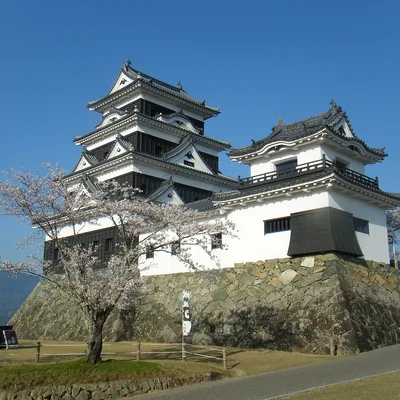
Cherry blossoms across Shiroyama Park frame the white tenshu; the climb up turns into a petal tunnel at peak
★★★★★
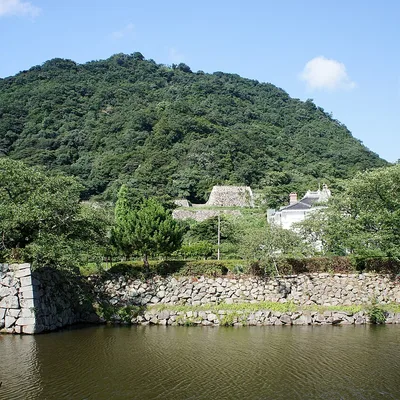
Broadleaf forest on the hill turns colour and red maples dot the green backdrop — a quiet yama-jiro view
★★★★☆
Once the leaves fall, stone walls and baileys emerge clearly — ideal for reading the pentagonal nawabari
★★★☆☆
Top 3 Highlights
1.The surviving Kanbun-era three-tier tenshu
A Kanbun-era keep with a karahafu entrance, no loopholes and no stone-drop holes — architecture of a peaceful age. Inside, a corridor with shoji doors and raised thresholds survive, and the gables bear three Date crests: kuyō, Uwajima-zasa and tate-mitsuhiki.
From the southeast stone steps of the honmaru, late afternoon light brings out the white plaster
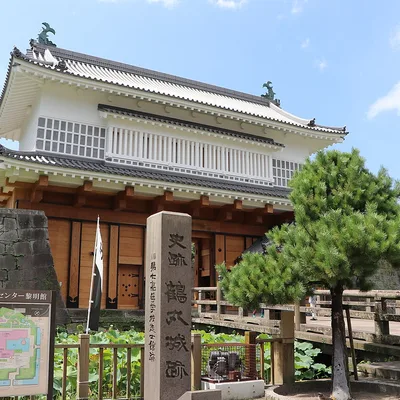
2.Noboritachi-mon, a giant yakui-mon gate
At the southern karamete (rear) approach stands a yakui-mon among the largest surviving in Japan. Analysis of its hemlock support pillars dates the timber to between 1430 and 1530, hinting that the gate could go back to Takatora's late-16th-century work.
Frame the gate from the south to bring out the broad square pillars and archaic two-tier nuki
3.Tōdō Takatora's pentagonal layout
Shogunate spies recorded the outer wall as four-sided, but Takatora made it pentagonal — generating a blind angle the attacker did not expect, the akikaku no nawa. Stone walls and scattered baileys descend from the honmaru in early-modern masugata form.
Compare the park map with the on-site layout before climbing — the geometry clicks at the top
Stories & Legends
Recommended For
Insider Tips
- 1.From the northeast corner of the honmaru terrace, today's Uwajima Port surface still aligns with where the sea once met the stone walls — the easiest spot to picture the original sea-castle and its inner anchorages.
- 2.The southern Noboritachi-mon approach is skipped by most visitors, leaving the medical-style gate, old stone steps and seasonal foliage almost to yourself — a clockwise loop, up the north side and down the south, catches the quietest castle.
- 3.The Shiroyama Kyōdokan museum, housed in the relocated 1845 arms warehouse, is free to enter and displays the precise one-tenth scale model built during the Man'en restoration of 1860 — closer than you can study the keep itself.
Visit Information
- Access
- About 20 minutes on foot from JR Uwajima Station on the Yosan Line, or a 5-minute walk from a Shiroyama-bound bus stop. By car, roughly 10 minutes from the Uwajima-Asahi Interchange on the Matsuyama Expressway, with paid parking at the foot of Shiroyama.
- Time Required
- About 1.5 hours for the keep and Shiroyama Park, 2 hours with the Kyōdokan
- Budget Guide
- Tenshu admission around 200 yen; with return transport from Uwajima Station and a tai-meshi lunch, expect roughly 3,000 yen as of 2024. Check Uwajima City for current fees.
Nearby Attractions
Tenshaen, the stroll garden of a retired Uwajima Date lord, lies about 15 minutes' walk south of the castle, and the adjacent Date Museum displays heirlooms of the Uwajima Date family. Within a 30-minute drive, the Uwa Sea coast and the dramatic terraced fields of Yusu Mizugaura offer one of Shikoku's most photogenic coastal landscapes.
Go Deeper
Deeper details for those with the time to read on.
Timeline
- 941
Tachibana builds the fort
In Tenkei 4 (941), the imperial envoy Tachibana Tachibana is recorded as having built a fort on this site during the suppression of the Fujiwara no Sumitomo rebellion — the seed of the later Itashima Marugushi Castle.
- 1595
Tōdō Takatora enters Uwa
In Bunroku 4 (1595), Tōdō Takatora was granted a 70,000-koku fief over Uwa District and took up residence at Itashima Marugushi Castle, opening the early-modern phase of the site.
- 1596
Full-scale rebuilding begins
In Keichō 1 (1596), Takatora launched the full-scale rebuilding of the site as a recognisably early-modern castle complex, including the famous pentagonal nawabari layout.
- 1601
Castle largely completed
In Keichō 6 (1601), the main construction of Uwajima Castle as an early-modern castle was substantially complete, even though Takatora had already moved on after Sekigahara.
- 1604
Kagomori keep relocated
In Keichō 9 (1604), Takatora had the keep of Kagomori Castle dismantled and re-erected at Uwajima as the Tsukimi Yagura (Moon-Viewing Turret), expanding the castle's silhouette.
- 1614
Date Hidemune enters Uwajima
In Keichō 19 (1614), Date Hidemune — eldest son of Date Masamune by a concubine — entered with a 100,000-koku fief, founding nine generations of Uwajima Date rule down to the Meiji Restoration.
- 1617
Renamed Uwajima Castle
In Genna 3 (1617), the Senjōjiki palace was sent from Fushimi Castle by Tokugawa Hidetada and re-erected in the sannomaru, and from this period the name Uwajima Castle took hold in common use.
- 1666
Present tenshu completed
Around Kanbun 6 (1666), under the second lord Date Munetoshi, the present independent layer-tower three-tier three-story tenshu rose in place of Takatora's original keep, in the form seen today.
- 1854
Ansei earthquake damage
In Ansei 1 (1854), the Ansei great earthquakes damaged the keep and twenty-four yagura, with four turrets collapsed outright, prompting a programme of large-scale repair across the castle grounds.
- 1934
Designated National Treasure
In Shōwa 9 (1934), the tenshu and the Ōtemon main gate were designated National Treasures under the old National Treasure Preservation Law — equivalent to today's Important Cultural Property status.
- 1937
National Historic Site
On 21 December Shōwa 12 (1937), the Uwajima Castle site was designated a National Historic Site, with management entrusted to Uwajima City.
- July 1945
Ōtemon lost to air raid
On 12 July 1945, the Uwajima air raid in the closing weeks of the Pacific War destroyed the Ōtemon main gate, which had been designated a National Treasure only eleven years earlier.
- 1950
Tenshu re-listed as ICP
In Shōwa 25 (1950), following the new Law for the Protection of Cultural Properties, the tenshu was redesignated as an Important Cultural Property under the modern framework.
- 2006
Top 100 Castles of Japan
On 6 April 2006, the Japan Castle Foundation selected Uwajima Castle as No. 83 of the Top 100 Castles of Japan, anchoring its place on the modern castle-tourism circuit.
- 2016
Site boundary extended
On 1 March 2016, the remains of the castle's saji-dokoro workshop and adjacent ground were added to the National Historic Site, broadening the formally protected footprint.
Detailed History
Uwajima Castle's origins reach back to Tenkei 4 (941), when the imperial envoy Tachibana Tachibana is said to have built a fort here during Fujiwara no Sumitomo's rebellion. Through the Muromachi period, a cadet Saionji line administered Uwa-shō, and a medieval fort known as Itashima Marugushi Castle emerged on the site. Under Hideyoshi's Shikoku campaign of 1585, Iyo passed to Kobayakawa Takakage; when he moved to Chikuzen in 1587, Toda Katsutaka entered Ōzu Castle and posted Toda Yozaemon at Itashima Marugushi. In Bunroku 4 (1595), Tōdō Takatora arrived with a 70,000-koku fief, and from Keichō 1 (1596) launched the full-scale rebuilding that produced a recognisably early-modern castle by 1601. Rewarded after Sekigahara in 1600, Takatora was promoted to a 200,000-koku domain covering half of Iyo and moved to Imabari; in Keichō 9 (1604) he had the keep of Kagomori Castle moved here and converted into the Tsukimi Yagura. In Keichō 19 (1614), Date Hidemune — eldest, illegitimate son of Date Masamune — entered with a 100,000-koku fief, and his line would rule Uwajima as a cadet branch of the Sendai Date for nine generations down to the Meiji Restoration. In Genna 3 (1617), the Senjōjiki palace was given by Tokugawa Hidetada from Fushimi Castle and re-erected in the sannomaru; from this time the name Uwajima Castle took hold. The Keian 2 (1649) earthquake damaged 116 ken of stone wall and 780 ken of long earthen walls, and from Kanbun 2 (1662) the second lord Date Munetoshi launched a comprehensive renovation, replacing the old keep with the present three-tier, three-story tenshu around Kanbun 6 (1666) and completing the works in Kanbun 11 (1671). The Ansei 1 (1854) earthquakes damaged the keep and twenty-four yagura, and a large-scale repair followed in Man'en 1 (1860), during which a precise one-tenth scale model of the keep was made. From Meiji 4 (1871) the castle came under the Ministry of War, and the Uwajima Port expansion of 1900–1913 swept away most of the moats and sannomaru stonework. In Shōwa 9 (1934) the tenshu and Ōtemon main gate were designated National Treasures under the old law, but the Ōtemon was lost in the Uwajima air raid of 12 July 1945. In Shōwa 24 (1949) the Date family donated the keep and most of Shiroyama to the city, and in Shōwa 25 (1950) the tenshu was redesignated an Important Cultural Property under the new law.
Cultural Significance
Uwajima Castle is one of only twelve castles in Japan to preserve an original tenshu surviving from the Edo period, ranking it among Shikoku's most important castle sites alongside Iyo-Matsuyama Castle, Marugame Castle and Kōchi Castle. The site was designated a National Historic Site in Shōwa 12 (1937) and was chosen as No. 83 of Japan's Top 100 Castles by the Japan Castle Foundation in 2006. Its alternate name Tsurushima-jō (Crane-Island Castle) is said to derive from the way its sea-projecting site resembled a crane when viewed from above. The castle is unusual in fusing two layers of authorship: Tōdō Takatora's rational, geometry-driven early-modern design, and the aesthetic adjustments of the Date family who followed. The Uwajima Date line also produced the Bakumatsu reformer Date Munenari, who pursued early-modernisation policies and a Western-style army ahead of the more famous southwestern domains. Today the tenshu is an Important Cultural Property at national level, while the Noboritachi-mon and the relocated Kōri-clan long gate are designated Tangible Cultural Properties by Uwajima City, and Shiroyama Park remains a beloved local cherry-blossom spot.
Architectural Details
Uwajima Castle is a teikaku-shiki (stepped) hirayama-jiro built on a 74-metre hill (some sources give 80 m), with the honmaru at the summit and a chain of baileys — ninomaru, obi-kuruwa, Tōbeemaru, Daiuemonmaru, Nagatomaru, Idomaru and sannomaru — descending toward the foothills, enclosed by samurai quarters within the outer moat. Its pentagonal outer perimeter, Takatora's signature, gave rise to the legend of the akikaku no nawa, the deliberate blind angle. The surviving tenshu is an independent layer-tower three-tier, three-story keep whose first storey is roughly six ken square. Each tier carries chidori-hafu and karahafu gables, and the exterior is finished in nageshi-style detailing over total white plaster. The entrance is a karahafu-roofed genkan; inside, shoji doors lining the corridor and high thresholds preserve early-Edo conventions otherwise rare in mid-Edo keeps. The windows are pentagonal with vertical lattices and lack loopholes or stone-drop holes, yet rifle-rests on the waist walls show defensive shooting was still in the design. Roof tiles and gables carry three Date crests — kuyō, Uwajima-zasa and tate-mitsuhiki. The Noboritachi-mon is a yakui-mon with flat square mirror pillars, an inner head beam of partly-stripped log, and two-tier nuki tie beams — among the largest yakui-mon to survive in Japan.