Azuchi Castle
安土城
近江八幡市 · JP
The phantom keep of Tenka Fubu — Oda Nobunaga's three-year wonder, now a Special Historic Site
Raised by Oda Nobunaga from 1576 on Mount Azuchi above Lake Biwa in Ōmihachiman, Shiga, this all-stone-walled castle bore the first full-fledged tenshu — a seven-storey keep with six floors above ground and one below, its uppermost story octagonal — and set the prototype for every early-modern Japanese castle before being burned down in 1582 after the Honnō-ji Incident.
Best Season & Time
Cherry blossoms bloom along the Ōte-michi as new green sets off the stone walls — Mount Azuchi at peak.
★★★★★
From the tenshu-dai, Lake Biwa panorama and autumn foliage meet crisp clear air — prime photography time.
★★★★★
The stone-step climb is punishing in direct sun; arrive at opening, carry water, treat the visit as a workout.
★★☆☆☆
Top 3 Highlights
1.The Tenshu-dai — Nobunaga's Summit Keep Foundation
The stone platform where Nobunaga's keep once stood — a seven-storey building (six floors above ground and one below), roughly 40 m tall according to the builder's plans, with an octagonal uppermost storey and a façade painted with tigers and dragons. As the first full-fledged tenshu in Japanese castle history, it marked a revolutionary departure from the earthen yamajiro of the Sengoku period.
Frame the foundation-stone array from the southeast entrance in soft mid-morning light.
2.Ōte-michi — 180-Meter Stone Stairway, 6 m Wide
A straight 180-meter, six-meter-wide main approach climbs from the foot of Mount Azuchi to the inner bailey. Anō-shū stonemasons built the total stone walls flanking both sides, with the traditional residence sites of Hashiba Hideyoshi and Maeda Toshiie lining the way.
Shoot upward from the Ōte-mon ruins on a clear morning to exaggerate the stairway's perspective.
3.Sōken-ji Three-Story Pagoda Inside the Castle
The surviving Muromachi-period three-story pagoda of Sōken-ji, a Rinzai Zen temple inside the castle precincts. Azuchi is the only Japanese castle to enclose a temple complex; the pagoda is an Important Cultural Property preserving Nobunaga's fusion of war, politics, religion.
Look up at the pagoda from across the southwest courtyard; autumn foliage adds a strong backdrop.
Stories & Legends
Recommended For
Insider Tips
- 1.From the reception to the tenshu-dai there are roughly 405 stone steps in series — wear proper shoes and bring water. A standard round trip runs 60-90 minutes; the Sōken-ji loop pushes it to 100-120 minutes. Cool early-morning starts are easiest on the legs.
- 2.From the tenshu-dai you can sweep both Lake Biwa and Nishi-no-Ko in a single panorama, and the most magical light comes at sunrise when mist rises off the water. Late autumn and winter mornings with calm wind tend to deliver the cleanest shooting conditions.
- 3.A full-scale reconstruction of the keep's top floors and replica wall paintings are displayed at the Azuchi Castle Archaeological Museum and at Tenshu Nobunaga no Yakata; a combined ticket lets you overlay the ruins with the original splendor.
Visit Information
- Access
- From Azuchi Station on the JR Biwako Line it is about a 25-minute walk, or roughly 10 minutes by rental bicycle. From the Meishin Expressway Ryūō IC it is about 20 minutes by car. A paid lot fronts the visitor reception; arrive early in autumn-foliage season.
- Time Required
- About 1.5 hours for the tenshu-dai round trip, half a day with the Sōken-ji loop.
- Budget Guide
- Admission roughly 700 yen for adults (as of 2024; confirm on the official site). With transport from Azuchi Station and a meal, plan on 2,500 to 3,500 yen per person.
Nearby Attractions
Walkable or short-drive options include the remains of Kannonji Castle (the Rokkaku clan's old seat, about 3 km southeast), the Azuchi Castle Archaeological Museum, Azuchi Castle Tenshu Nobunaga no Yakata, and Sasaki-jinja near the station. Within a 30-minute drive lie the Ōmihachiman Suigō waterways and the Hachimanyama Ropeway.
Go Deeper
Deeper details for those with the time to read on.
Timeline
- 1576
Construction begins
In the first month of Tenshō 4, Oda Nobunaga named Niwa Nagahide chief construction commissioner and broke ground on Mount Azuchi, with Anō-shū stonemasons handling the stone walls.
- May 1579
Keep completed and Nobunaga enters
The five-story keep was completed and Nobunaga moved in. Later that year he hosted the Azuchi Religious Debate between Jōdo-shū and Nichiren-shū factions inside the castle.
- May 1582
Reception of Tokugawa Ieyasu
On the fifteenth of the fifth month of Tenshō 10, Akechi Mitsuhide served as host for the formal reception of Tokugawa Ieyasu at Azuchi — later read as a prelude to his break with Nobunaga.
- June 1582
Honnō-ji Incident and the great fire
On the second day Akechi Mitsuhide's revolt forced Nobunaga's suicide at Honnō-ji in Kyoto; soon after Mitsuhide's defeat at Yamazaki around the fifteenth, the keep and inner bailey burned down.
- 1585
Abandoned with Hachimanyama Castle
In Tenshō 13, with Toyotomi Hidetsugu's construction of Hachimanyama Castle nearby, Azuchi Castle was abandoned outright and the still-functional second bailey lost its remaining role.
- 1918
Azuchi Preservation Society founded
In Taishō 7, local citizens formed the Azuchi Preservation Society (Azuchi Hoshōkai) to safeguard the castle site, launching the modern conservation movement.
- 1926
Designated national historic site
In Taishō 15, the site was designated a national historic site under the Law for the Preservation of Historic Sites, Places of Scenic Beauty, and Natural Monuments, entering public protection.
- 1952
Promoted to Special Historic Site
In Shōwa 27, the Cultural Properties Protection Law elevated the site to Special Historic Site — the highest tier of designation available to a Japanese castle ruin.
- 1989-2009
Twenty-year survey program
From Heisei 1, Shiga Prefecture's twenty-year excavation and maintenance program steadily revealed the Ōte-michi, the traditional Hashiba Hideyoshi residence site, and other features.
- 1992
Partial keep reconstruction abroad
Based on the Tenshu Sashizu plan, a reconstruction of the keep's fifth and sixth floors was shown at the Seville World Expo, and is now displayed at the Azuchi Castle Tenshu Nobunaga no Yakata museum.
- 1999
Seiryōden-style inner palace identified
In Heisei 11, a building with the same plan as the Imperial Seiryōden was identified from foundation stones at the inner bailey, strengthening the imperial-visit theory.
- 2006
Selected as a Top 100 Castle
On 6 April of Heisei 18, the Japan Castle Foundation selected Azuchi Castle as No. 51 of the Top 100 Japanese Castles.
- 2024
Inner-bailey approach platform measured
In December of Reiwa 6, the Reiwa Great Survey reported that the building on the inner-bailey approach platform east of the tenshu-dai measured roughly 9.5 m by 17.5 m.
Detailed History
Azuchi Castle was built from 1576 to 1579 on Mount Azuchi on the eastern shore of Lake Biwa in Ōmi Province as one of the primary castles of Oda Nobunaga; Niwa Nagahide had responsibility for the construction. Nobunaga sited it close enough to Kyoto to watch over the approaches to the capital while keeping it outside the city, immune to its fires and conflicts, and at the same time strategically advantageous for managing the routes between his greatest rivals — the Uesugi to the north, the Takeda to the east, and the Mōri to the west. The complex was no mere military structure but a mansion intended to impress and intimidate rivals with both its defences and its lavish apartments, decoration, flourishing town and religious life. Its keep, called tenshu (or tenshukaku), was a seven-storey building with six floors above ground and one below — the beginning of the full-fledged tenshu tradition in Japanese castles — with audience halls, private chambers, offices and a treasury arranged as though it were a royal palace; all seven storeys were decorated by Kanō Eitoku, and the keep alone was unique in that its uppermost storey was octagonal and its façade colourfully painted with tigers and dragons rather than left solid white or black. Nobunaga built a defended castle town at the lake shore — including the Jōdo-shū temple Jōgon-in — and in summer 1577 issued a municipal charter granting residents tax and corvée immunities and forcing travellers on the Nakasendō to lodge there overnight, so that by 1582 its inhabitants numbered roughly 5,000. The castle hosted Tokugawa Ieyasu and other powerful guests, and the 1579 Azuchi religious debate between Nichiren and Jōdo-shū leaders took place there. In 1582 Akechi Mitsuhide's forces took the castle a few days after assassinating Nobunaga at Honnō-ji, and it was set aflame about a week later — accounts variously blame looting townspeople or one of Nobunaga's sons. Today only the stonework remains; the site was designated a National Historic Site in 1926 and upgraded to a Special National Historic Site in 1952, and in 2006 it was listed as one of Japan's Top 100 Castles by the Japan Castle Foundation.
Cultural Significance
Azuchi Castle was designated a National Historic Site in 1926 and elevated to a Special National Historic Site in 1952, and in 2006 was listed as one of Japan's Top 100 Castles by the Japan Castle Foundation. The site sits within the grounds of the Biwako Quasi-National Park, so that the surrounding lake landscape and the castle remains are protected together. The principal cultural significance of Azuchi is that, in the words of many researchers, it was the catalyst for the establishment of early modern castles in Japan from the Azuchi–Momoyama period onwards: the yamajiro of the Sengoku period had essentially been earthen fortresses cut into the mountain with rocks and earth heaped up for military priority, but Nobunaga's stone castle was a revolutionary departure from these — a 'show castle' built first on stone walls, with a tower keep at its heart, where political function stood beside the military one. Built not as a cold military structure but as a mansion meant to impress and intimidate rivals with lavish apartments and decoration alongside its defences, and the seat of his Tenka Fubu policy of unification by force, the castle gave its name to the Azuchi–Momoyama period itself. Its memory was further amplified abroad by the Azuchi Screens — six-folding panels depicting the castle and its town, gifted by Nobunaga to Pope Gregory XIII and displayed at the Vatican before vanishing — long considered pivotal works in the development of Japanese folding-screen painting.
Architectural Details
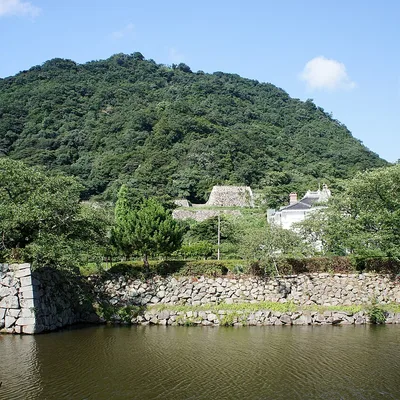
Azuchi is a textbook yamajiro mountain castle running from the summit of Mount Azuchi (which rises about 100 m above Lake Biwa) down its slopes, distinguished by its predominant use of stone — walls of huge granite blocks fitted carefully together without mortar, ranging from 5.5 to 6.5 m in thickness. At its core stood the great keep: the builder's plans for the castle show the donjon to be roughly 40 m tall with seven levels — a seven-storey building with six floors above ground and one below, the first true tower keep in Japan, with audience halls, private chambers, offices and a treasury arranged as though it were a royal palace and every storey decorated by Kanō Eitoku. The uppermost storey was octagonal, and the donjon's façade — unlike the solid white or black of other keeps — was painted with tigers and dragons. Around it Azuchi shows five other militarily distinct features: the predominant use of stone for the walls; the high central tower that gave defenders increased visibility for the use of guns; the massive thickness of the walls; and irregularly formed inner citadels that gave ample defensive positions against intruders. The castle was strategically placed at the intersection of three highways converging on Kyoto from the east, with the site rising 100 m above Lake Biwa. Confucius and other Confucian figures were depicted in the keep's paintings, suggesting Nobunaga's thinking was shifting from battlefield tactics toward the responsibility of ruling and ensuring peace and order.