Matsumoto Castle
松本城
丸の内 · JP
Black-lacquered National Treasure — the only flatland keep of Japan's twelve survivors
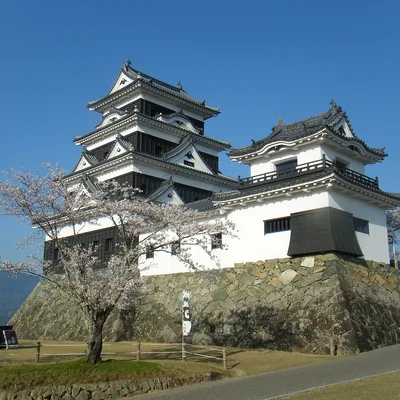
In Matsumoto City, Nagano Prefecture, the five-tier six-story donjon raised by Ishikawa Kazumasa and Yasunaga his son joins the Inui-kotenshu, Watari-yagura, Tatsumi-tsuke-yagura and Tsukimi-yagura — all five jointly registered as National Treasures.
Best Season & Time
Cherry blossoms against the black keep create striking contrast; the Yozakura-kai night event adds free entry
★★★★★
A snow-dusted black keep is a Shinshu-only spectacle, with thin crowds offering a connoisseur's quiet window
★★★★☆
Maples around the keep redden while the Northern Alps may take their first snow — a brief but striking spell
★★★★☆
Summer brings the Taiko-mon Special Night Opening and similar events, perfect for cool-air evening sightseeing
★★★☆☆
Top 3 Highlights
1.Black-lacquered keep and a one-off composite layout
The imposing main tower is sheathed in black-lacquered weatherboarding, with the Inui-kotenshu at the north and Tatsumi-tsuke-yagura plus Tsukimi-yagura on the east — a layout unmatched among surviving Japanese castles. Its moat-side silhouette is the postcard image of the site.
Frame the keep with the Inui-kotenshu from west of the Honmaru garden entrance, early morning
2.Mirror reflection across the moat at Uzumi-bashi
At first light the inner moat returns a clean inverted image of the tower, the vermilion Uzumi-bashi bridge providing a colour accent. Even when the bridge is closed to crossing, the reflection can be captured from the bank, making this the connoisseur's photo angle.
Aim wide at the waterline from the western outer moat near Uzumi-bashi on a windless morning
3.Black walls against white snowfall powder
Deep Shinshu winters pile snow on roofs and stone bases, and the clash between black-lacquered walls and white powder turns almost theatrical. With few visitors about, the castle becomes a hushed monochrome stage you can have almost to yourself.
Shoot from the Taiko-mon side the morning after snowfall, using gentle backlight to outline the keep
Stories & Legends
Recommended For
Insider Tips
- 1.Inside the keep wooden stairs reach inclines as steep as 61 degrees, so skirts and heels are impractical and rental slippers feel slippery. Sturdy walking shoes and trousers are essential, and at peak periods the entry queue can stretch beyond 90 minutes.
- 2.The small open space near the Uzumi-bashi bridge, just behind the Kuro-mon ticket office, yields the cleanest reflection in the moat. The outer perimeter walk itself is free, so an early-morning loop is a thrifty way to enjoy the castle in solitude.
- 3.From the south-east corner of the Honmaru garden, by the former Ninomaru palace site, you can frame the main keep with the Inui-kotenshu and the Tsukimi-yagura in a single shot — a local-photographer favourite that goes unmarked on tourist maps.
Visit Information
- Access
- About a 15-minute walk from the Oshiro-guchi exit of JR Matsumoto Station, or a 3-minute walk after taking the Town Sneaker North Course bus to Matsumotojo / Shiyakusho-mae. From Shinjuku the Limited Express Azusa reaches Matsumoto in roughly 2 hours 40 minutes.
- Time Required
- About two hours including a tour of the keep, or 30 minutes for an outer-perimeter walk
- Budget Guide
- Honmaru garden admission (with the keep) is 700 yen for adults as of 2024; the Town Sneaker one-day bus pass is 300 yen, and a Shinshu soba lunch nearby runs about 1,500 yen.
Nearby Attractions
Within ten minutes on foot lies the former Kaichi School, a National Treasure pseudo-Western schoolhouse opened in 1873; a fifteen-minute walk reaches Nawate-dori shopping street and Yohashira Shrine. Nakamachi-dori, lined with old storehouse-style shops, sits twenty minutes away. By car, Asama Onsen and Utsukushigahara highland lie within thirty minutes.
Go Deeper
Deeper details for those with the time to read on.
Timeline
- 1504-1520
Fukashi Castle founded
During the Eishō era the Ogasawara clan, provincial governors of Shinano, built Fukashi Castle as a satellite of Hayashi Castle — the origin point of present-day Matsumoto Castle.
- 1550
Captured by the Takeda
In Tenbun 19 Takeda Shingen's Shinano campaign overran Fukashi and exiled the Ogasawara lord Nagatoki, with the Takeda retainer Baba Nobuharu installed as castellan over the Matsumoto Basin.
- 1582
Retaken by the Ogasawara
After the Takeda collapsed, Ogasawara Sadayoshi, then a Tokugawa Ieyasu vassal, recovered the fortification from a turbulent succession of holders and renamed it Matsumoto Castle.
- 1590
Ishikawa Kazumasa installed
Following the Toyotomi-driven transfer of Tokugawa Ieyasu to the Kanto, Ishikawa Kazumasa entered Matsumoto and began re-laying out the keep, wards and castle town with Yasunaga his son.
- circa 1593-1597
Core of the donjon completed
Ishikawa Kazumasa with Yasunaga his son finished the main donjon and connected structures across the Bunroku-Keichō years, with the surviving timbers dated to roughly 1596-1597.
- circa 1633
Tsukimi-yagura added
Around Kan'ei 10 lord Matsudaira Naomasa added the Tatsumi-tsuke-yagura and the vermilion-railed Tsukimi-yagura in anticipation of a visit by shōgun Tokugawa Iemitsu en route to Zenkō-ji.
- 1686
Jōkyō uprising
In Jōkyō 3 a peasant protest against heavy taxation surrounded the castle, and twenty-eight leaders led by Tada Kasuke were executed the following year — a defining tragedy in the castle's lore.
- 1872
Donjon auctioned and rescued
In Meiji 5 the abolition-of-castles policy auctioned off the keep, but local resident Ichikawa Ryōzō and supporters bought it back with revenue from the Chikuma Prefectural Exposition.
- 1903-1913
Great Meiji Restoration
Headmaster Kobayashi Unari founded the Matsumoto Donjon Preservation Society and led a thorough structural rescue of the leaning tower from Meiji 36 through Taishō 2.
- 1930
National Historic Site
In Shōwa 5 the grounds gained national historic-site status, formally placing them under cultural-property protection.
- 1936
Prewar National Treasure
On 20 April Shōwa 11 the donjon, Inui-kotenshu, Watari-yagura, Tatsumi-tsuke-yagura and Tsukimi-yagura were jointly registered as National Treasures under the prewar law.
- 1950-1955
Great Shōwa Restoration
The first project funded under postwar National Treasure conservation dismantled and rebuilt the keep, recovering the black-lacquered finish identified in original timbers.
- 1952
Postwar National Treasure
On 29 March Shōwa 27 the same five structures were re-registered as National Treasures under the new Cultural Properties Protection Law.
- 2006
Top hundred castles entry
On 6 April Heisei 18 Matsumoto Castle joined Japan's leading hundred-castle list as its 29th entry, chosen by the Japan Castle Foundation.
- 2019-2020
Dendrochronology study
A tree-ring dating study of the main donjon's timbers confirmed that much of the surviving wood was felled in the Bunroku-Keichō years, anchoring the keep's construction date scientifically.
Detailed History
Matsumoto Castle traces its origins to the Eishō era (1504-1520), when the Ogasawara clan of Shinano, then provincial governors, built Fukashi Castle as a satellite of Hayashi Castle. In 1550 (Tenbun 19) Takeda Shingen's Shinano campaign captured Fukashi and drove the Ogasawara lord Nagatoki into exile; the Takeda retainer Baba Nobuharu was installed as castellan over the Matsumoto Basin. With the destruction of the Takeda in 1582 (Tenshō 10) the castle changed hands rapidly — first to Kiso Yoshimasa under Oda Nobunaga, then, after the Honno-ji incident, to Ogasawara Dosetsusai and Ogasawara Sadayoshi, who renamed it Matsumoto Castle. In 1590 (Tenshō 18) Toyotomi Hideyoshi's Odawara campaign moved Tokugawa Ieyasu to the Kanto, and Ishikawa Kazumasa was appointed lord of Matsumoto. Kazumasa with Yasunaga his son raised the surviving core: the main donjon, Inui-kotenshu and connecting corridor were completed between Bunroku and Keichō (1593-1597). The Ishikawa later lost their domain in the Ōkubo Nagayasu Incident; the Ogasawara returned briefly before the Matsudaira, Mizuno and Toda-Matsudaira ruled in succession until the Meiji Restoration. Around 1633 (Kan'ei 10) lord Matsudaira Naomasa added the Tatsumi-tsuke-yagura and Tsukimi-yagura, grafting a moon-viewing wing onto a purely military donjon. In 1686 (Jōkyō 3) the Jōkyō uprising against heavy taxation surrounded the castle, and the next year the ringleader Tada Kasuke and twenty-seven petitioners were executed. In 1872 (Meiji 5) the abolition-of-castles policy auctioned the keep; the Matsumoto resident Ichikawa Ryōzō rescued it with revenue from the Chikuma Prefectural Exposition. When the tower began to lean in late Meiji, headmaster Kobayashi Unari founded the Matsumoto Donjon Preservation Society and led the Great Meiji Restoration from 1903 to 1913 (Meiji 36 - Taishō 2). The grounds gained national historic-site status in Shōwa 5 (1930), and on 20 April Shōwa 11 (1936) the donjon, Inui-kotenshu, Watari-yagura, Tatsumi-tsuke-yagura and Tsukimi-yagura were jointly registered as National Treasures under the prewar law. On 29 March Shōwa 27 (1952) the five were re-registered under the postwar Cultural Properties Protection Law. The Great Shōwa Restoration of 1950-1955 dismantled and rebuilt the keep, and lacquer traces uncovered then guided recovery of the black finish visible today.
Cultural Significance
Matsumoto Castle is the only flatland fortress among Japan's twelve surviving original keeps, and one of only five whose donjons are designated National Treasures — alongside Himeji, Inuyama, Hikone and Matsue. The five buildings of its central complex (donjon, Inui-kotenshu, Watari-yagura, Tatsumi-tsuke-yagura and Tsukimi-yagura) are jointly registered as National Treasures, while the entire site is protected as a national historic site. The well-preserved grounds, taking in the Honmaru and Ninomaru wards, joined the country's leading hundred-castle list as the 29th entry on 6 April Heisei 18 (2006), and the surrounding cityscape was picked for the One Hundred Urban Landscapes of Japan in 2000 (Heisei 12). The vermilion-railed Tsukimi-yagura, added by Matsudaira Naomasa in anticipation of a planned visit by Tokugawa Iemitsu en route to the famed Zenkō-ji temple, is architecturally exceptional, grafting a refined moon-viewing pavilion onto a stark military donjon — a combination unknown elsewhere. The story of how Matsumoto citizens funded the 1872 reprieve and then sustained the keep through both the Meiji and Shōwa restorations is now taught as a pioneering case of grassroots heritage preservation.
Architectural Details
The plan adopts a typical hirajiro (flatland) layout, with the Honmaru, Ninomaru and Sannomaru wards laid out in roughly square form and separated by water moats, combining a tiered (teikaku-shiki) and enveloping (rinkaku-shiki) configuration. At the centre stands a layered (sotō-gata) five-tier, six-story donjon: the first tier carries a hakama-shaped ishiotoshi stone drop; chidori-hafu gables face north and south at the second tier and east and west at the third; mukai-karahafu curved-Chinese bay windows protrude from the third-tier north and south faces. To the north the donjon is linked to the Inui-kotenshu via the Watari-yagura corridor, and to the east the Tatsumi-tsuke-yagura and Tsukimi-yagura are joined directly — the resulting composite-connected (fukugō-renketsu-shiki) form has no equivalent among surviving castles. The tower shows transitional character between watchtower (bōrō) and tiered styles, with a windowless concealed level inside the second tier — known as the secret floor — surviving from an earlier large-roof structure. Black-lacquered weatherboarding clads the walls from the first to the topmost tier, restored to the colour identified from lacquer traces uncovered during the Great Shōwa Restoration. The Tsukimi-yagura, with vermilion railings and openable doors on three sides, lends the otherwise martial complex its sole touch of courtly refinement.