Kubota Castle
久保田城
秋田市 · JP
A castle of earth, not stone: the Satake seat that anchors the 100 Fine Castles of Japan
At the heart of Senshu Park in Akita City, this hirayama castle was completed in 1604 as the seat of the Satake clan of Kubota Domain, and its earthen ramparts without stone walls embody the Edo-period style of Tohoku, ranked No. 9 of the 100 Fine Castles of Japan.
Best Season & Time
About 1,000 cherries fill the honmaru ruins as the snow melts, with bonbori lanterns for late hanami.
★★★★★
Around 3,000 lotus plants bloom along the second-bailey moats during the Kantō Matsuri festival.
★★★★☆
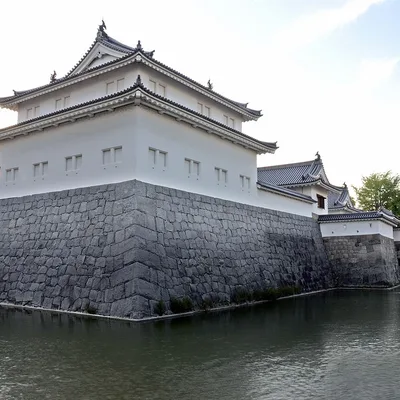
Maples and ginkgos around the inner bailey turn gold and crimson against the white walls of the Osumi-yagura.
★★★★☆
Snow-covered ramparts and the Osumi-yagura against the Asahi River make a quietly cinematic winter scene.
★★★☆☆
Top 3 Highlights
1.Osumi-yagura - the symbol of a castle without a tenshu
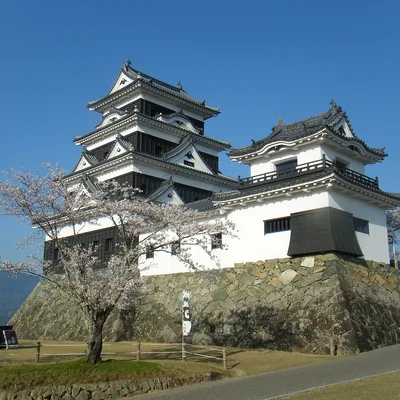
Reconstructed in 1989 as a three-story whitewashed corner tower on the highest point of the honmaru, the Osumi-yagura houses a small history exhibition and an observation floor overlooking Akita and the Sea of Japan, standing as the heart of a castle that never had a main keep.
From the north honmaru lawn, frame the white walls behind cherry-blossom branches.
2.Omonogashira-gobansho - sole surviving Edo guardpost
A modest single-story wooden guardpost where monogashira foot soldiers once watched visitors entering the second bailey, the only Edo-period building on the entire castle site to survive both the 1880 fire and the Meiji demolitions, now a tangible cultural property of Akita City.
Right of Nagasaka slope from the Kuromon ruins; morning light highlights the thatched roof.
3.Senshu Park cherry blossoms - 1,000 trees on the ruins
Roughly 1,000 cherry trees, including Somei Yoshino planted in 1892, blanket the former castle compound in soft pink each spring, and the bonbori-lantern-lit night blossoms over the honmaru lawn in late April are a defining ritual of Akita's snowbound late spring.
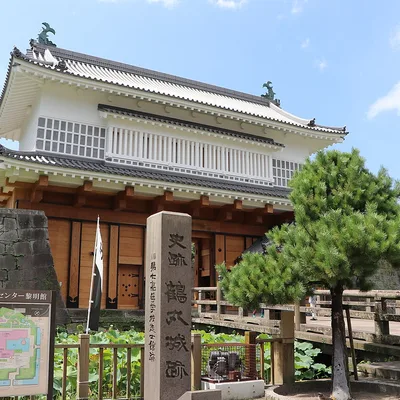
Vertical shot from the honmaru-gate steps, layering gate against blossoms; long exposure at night.
Stories & Legends
Recommended For
Insider Tips
- 1.Admission to the Osumi-yagura is only about 110 yen for adults, exceptionally low among Japanese castles, and the fourth-floor deck looks out to Akita, the Oga Peninsula and the Sea of Japan; the tower opens only April-November and closes in winter.
- 2.The Satake Historical Material Museum on the second-bailey site costs another 110 yen, and a combination ticket with the Osumi-yagura is sometimes offered that saves roughly 100 yen over separate tickets, so ask at the desk before paying full price.
- 3.The Omonogashira-gobansho is the only Edo-period structure left, but its interior opens only occasionally; the building itself is the attraction, and slanted light just after 7 a.m. brings out the thatched roof while crowds are still absent.
Visit Information
- Access
- About a 10-minute walk from JR Akita Station's west exit reaches the former Otemon gate at the entrance to Senshu Park; alternatively a bus bound for the Chuo Kotsu Akita depot from stop 2 reaches Toricho stop in 5 minutes, with a 3-minute walk from there.
- Time Required
- About 1.5-2 hours basic, or 3 hours with the Osumi-yagura and Satake museum.
- Budget Guide
- Around 220 yen total for the Osumi-yagura (110 yen) and the Satake Museum (110 yen); no extra transport from JR Akita Station. Confirm fees on the Akita tourism site.
Nearby Attractions
Five minutes on foot is the Akarenga Folk Museum, a brick former bank building and Important Cultural Property; ten minutes away is the Akita City Folk Performing Arts Center, where Kantō Matsuri pole-lantern routines are demonstrated. The Akita Arts Theater Milhaus stands on former sannomaru ground.
Go Deeper
Deeper details for those with the time to read on.
Timeline
- 1602
Satake Yoshinobu arrives in Dewa
Reassigned from his 540,000-koku Hitachi domain to 200,000 koku in Dewa after the Sekigahara settlement, Satake Yoshinobu enters the former Akita-clan Minato Castle and decides to construct a new headquarters.
- 1604
Honmaru completed on Mount Shinmei
Under chief commissioners Kajiwara Masakage and Shibue Masamitsu, the honmaru of the new castle on Mount Shinmei is finished and Minato Castle is dismantled in favor of the new headquarters.
- 1633
Great Kanei fire
The honmaru burns to the ground; lord Satake Yoshitaka rules temporarily from the Shibue mansion in the lower sannomaru while the keep is restored two years later.
- 1647
Name 'Kubota Castle' first attested
A Dewa Province pictorial map dated 1647 records the spelling 'Kubota Castle' for the first time, suggesting the change from the original 'Kubota' (窪田) characters occurred around this date.
- 1778
Great Anei fire
A lightning strike on the leap seventh month of 1778 razes the honmaru once again; the principal palace is rebuilt by 1781 under the eighth lord Satake Yoshiatsu.
- 1868
Boshin War spares the castle
Siding with the Meiji government, Kubota Domain is attacked by Shonai and Morioka, but the surrender of Sendai and Yonezawa halts Shonai at Tsubakidai 12 km from the city, sparing the castle itself.
- 1872
Akita Prefectural Office in the honmaru
In April the new Akita Prefectural Office opens inside the honmaru, but it relocates by November to the former Meitokukan domain school in Higashinekoya-machi.
- 1880
Meiji conflagration
A great fire on July 21 sweeps the abandoned castle precinct, destroying nearly every remaining building; only the Omonogashira-gobansho survives intact.
- 1890
Return to the Satake family
The Army Ministry transfers the empty castle grounds back to the Satake family, and from 1892 Akita City begins planting the 1,170 cherry trees that will define Senshu Park.
- 1984
Donation of 14.6 hectares
Honoring the will of the 35th Satake head Yoshinari, the family donates 14.6 hectares of the former castle grounds to Akita City for permanent use as a park.
- 1989
Osumi-yagura reconstructed
The Shinheigu Osumi-yagura corner tower is reconstructed in reinforced concrete in a three-story silhouette and opens as a small history exhibition and observation deck.
- 2001
Honmaru main gate rebuilt
The honmaru omote-mon main gate is rebuilt in traditional wooden construction based on Edo-period drawings and excavation surveys, restoring the historic frontage at the park entrance.
- 2006
Listed among the 100 Fine Castles
Kubota Castle is selected as No. 9 of the 100 Fine Castles of Japan by the Japanese Castle Foundation, joining the pilgrimage circuit popular with castle enthusiasts nationwide.
- 2008
Scenic place of Akita City
The grounds are formally designated a scenic place by Akita City under the name 'Senshu Park (Ruins of Kubota Castle),' giving statutory protection to both landscape and surviving historical structures.
Detailed History
In 1602 (Keicho 7), in the post-Sekigahara reshuffle, Satake Yoshinobu was relocated from his 540,000-koku Hitachi territory to a 200,000-koku Dewa fief and arrived at Minato Castle, the former Akita-clan seat in Tsuchizaki. Finding the flat-ground castle indefensible and too small for his retinue, he set commissioners Kajiwara Masakage and Shibue Masamitsu to work on a new fortress atop Mount Shinmei in May 1603 (Keicho 8). The honmaru was finished on August 28, 1604 (Keicho 9), Minato Castle was dismantled, and the new site was confirmed as the clan headquarters. The castle was originally written 'Kubota' (窪田); the modern spelling first appears in the 1647 (Shoho 4) Dewa Province pictorial map. The honmaru burned in 1633 (Kanei 10) and again on the leap seventh month of 1778 (Anei 7), but each time the lord ruled from a senior-retainer residence in the third bailey while the keep was rebuilt, the 1781 (Tenmei 1) restoration being completed under Lord Yoshiatsu. During the Boshin War of 1868 the domain sided with the Meiji government and came under attack from Shonai and Morioka, but the surrender of Sendai and Yonezawa forced the Shonai troops to retreat at Tsubakidai 12 km from the city, sparing the castle itself. With the abolition of the han system in 1871 (Meiji 4), Kubota Domain became Akita Domain and dissolved, and in April 1872 (Meiji 5) the Akita Prefectural Office briefly opened in the honmaru before moving to Higashinekoya-machi that November. Listed for preservation in 1873 (Meiji 6), the site was nonetheless effectively abandoned, and on July 21, 1880 (Meiji 13) a great fire destroyed almost everything except the Omonogashira-gobansho. In 1890 (Meiji 23) the Army Ministry returned the site to the Satake family; Akita City planted 1,170 cherry trees from 1892, and in 1896 the prefecture commissioned garden designer Nagaoka Yasuhei to lay out Senshu Park. Following the will of the 35th head Yoshinari, 14.6 hectares were donated to Akita City in 1984 (Showa 59); the Osumi-yagura was rebuilt in concrete in 1989 (Heisei 1), the honmaru main gate restored in wood in 2001 (Heisei 13), and the castle was selected as No. 9 of the 100 Fine Castles of Japan in 2006 (Heisei 18). Akita City designated it a scenic place in 2008.
Cultural Significance
Kubota Castle is the textbook example of an eastern, earthwork-based castle: it has no main keep and only token stone footings, in contrast to the towering tenshu and high stone walls of the Oda-Toyotomi castles of western Japan. This is generally attributed to the rarity of stone-wall construction in the Satake home territory of Hitachi and northern Honshu, and to political caution toward the Tokugawa shogunate, although the Satake later contributed stone-wall work to Edo Castle, which complicates any simple 'no expertise' explanation. The alternative names Yadome-jo (矢留城) and Kuzune-jo (葛根城) recall an earlier Yadome stronghold of the Miura branch of the Andō (Akita) clan that stood on the same Mount Shinmei, an old sacred hill dedicated to Shinmei-gu. Edo-period and Meiji documents sometimes refer simply to 'Akita Castle,' but it should not be confused with the ancient Nara-period Akita Castle (Q11536175), a separate fortified settlement nearby. Today the site enjoys triple protection: No. 9 of the 100 Fine Castles of Japan, a scenic place of Akita City as Senshu Park (Ruins of Kubota Castle), and the Omonogashira-gobansho as a city tangible cultural property, making it one of the most thoroughly documented early-modern castle complexes in Tohoku.
Architectural Details
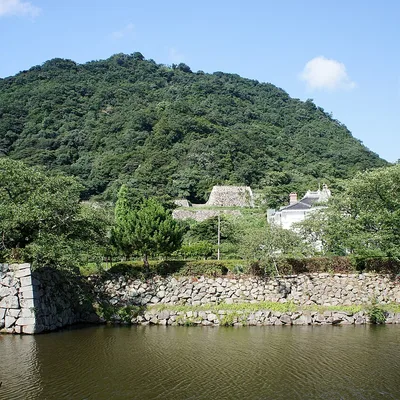
Kubota Castle is a hirayama (flatland-hill) castle on the leveled summit of Mount Shinmei, a 40-meter hill also known as Mitsumori-yama or Mitake-yama, with a concentric layout of honmaru, ninomaru, sannomaru, kita-no-maru and a small western bailey. Stone appears only sparingly at the base, with the main defensive element being earthen ramparts in the so-called hachimaki style capped by long earth walls. The castle has no main keep; instead, a single-story watch room called Dashi-Goshoin was built at the southwestern projection of the honmaru as a substitute, supplemented by eight yagura watchtowers along the ramparts. The honmaru had five gates - omote-mon main gate, ura-mon rear gate, obikuruwa-mon, an embedded uzumi-mon and the kiritoguchi - while the ninomaru opened through four: Matsushita-mon, Kuro-mon, the unclean Umaya-mon and the northern Tsuchi-mon. The current Osumi-yagura is a three-story reinforced-concrete reconstruction of 1989, the honmaru main gate a 2001 wooden reconstruction, and only the Omonogashira-gobansho survives from the Edo period as a thatched single-story wooden building. Wet moats reusing the old course of the Asahi River partially survive in the south, east and west outer moats, and the staggered streets of the samurai uchimachi and the grid of the merchant tomachi still define central Akita.