Kumamoto Castle
熊本城
中央区 · JP
Where Kato Kiyomasa's musha-gaeshi walls still defy invaders — Japan's Three Premier Castles
On Kumamoto's Chausuyama plateau stands the vast hilltop fortress built in seven years by master architect Kato Kiyomasa. Stripped of its keep in 1877 and devastated by the 2016 earthquake, the castle steadily reclaims its proud silhouette through restoration.
Best Season & Time
About 800 Yoshino cherry trees with the restored great keep — one of Japan's Top 100 cherry blossom sites
★★★★★
Fresh greens and the castle's ginkgo grove shine, with evening light-ups (sunset to 23:00) drawing crowds
★★★☆☆
'Ginkgo Castle' earns its name with yellow ginkgo and red maple — quieter than spring, a hidden best season
★★★★★
Snow on the black keep creates a striking contrast — a quiet favorite among cold-tolerant photographers
★★★☆☆
Top 3 Highlights
1.The Restored Great Keep in Black-and-White Glory
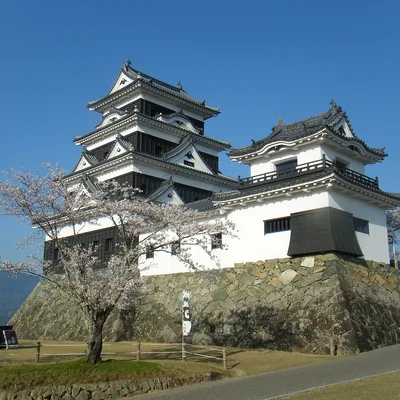
Standing 30.3 m tall in a layered three-story concrete reconstruction from 1960, the great keep reopened April 2021 after earthquake repairs. Black lacquered boards against white plaster capture Kiyomasa's signature design; the deck offers panoramas to the Aso caldera rim.
Frame the great and small keeps together from the east side of Ninomaru Square in morning light
2.The Elegant Curves of the Musha-Gaeshi Walls
Curving gently at the base and steeply outward at the top, the iconic stones earned the name musha-gaeshi (warrior repeller) — the walls that turned back Saigo Takamori in 1877. Three masonry styles (nozura-zumi, uchikomihagi, kirikomihagi) sit side by side as a castle textbook.
Shoot from a low angle along the wall sequence from Hoate-gomon to Akazu-no-mon for the curve
3.Living Record of the 2016 Earthquake and Restoration
The M7.3 main shock toppled roof tiles and shachihoko, collapsed many stone walls, and left the Iidamaru turret balanced on one column of stones — the 'miracle one-legged wall' that drew national attention. An elevated walkway now lets visitors observe repair sites up close.
Look down from the elevated walkway to capture the collapsed walls and active restoration zones
Stories & Legends
Recommended For
Insider Tips
- 1.The Special Visitor Walkway (an elevated path completed in 2020) lets you look down on in-progress stone walls and turrets — one of the few places worldwide to experience active cultural property restoration as a tourist attraction.
- 2.Josaien at the southwest foot of the castle is a tourist complex offering Higo cuisine (karashi-renkon, basashi horse sashimi, ikinari-dango), perfect for a meal before entering and for souvenir shopping on the way back.
- 3.The 'Restoration Castle Lord' program (launched 2018) carves your name on a roll of honor for donations of 10,000 yen or more, granting a Lord certificate and a free-entry pass — Japan's only such program and a unique travel keepsake.
Visit Information
- Access
- About 17 minutes by tram from JR Kumamoto Station, then a 10-minute walk from Kumamoto-jo Shiyakusho-mae tram stop. About 1 hour by limousine bus from Kumamoto Airport, or 45 minutes by Kyushu Shinkansen from Fukuoka.
- Time Required
- About 2 hours for the keep and palace; half a day with the walkway and Josaien.
- Budget Guide
- Adult admission JPY 800; junior/senior high JPY 300; elementary and under free. A JPY 500 one-day tram pass pairs well. (Prices as of 2024.)
Nearby Attractions
Josaien at the southwest foot of the castle offers Higo cuisine and souvenirs in one complex. A 15-minute walk reaches Suizenji Jojuen, the Hosokawa family's strolling pond garden modeled on the Tokaido fifty-three stations. By car, Mt. Aso (one of the world's largest calderas) is about one hour away and pairs with a day-long itinerary.
Go Deeper
Deeper details for those with the time to read on.
Timeline
- 1467
Chiba Castle Founded
Ideta Hidenobu of the Kikuchi clan builds a small fortress called Chiba Castle on Chausuyama, the beginning of Kumamoto Castle's history.
- 1588
Kato Kiyomasa Arrives
Granted 195,000 koku of northern Higo Province by Toyotomi Hideyoshi, Kato Kiyomasa takes up residence as castle lord.
- 1591
Construction Begins
Drawing on his harsh experience at the siege of Ulsan in Korea, Kiyomasa launches full-scale construction of an early modern castle on Chausuyama.
- 1607
Castle Completed
After sixteen years of construction, the castle is completed; the following year the area's name is changed to today's Kumamoto characters.
- 1632
Hosokawa Clan Takes Over
Kiyomasa's son Tadahiro is stripped of the domain; Hosokawa Tadatoshi enters as the new lord of 540,000 koku and the clan rules until the Meiji era.
- February 1877
Satsuma Rebellion Siege
A garrison of 4,000 holds off Saigo Takamori's 14,000 men for fifty-two days, leading to Saigo's reported lament that he had lost to Lord Kiyomasa.
- February 19, 1877
Keeps Destroyed by Fire
A fire of unknown origin two days before Saigo's general assault destroys the great and small keeps, the Honmaru Goten Palace, and principal turrets.
- 1933
Cultural Property Designation
Thirteen surviving buildings including the Uto Yagura are designated National Treasures under the prewar system (today's Important Cultural Properties).
- 1955
Special Historic Site
The entire castle grounds are designated a Special Historic Site, the highest national rank for cultural property protection.
- 1960
Keep Exterior Reconstruction
The exterior of the great and small keeps is reconstructed in reinforced concrete, a landmark of Japan's postwar reconstruction.
- 2008
Honmaru Palace Reconstruction
Marking 400 years since the castle's completion, the Honmaru Goten Palace great hall is reconstructed in wood, reviving Edo-era architectural splendor.
- April 2016
Kumamoto Earthquakes
Magnitude 7.3 shocks topple roof tiles and shachihoko, collapse many stone walls, and leave the Iidamaru turret balanced on a single column of stones.
- April 2021
Keep Reopens
Five years after the earthquakes, the great keep's restoration is completed and the interior reopens as a symbol of regional hope and recovery.
- 2052 (planned)
Full Restoration Target
Originally scheduled for 2037, the restoration timetable was extended in November 2022 to 2052, making this a multi-decade cultural property project.
Detailed History
Kumamoto Castle's history begins in 1467 when Ideta Hidenobu of the Kikuchi clan, then shugo of Higo, built a small fortress called Chiba Castle on Chausuyama. In 1496 Kanokogi Chikakazu raised a second fortification with the old Kumamoto spelling, and through the 16th century the Otomo and Shimazu clans contested the region. In 1588 Kato Kiyomasa received 195,000 koku of northern Higo after Hideyoshi's pacification of Kyushu. A veteran of the brutal siege of Ulsan, Kiyomasa began the great expansion of the castle on Chausuyama in 1601, after fighting on Tokugawa Ieyasu's side at Sekigahara in 1600 and receiving all of Higo (520,000 koku). The complex was finished in 1607, and the area's name was changed to today's characters. Legend holds that Kiyomasa dug 120 wells inside, planted edible taro stems beneath the tatami, and used kanpyo strips as plaster reinforcement that could be eaten in emergencies. In 1632 his son Tadahiro was stripped of the domain, and Hosokawa Tadatoshi took 540,000 koku; the Hosokawa held Kumamoto until the end of the Edo period. After the 1871 abolition of domains, the imperial Kumamoto Garrison was established. In February 1877 the Satsuma Rebellion made the castle the western anchor of the imperial response. Two days before Saigo Takamori's assault, on February 19, a fire of unknown origin destroyed the keeps, the Honmaru Palace, and the principal turrets. Yet General Tani Tateki's 4,000 men withstood Saigo's 14,000 for fifty-two days, and Saigo's reported lament that he had lost to Lord Kiyomasa rather than to the Meiji government became one of the most famous lines in modern Japanese history. In 1933 thirteen surviving structures including the Uto Yagura were designated National Treasures (today's Important Cultural Properties), and in 1955 the grounds became a Special Historic Site. The great keep was rebuilt in reinforced concrete in 1960, and from 2003 wooden reconstruction of the Honmaru Palace proceeded. The April 14 and 16, 2016 main shocks caused catastrophic damage: roof tiles and shachihoko fell, walls collapsed, and the Iidamaru turret stood on one column. Repairs began June 2016; the keep reopened April 2021. The full timetable, initially 2037, was extended in November 2022 to 2052.
Cultural Significance
Kumamoto Castle is counted alongside Himeji and Matsumoto (or, in alternate listings, Nagoya or Osaka) as one of Japan's Three Premier Castles, representing the apogee of Kato Kiyomasa's engineering. Thirteen structures including the Uto Yagura, eleven other turrets, the Akazu-no-mon gate, and a long wall are Important Cultural Properties, while the grounds bear the Special Historic Site designation — a rare double honor. The nickname 'Ginkgo Castle' (Ginnan-jo) derives from a great ginkgo in the Honmaru, said to have been planted by Kiyomasa as siege provisions; the first tree burned in 1877 and the current one is the second generation. The choice of ginkgo as a famine food captures Kiyomasa's siege-mindedness. The fifty-two-day defense during the Satsuma Rebellion, in which 4,000 government soldiers held off 14,000 men, became a defining episode in modern Japanese history, and Saigo's purported lament that he had lost to Lord Kiyomasa rather than the Meiji government remains a much-quoted line. The 2016 earthquake damage transformed restoration into a national project: more than 600,000 'Restoration Castle Lord' donors have contributed, making the castle a symbol of disaster recovery and heritage stewardship. NHK dramas including Aoi Tokugawa Sandai and Gunshi Kanbei have repeatedly used the castle as a backdrop.
Architectural Details
Kumamoto Castle is a connected-bailey hilltop castle of roughly 1.6 km east-to-west by 1.2 km north-to-south, built on the Chausuyama plateau (about 50 m above the plain). The keeps form a connected pair: the great keep (three-story, six-floor with basement, rising 30.3 m) and the small keep (two-story, four-floor with basement). The 1960 reconstruction used reinforced concrete but faithfully replicates the original contrast of black lacquered weatherboarding and white shikkui plaster. The complex originally held 49 turrets, 18 turret gates, and 29 smaller gates. The Uto Yagura — a five-story turret that alone escaped the 1877 fire — is designated an Important Cultural Property and is the only large-scale original Edo-period structure left on site. Stone walls show three masonry techniques side by side: uncoursed nozura-zumi, semi-dressed uchikomihagi, and dressed kirikomihagi. The Niyo-no-Ishigaki ('two-style wall') juxtaposes Kiyomasa-era and Hosokawa-era masonry as a living textbook. The signature musha-gaeshi walls curve from a gentle base outward to a sharp overhang, designed so attackers could climb partway but never surmount the top. Roof tiles were deliberately weighted to fall during earthquakes, lightening the load and saving the frame — a feature that proved its worth in 2016, when the keep's shell survived largely intact.