Kokura Castle
小倉城
城内 · JP
Hosokawa Tadaoki's karazukuri keep — Kyushu's signature castle on the Murasaki River
At the mouth of the Murasaki River in Kitakyushu, Kokura Castle was raised from 1602 by Hosokawa Tadaoki — a four-story keep whose top floor overhangs the lower stories in the karazukuri form that set the template for Tsuyama and Takamatsu. Number 181 on Japan's Continued Top 100 Castles.
Best Season & Time
Over 300 cherry trees in bloom; the keep plaza is open to 22:00 for evening viewing
★★★★★
Fresh greenery and the keep reflected on the Murasaki River — coolest at dawn and dusk
★★★☆☆
The Castle Festival and Take-Akari bamboo lanterns make dreamlike evenings with maple foliage
★★★★★
The quietest season; a rare snow dusting makes the karazukuri keep ethereal
★★★☆☆
Top 3 Highlights
1.The Karazukuri (Nanban-style) Keep
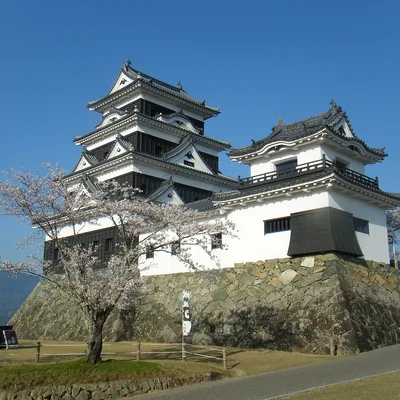
The keep's hallmark is karazukuri, with the topmost balcony overhanging the floors below — Tadaoki's signature aesthetic. The 1959 concrete reconstruction added chidori and karahafu gables, with white plaster and the black overhang giving Kitakyushu its skyline.
Telephoto from the Riverwalk Kitakyushu deck across the river
2.Honmaru and Tadaoki-Era Stone Walls
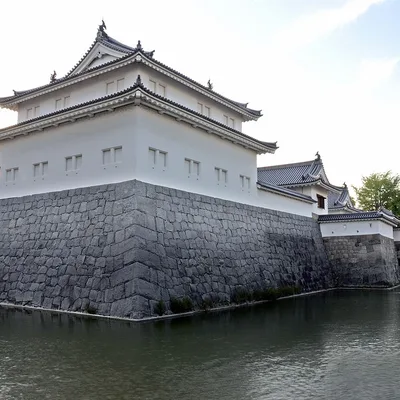
The honmaru hosted the 12th Division headquarters in the Meiji era, anchoring Kitakyushu as a military city, and its uncoursed nozura-zumi stone walls survive. A 2004 survey at Shinozakiguchi uncovered Tadaoki-era unebori trenches — remnants of the Hosokawa fortification school.
Frame keep and walls together from the south-west corner of the plaza
3.Castle Garden and Seicho Museum
Opened in 1998 on the Ogasawara clan's lower residence grounds, the strolling pond garden faces the keep across the water from the shoin pavilion. The adjacent Matsumoto Seicho Memorial Museum reconstructs the Kitakyushu-born mystery master's writing studio at full scale.
Use the keep as a borrowed-scenery backdrop from the shoin veranda
Stories & Legends
Recommended For
Insider Tips
- 1.The seventeen-strong 'Kokura Castle Warrior Troupe' portrays Hosokawa Tadaoki, Hosokawa Gracia, and Miyamoto Musashi on weekends and holidays. Check their social channels in advance to time your visit for a live performance.
- 2.An elevator added during the 2019 renovation lets visitors who struggle with stairs reach the top floor. Combine the lift with stairs to enjoy the karazukuri exhibits and hands-on dioramas at a comfortable pace.
- 3.Local photographers favor looking down on the castle from the deck of the red Riverwalk Kitakyushu complex; at the blue hour the illuminated keep and modern architecture combine into a uniquely Kitakyushu castle scene.
Visit Information
- Access
- About 15 minutes on foot from JR Kokura Station, or 10 minutes from JR Nishi-Kokura Station. Kokura is a Sanyo Shinkansen stop — 20 minutes from Fukuoka, 45 minutes from Hiroshima. Five minutes by car from the Kitakyushu Expressway Otemachi exit.
- Time Required
- About 1 hour for the keep; 2-3 hours with the garden and Seicho Museum.
- Budget Guide
- Keep JPY 350 adult; garden JPY 300; Seicho Museum JPY 600; combined ticket JPY 700. (2024 prices.)
Nearby Attractions
Kokura Castle Garden and the Matsumoto Seicho Memorial Museum sit inside the same park. Across the Murasaki River, the red-brick Riverwalk Kitakyushu is a retail and theater complex. A 15-minute walk reaches Tanga Market and the Uomachi Gintengai, the first covered shopping street in Japan; a 30-minute drive opens the retro Mojiko district.
Go Deeper
Deeper details for those with the time to read on.
Timeline
- 1569
Mori clan castle
The Mori clan raises a castle here in opposition to the Otomo, and the Takahashi and Mori (Mōri) families take it as their seat in turn.
- 1587
Mori Katsunobu enters
After Hideyoshi's Kyushu campaign, his retainer Mori Katsunobu enters with a 60,000-koku fief and is later granted the Mori surname.
- 1602
Tadaoki's reconstruction
Granted Buzen with 399,000 koku for his Sekigahara service, Hosokawa Tadaoki spends seven years rebuilding the castle in the karazukuri style.
- 1632
Ogasawara clan enters
The Hosokawa transfer to Higo Kumamoto and the fudai Ogasawara Tadazane enters from Akashi with 150,000 koku, holding it through the Bakumatsu.
- 1837
Keep destroyed by fire
The honmaru palace and the keep are lost to an accidental Tenpo-era fire; only a substitute three-story Osangai is rebuilt in their place.
- 1866
Self-immolation in Choshu war
Facing Choshu's advance during the Second Choshu Expedition, the Kokura garrison sets fire to the castle itself and retreats, evacuating the young lord to Kumamoto.
- 1875
Imperial Army garrison
The 14th Infantry Regiment and the 12th Brigade headquarters are stationed on the Matsu-no-maru, beginning Kitakyushu's history as a military city.
- 1898
12th Division headquarters
The 12th Division headquarters is built on the honmaru ruins, anchoring military administration until the unit moved to Kurume in 1925.
- 1959
Keep reconstruction
A reinforced-concrete reconstruction of the keep is funded by 60 million yen of citizens' donations, becoming a symbol of Kitakyushu's postwar recovery.
- 2004
Unebori discovery
A survey at the Shinozakiguchi outer enclosure uncovers Tadaoki-era unebori trenches and horishouji baffles, illuminating the Hosokawa school.
- 2017
Continued Top 100 Castles
The Japan Castle Foundation lists Kokura as number 181 of the Continued Top 100 Japanese Castles, adding it to the official stamp rally.
- 2019
Full renovation
After an eight-month closure, the keep reopens with a renewed interior, a new elevator, and the adjacent Shiro Terrace visitor center.
Detailed History
Edo-period genealogies trace a fortress here to Ogata Korenari in the Bunei era (1264-1274), though no reliable contemporary record survives. The first documented castle dates to 1569, when the Mori clan raised a fortress in resistance to the Otomo. After Hideyoshi's 1587 Kyushu campaign, his retainer Mori Katsunobu was given a 60,000-koku fief and the castle. The Mori sided with the western army at Sekigahara in 1600 and were dispossessed; the victorious Hosokawa Tadaoki was awarded 399,000 koku across Buzen with parts of Bungo. Initially seated at the old Kuroda castle of Nakatsu, Tadaoki spent seven years from 1602 rebuilding the Mori castle at Kokura, completing in 1609 a layered keep of four stories and five roofs joined by covered bridge to a smaller adjoining keep. A leading tea master, Tadaoki imposed his distinctive karazukuri design — a top floor balcony overhanging the lower floors — a form so unusual it drew sightseers and was emulated at Tsuyama and Takamatsu. He simultaneously laid out the castle town: the Murasaki River became the divide between western samurai and eastern merchant quarters. In 1632 the Hosokawa transferred to a 540,000-koku fief in Higo, and the fudai daimyo Ogasawara Tadazane moved in from Akashi with 150,000 koku, beginning a 230-year tenure. The keep burned in 1837 and was never fully rebuilt. In 1866, during the Second Choshu Expedition, the Kokura garrison chose to abandon and burn the castle, evacuating the young lord to Kumamoto. After the Meiji Restoration, the 14th Infantry Regiment was stationed on the former Matsu-no-maru in 1875; in 1898 the 12th Division headquarters rose on the honmaru ruins, making Kokura a military hub until the unit relocated to Kurume in 1925. The current keep was completed in 1959 at a cost of 60 million yen through citizens' fund-raising. Designer Fujioka Michio's drawings followed documentary evidence, but at the local chamber of commerce's insistence, large irimoya, chidori, and karahafu gables were added — a departure he later regretted. In 2007 the 90,000 roof tiles were entirely replaced; in 2017 the castle was listed as number 181 of the Continued Top 100 Castles; in 2019 a full interior renovation added an elevator and the Shiro Terrace visitor center.
Cultural Significance
Although the modern keep carries no cultural property designation, listing as number 181 of the Continued Top 100 Castles formally recognizes the site's historical importance. The castle accumulated alternative names through its long history — Katsuyama, Shitsuki, Yukin, and Koi-no-Shiro among them — and stands as a representative coastal stronghold from the wave of harbor castles favored by early-Tokugawa-era daimyo posted to Kyushu. The karazukuri (nanban-zukuri, 'southern barbarian style') design Tadaoki imposed on the keep was unprecedented and went on to influence Tsuyama and Takamatsu. The 1959 reconstruction held outsized civic meaning for postwar Kitakyushu, a heavy-industrial city heavily bombed during the war that would merge five municipalities to form modern Kitakyushu City in 1963; the keep became a focus of civic identity even as the added gables sparked debate over fidelity versus tourist appeal. The Murasaki River that divides the castle town into samurai and merchant quarters still shapes the urban texture, and produced authors including Matsumoto Seicho, Hayashi Fumiko, and Hino Ashihei. The Matsumoto Seicho Memorial Museum, opened in 1998 inside the castle park, reconstructs the master's writing studio at full scale. The 'Kokura Castle Warrior Troupe' playing Tadaoki, Gracia, and Musashi has become a tourism icon that bridges heritage and entertainment.
Architectural Details
Kokura was a tiered (teikaku-shiki) flatland castle centered on the honmaru, with the Matsu-no-maru south and the Kita-no-maru north wrapped by the ni-no-maru, san-no-maru, and outer enclosure, while the Murasaki River served as a natural moat — an integrated sogamae layout. Tadaoki's keep was a connected layered structure: a four-story, five-roofed main keep joined by roofed bridge to a single-story lesser keep, with a yudono bath chamber on the first floor (unusual for a keep) and a 3-ken square upper room on the top floor ringed by verandas. The defining karazukuri feature was a half-ken interior balcony covered by sliding panels projecting beyond the floors below; the black-lacquered panels contrasted with the white plaster of the lower floors and were known as the kokudan, 'black tier'. Apart from a single irimoya gable at the top, the historic silhouette was strikingly simple. The current keep was reconstructed in reinforced concrete in 1959 to Fujioka Michio's documentary research, but the addition of large irimoya, chidori, and karahafu gables at the chamber of commerce's insistence gave the modern building a decorative quality the original lacked. The stone walls are nozura-zumi uncoursed work; the 2004 Shinozakiguchi survey identified Tadaoki-era unebori trenches and horishouji baffles. The 1959 keep covers about 2,520 square meters and rises about 28.7 meters.