Osaka Castle
大坂城
大阪城 · JP
The Taiko's ambition and the Tokugawa's prestige — one of Japan's three great castles in Osaka
On the Uemachi Plateau in Chuo-ku, Osaka, the castle was begun by Toyotomi Hideyoshi in 1583, fell at the Siege of Osaka in 1614-15, and was rebuilt by Tokugawa Hidetada from 1620 to 1629. The 1931 reinforced-concrete keep is one of Japan's three great castles.
Best Season & Time
Three hundred Yoshino cherries in Nishi-no-maru frame the keep; night illumination joins blossoms and tower
★★★★★
Sunset beer gardens fill the main bailey; the keep museum is an air-conditioned refuge from the heat
★★★☆☆
Ginkgo and maple in Nishi-no-maru play against Tokugawa stone walls, with quieter crowds than spring
★★★★☆
Winter illumination 'Sakuyalumina' lights the keep and walls in dreamlike colour, with sparser crowds
★★★★☆
Top 3 Highlights
1.Reconstructed Keep and Tokugawa High Stone Walls
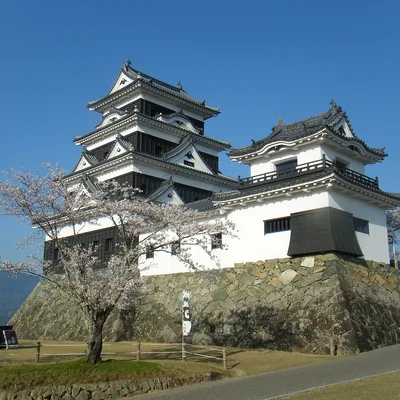
Funded by 1.5 million yen of citizens' donations in 1931, the third-generation keep is a five-story reinforced-concrete tower about 55 meters tall. Modelled on the Summer Siege folding-screen, its gold shachi made it Osaka's signature, a Registered Cultural Property since 1997.
Frame the keep vertically from Nishi-no-maru garden across the inner moat
2.The Takoishi at Sakuramon — the Castle's Largest Stone
In the Sakuramon masugata, the Takoishi (Octopus Stone) covers 59.43 square meters and weighs about 108 tons — the castle's largest mirror stone. Quarried from Shodoshima granite, its markings resemble an octopus; nearby Furisode-ishi and Higo-ishi sit at thirty to fifty tons.
After passing through Sakuramon Gate, turn back to fit the whole boulder in one frame
3.Toyotomi Stone Wall Museum — 400 Years Underground
The recently opened Toyotomi Stone Wall Museum displays the buried Tsumenomaru stone walls of the Toyotomi-era castle in situ beneath the Tokugawa rebuild. An exceptionally rare facility, it offers an authentic encounter with 400-year-old original masonry under the Tokugawa Osaka Castle.
Use a wide-angle lens in the underground gallery to capture the entire stone wall
Stories & Legends
Recommended For
Insider Tips
- 1.Just inside Sakuramon Gate stands Kinmeisui Idoya, a Tokugawa-era Important Cultural Property from 1626. Unlike the showy keep, this restrained early-Edo wooden survivor is easy to miss for its modest signage — a quiet hidden gem of timber craft.
- 2.Before lining up for the keep, cross Gokurakubashi to Yamazato-Maru, where a marker notes Hideyori and Yodo-dono's seppuku at the close of the Summer Siege. Sparsely visited, the spot offers a calm place to reflect on the clan's final hour.
- 3.From the eighth-floor deck a 360-degree panorama runs from Tsutenkaku to Abeno Harukas and the Umeda skyline. Arriving at the 9 a.m. opening avoids crowds, and morning sidelight from the east captures both keep and cityscape.
Visit Information
- Access
- About 10 minutes on foot from JR Osaka-jokoen Station on the Osaka Loop Line, 15 minutes from Tanimachi-yonchome Station (Tanimachi or Chuo Lines), and 15 minutes from Morinomiya Station. Roughly 15 minutes from Shin-Osaka by Midosuji and Chuo subways.
- Time Required
- About 2 hours for the keep and main bailey, half a day for the whole park.
- Budget Guide
- Castle keep: JPY 600, free for junior high and below. Toyotomi Stone Wall Museum: JPY 700. Park grounds free. Check the official site for current rates (figures as of 2024).
Nearby Attractions
Five minutes' walk away, Osaka-jo Park is a vast green offering plums, cherries and lotus through the seasons. The Osaka Museum of History exhibits the castle with the Naniwa-no-Miya palace ruins. Nakanoshima, Dotonbori, Tsutenkaku and Abeno Harukas are within fifteen minutes by subway, making the castle a natural launching point for half-day Osaka tours.
Go Deeper
Deeper details for those with the time to read on.
Timeline
- 1583
Hideyoshi Begins Construction
After his victory at the Battle of Shizugatake, Hashiba Hideyoshi opens construction on the ruins of Ishiyama Hongan-ji, launching a nationwide levy to quarry giant stones from Shodoshima.
- 1598
Toyotomi Castle Completed
Phase four completes the five-story, nine-tier keep, umadashi outwork and lordly residences. In August of the same year Hideyoshi dies and Hideyori inherits.
- 1614
Winter Siege of Osaka
Toyotomi Hideyori clashes with Tokugawa Ieyasu; Sanada Yukimura's Sanadamaru outwork to the south repels a Tokugawa army of two hundred thousand.
- 1615
Summer Siege and Fall
On the pretext of a breached truce, fighting resumes; the Toyotomi Osaka Castle burns and falls, the clan ends, and Hideyori and Yodo-dono commit seppuku at Yamazato-Maru.
- 1620-1629
Tokugawa Hidetada's Rebuild
A nine-year national levy mobilises 162 western daimyo across three phases; buried earth and high stone walls erase Toyotomi traces and lock in the surviving plan.
- June 1660
Powder-Magazine Explosion
Lightning strikes the powder magazine near Aoya Gate; roughly 82 tons of black powder detonate, killing 29 and injuring some 130, with the gate door hurled fourteen kilometers to Kuragari Pass.
- 1665
Lightning Destroys Second Keep
Lightning consumes the second-generation keep in the second month of Kanbun 5, and the tower remains unrebuilt for 265 years, leaving only the keep base.
- January 1868
Boshin War Destroys Main Bailey
After the Battle of Toba-Fushimi, Tokugawa Yoshinobu retreats from Osaka to Edo; the inner palace, eleven three-tier turrets and eight two-tier turrets are lost.
- 1888
Fourth Division Headquarters
The Meiji government repurposes the castle as army land; the surviving Miraiza Osaka-jo serves as the divisional office.
- 1931
Third Reconstruction Keep Completed
Osaka citizens raise 1.5 million yen for a steel-reinforced-concrete third-generation keep, which becomes the city's signature symbol.
- 1953
Special Historic Site
The 710,000-square-meter precinct is named a National Special Historic Site under the Cultural Properties Protection Law, the highest level of protection.
- 1997
Keep Becomes Cultural Property
The 1931 reconstructed keep is added to the Registered Tangible Cultural Property list, recognising pre-war reinforced-concrete civic architecture.
- Recently
Toyotomi Stone Wall Museum Opens
The museum opens to display the buried Tsumenomaru stone walls of the Toyotomi Osaka Castle beneath the main bailey, letting visitors see 400-year-old masonry in situ.
Detailed History
Osaka Castle's history opens in 1583, when Hashiba Hideyoshi — fresh from defeating Shibata Katsuie at Shizugatake — began construction on the ruins of Ishiyama Hongan-ji, burned in 1580. He sent Kato Kiyomasa, Katagiri Katsumoto and Hosokawa Tadaoki to Shodoshima as stone-quarrying commissioners. The project ran in four phases: phase one (1583-85) raised the inner bailey, phase two (1586-88) the second bailey, phase three (1594-96) the outer enclosure, and phase four (1598) added the umadashi outwork and lordly residences; the five-story, nine-tier Toyotomi keep was complete. Hideyoshi moved to Jurakudai after the 1587 Kyushu campaign and, on retiring as Kampaku in 1591, to Fushimi Castle. He died in 1598. After Ieyasu's victory at Sekigahara in 1600, the Toyotomi house fell from 2.2 million koku to 657,400 koku across Settsu, Kawachi and Izumi. Hideyori still held the castle, but the Winter Siege of 1614 demanded demolition of the outer moats; when Hideyori restored them, the Summer Siege of 1615 (Genna 1) burned the castle and ended the Toyotomi clan. Ieyasu's grandson Matsudaira Tadaaki held the site at 100,000 koku, but in 1619 was reassigned to Yamato Koriyama and the castle reverted to Tokugawa direct rule. From 1620 Tokugawa Hidetada launched a full rebuild to expunge Toyotomi traces, mobilising 162 western daimyo across three phases and completing the surviving plan in 1629 (Kanei 6). Seventy successive Osaka Castle wardens served through the Edo period. On 18 June 1660 lightning struck the gunpowder magazine near Aoya Gate, detonating roughly 82 tons of black powder: 29 dead and about 130 injured, with the gate door reportedly hurled fourteen kilometers to Kuragari Pass. Lightning consumed the second keep in 1665 (Kanbun 5), and it remained unrebuilt for 265 years. In 1783 lightning burned the Ote Tamon-yagura. The Boshin War of January 1868 destroyed the inner palace and 19 turrets, staging Tokugawa Yoshinobu's flight to Edo. The Meiji era installed the Imperial Army's Fourth Division headquarters and the Osaka Artillery Arsenal; an American air raid on 14 August 1945 destroyed four more turrets. In 1931 Osaka citizens raised 1.5 million yen to build a reinforced-concrete third-generation keep. In 1953 the entire 710,000-square-meter castle precinct was designated a National Special Historic Site, and in 1997 the 1931 keep itself was added to the Registered Tangible Cultural Property list. The Toyotomi Stone Wall Museum, displaying the buried Tsumenomaru walls of the Toyotomi-era castle, has more recently opened on the precinct.
Cultural Significance
Osaka Castle ranks with Nagoya Castle and Kumamoto Castle as one of Japan's three great castles, with the 710,000-square-meter precinct designated a National Special Historic Site. Thirteen early-Edo structures, including the Ote-mon Gate, Sakuramon Gate, Sengan-yagura, Inui-yagura, Ichiban-yagura, Rokuban-yagura, Tamon-yagura, Kinzo storehouse, Ensho-gura gunpowder magazine, and the Kinmeisui Idoya well house, are designated Important Cultural Properties. The 1931 reconstructed keep was added to the Registered Tangible Cultural Property list in 1997, recognising the value of pre-war reinforced-concrete civic architecture. Alternate names include 'Kinjo' (Brocade Castle) and 'Kinjo' (Gold Castle); locally the affectionate 'Taiko-han no Oshiro' ('the Taiko's castle,' after Hideyoshi's title) fuses Hideyoshi's rags-to-riches arc with the tragedy of the Siege of Osaka into a singular Osaka civic emblem. Buried Toyotomi-era inner-bailey stone walls uncovered by recent archaeology have been put on public view in the Toyotomi Stone Wall Museum. The castle has anchored numerous productions — NHK's taiga dramas 'Sanadamaru,' 'Taikoki,' 'Onna Taikoki' and 'Dosuru Ieyasu'; Akira Kurosawa's film 'Kagemusha'; and Shiba Ryotaro's novel 'Josai' — and served as backdrop for commemorative photographs at the 2019 G20 Osaka summit, securing its place as an international civic icon.
Architectural Details
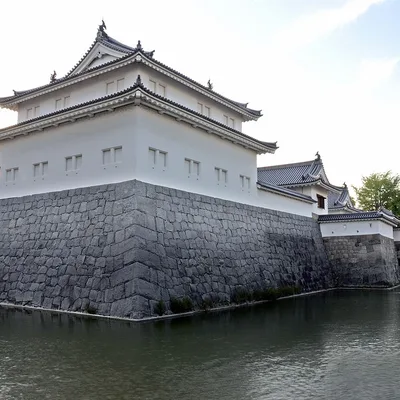
Osaka Castle is a teikaku-style hirajiro on the tip of the Uemachi Plateau, with the main bailey ringed by inner and outer water moats and second, west and Yamazato baileys around it. The Tokugawa rebuild raised the main-bailey stone walls seven to fifteen meters above the buried Toyotomi work, founded entirely on fresh masonry; granite from Shodoshima dominates the work, and giant boulders are scattered through the precinct. The Takoishi at Sakuramon masugata covers 59.43 square meters and weighs an estimated 108 tons — the largest mirror stone in the castle — alongside Furisode-ishi and Higo-ishi at thirty to fifty tons. The reconstructed keep is a five-story, eight-floor steel-reinforced-concrete tower rising about 55 meters above the keep base, itself a Tokugawa stone foundation over 20 meters high, for a total height of roughly 75 meters. The watchtower exterior is in black lacquer with gold leaf reproducing the Summer Siege folding-screen, with chidori-hafu and irimoya-hafu gables on each floor and a top story crowned with gold shachi, tigers and cranes. The 'Osaka-jo Tenshukaku' museum opens all eight floors via elevator and stairs, exhibiting the history of Hideyoshi and the Siege of Osaka. The thirteen Important Cultural Properties are genuine early-Edo survivors; the Ote-mon Koraimon gate, Sengan-yagura and Inui-yagura preserve the 1620-1629 design in situ.