Marugame Castle
丸亀城
丸亀市 · JP
Japan's tallest combined stone walls crowned by the smallest of the twelve surviving keeps
Rising over Kameyama hill in Marugame, Kagawa, this hilltop fortress stacks stone walls to a combined 60 meters and curves them outward in the elegant 'fan slope'. The keep above is the smallest of Japan's twelve surviving original castle towers — No. 78 on the Top 100 list.
Best Season & Time
Cherry blossoms in Kameyama Park frame the white keep — the Marugame Castle Cherry Festival is the year's peak
★★★★★
Fresh greens and the Seto blue sky — visit early in the morning when stone-wall shade keeps the slope cool
★★★☆☆
Maple foliage on Kameyama contrasts the white keep — the Marugame Castle Festival overlaps a quieter season
★★★★☆
Crisp clear air reveals the Great Seto Bridge from the keep, with frost-dusted stone walls at dawn
★★★☆☆
Top 3 Highlights
1.The Smallest of Japan's Twelve Original Keeps
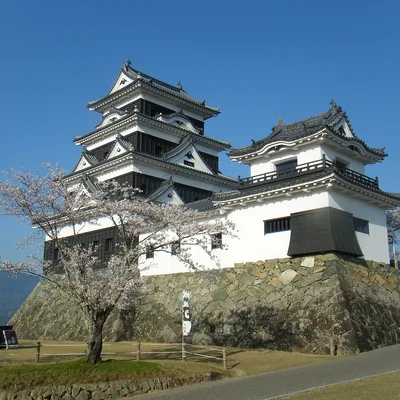
Completed in 1660 under the Kyogoku, the three-story keep stands just 15 meters tall — the smallest of Japan's twelve surviving originals. Clad in white plaster with karahafu and chidori-hafu gables, the tower perches atop the colossal stone foundation, a unique silhouette.
Frame from the north side of Sannomaru plaza after the Mikaerizaka slope, looking up at the keep
2.The Fan-Slope Stone Walls of Marugame
Rough nozura-zumi at the base meets sangi-zumi corners as the walls curve upward and snap vertical at the top in the ogi-no-koubai. Four tiers totaling 60 meters form Japan's tallest combined stone walls — the Sannomaru alone reaches 31 meters.
Shoot from the south side of Sannomaru looking up, or frame the wall head-on through Ote gate
3.Seto Inland Sea Vistas from the Main Bailey
From the main bailey atop Kameyama at 66 meters, the view sweeps north to the Seto Inland Sea, with Iinoyama — Sanuki's Mount Fuji — in the foreground and the Great Seto Bridge across the horizon. This panorama distills the geography the Kyogoku ruled from Marugame.
On a clear afternoon, shoot wide from the north edge of the main bailey toward the sea
Stories & Legends
Recommended For
Insider Tips
- 1.The Mikaerizaka or 'Look-Back Slope' lives up to its name with a sharp gradient; handrails were installed in 2018. Wear sturdy shoes and pause on each landing to look back — the colossal stone wall reveals itself in stages.
- 2.Since July 2024, the Marugame Castle Experience castle-stay lets guests sleep in the historic Enjukan annex and use the keep as an after-hours private lounge — an exceptionally rare chance to spend a night inside an original castle.
- 3.The 2018 stone-wall collapse is still being repaired with completion targeted for March 2028. The free PR Center displays dismantling-survey findings — including that the Sannomaru wall is a single 31-meter span — at the masonry-research frontier.
Visit Information
- Access
- About a 15-minute walk from JR Shikoku Yosan Line Marugame Station, or a short walk from the Marugame Community Bus stop at Marugame Castle. About 25 minutes from Takamatsu Station by the Sunport Rapid, or 35 minutes from Okayama Station via the limited express Shiokaze.
- Time Required
- About 1.5 hours for the stone walls and keep, or 2 hours including the city museum.
- Budget Guide
- Keep admission about JPY 200 for adults and JPY 100 for children; the castle grounds are free. (Prices as of 2024; confirm on the official site.)
Nearby Attractions
At the castle's foot, Marugame City Museum exhibits Kyogoku archives and the unique 1/650 wooden Marugame-jo Kizu model. Tori-machi shopping street and Showa-retro Akitora-no-Yakata are nearby, and Iinoyama (Sanuki's Mount Fuji) to the northeast is a popular half-day hike. By rail, Kotohira Shrine and Takamatsu Castle are easy day trips.
Go Deeper
Deeper details for those with the time to read on.
Timeline
- Early Muromachi
First Fort on Kameyama
Nara Motoyasu, senior retainer of the kanrei Hosokawa Yoriyuki, builds the first fort on Kameyama hill — the medieval ancestor of Marugame Castle.
- 1597
Ikoma Chikamasa's Foundation
Granted Sanuki Province at 170,000 koku, Ikoma Chikamasa begins building a sub-castle on Kameyama to control the western part of Sanuki from Takamatsu.
- 1602
Initial Castle Completed
After six years of work, the inner moat, stone walls, and baileys around Kameyama are essentially complete, providing a stronghold for western Sanuki.
- 1615
Ikkoku-Ichijo Crisis
Targeted for demolition under the one-castle-per-domain law, lord Ikoma Masatoshi reportedly screens its key points with trees to save it from destruction.
- 1641
Marugame Domain Founded
Yamazaki Ieharu transfers in from Higo Tomioka at 50,000 koku, founding Marugame Domain; major reconstruction begins in 1643 with shogunate backing.
- 1658
Kyogoku Clan Takes Marugame
After the Yamazaki line dies out in three generations, Kyogoku Takakazu transfers in from Harima Tatsuno at 60,000 koku, beginning two centuries of rule.
- 1660
Keep Completed
Takakazu reorients the main gate from the seaward side to the present Ote-mon, and the three-story keep is completed atop the great stone walls.
- 1673
Reconstruction Complete
After 32 cumulative years of building, the major reconstruction concludes — most of the surviving stone walls date from this period of work.
- 1869
Palace Fire
A fire in the second year of Meiji destroys the main palace and the Inui Yagura turret, ending the castle's role as a center of domain administration.
- 1876
Turrets Demolished
From 1876 the army demolishes most yagura turrets and curtain walls, though the keep and central structures are deliberately preserved.
- 1950
Important Cultural Property
Under the new Cultural Properties Protection Law, the keep is designated an Important Cultural Property, formalizing postwar protection.
- 1953
National Historic Site
The entire castle grounds are designated a National Historic Site, securing Kameyama Park's role as Marugame's cultural anchor.
- 2006
Japan Top 100 Castles
The Japan Castle Foundation selects Marugame as No. 78 on its Japan Top 100 Castles list, drawing national castle pilgrims to the site.
- October 2018
Stone Wall Collapse
July rains and Typhoon No. 24 cause parts of the southwestern obi-kuruwa and Sannomaru hitsujisaru-yagura walls to collapse, starting an ongoing rebuild.
- July 2024
Castle-Stay Begins
The Marugame Castle Experience launches, offering overnight stays at the Enjukan annex and after-hours private lounge access inside the keep itself.
Detailed History
Marugame Castle's history begins in the early Muromachi period when Nara Motoyasu, a retainer of kanrei Hosokawa Yoriyuki, built the first fort on Kameyama hill. Serious castle-building started in 1597, when Ikoma Chikamasa — granted all of Sanuki Province at 170,000 koku under Toyotomi — held Takamatsu Castle as his main base and began construction on Kameyama as a sub-castle for the western province. Six years of work brought the initial castle largely to completion by 1602. The 1615 Ikkoku-Ichijo Law, permitting only one castle per domain, put Marugame at imminent risk; tradition holds that lord Ikoma Masatoshi screened its key points behind dense trees, sparing the castle from destruction. In 1640 the Ikoma clan was demoted to Yashima in Dewa Province as punishment for the Ikoma Disturbance. The following year Yamazaki Ieharu was installed at 50,000 koku from Tomioka in Higo Province, and Marugame Domain was formally established. Ieharu — a noted castle builder who had worked on Osaka and Shimabara — secured 300 kan of silver and sankin-kotai exemption from the shogunate in 1643, pressing forward with a major rebuild reportedly meant as a bulwark against Christian uprisings in the Seto islands. The Yamazaki line died out in 1658, and Kyogoku Takakazu transferred in from Tatsuno in Harima at 60,000 koku, where the Kyogoku would remain until Meiji. In 1660, Takakazu shifted the main gate from the seaward karame-mon to the present Ote-mon, and the three-story keep was completed atop the great stone walls. The castle was considered completed in 1670, after decades of cumulative work, and most surviving stone walls date from this period. A fire in 1869 destroyed the main palace and the Inui Yagura. An 1872 auction notice was cancelled when the castle came under the Ministry of the Military; in 1873 it was transferred to the Army Ministry. From 1876 most yagura turrets and curtain walls were demolished, but the keep and central area were preserved. The site opened as Kameyama Park in 1919. The keep was designated a National Treasure in 1943 and an Important Cultural Property in 1950, and the entire site became a National Historic Site in 1953. It was added to the Japan Top 100 Castles list at No. 78 in 2006.
Cultural Significance
Marugame Castle is unusual in combining one of Japan's twelve surviving original keeps with the country's tallest combined stone walls — 60 meters across four tiers — embodying the high point of early-modern Japanese masonry. Even individually, the 31-meter Sannomaru wall is the second-tallest single stone wall in Japan after Osaka Castle, and its 'fan slope' (ogi-no-koubai) — rising gently from rough nozura-zumi and snapping vertical at the top — represents the apex of a technique balancing beauty, drainage, and earthquake resistance. The entire site is a National Historic Site, and three buildings — the keep, the Ote Ichi-no-mon, and the Ote Ni-no-mon — are Important Cultural Properties. Only three Japanese castles — Marugame, Hirosaki, and Kochi — preserve both an original main gate and an original keep, making Marugame a rare example where the spatial logic of early-modern daimyo rule remains legible. Also called 'Kameyama-jo' and 'Horai-jo', the site holds a unique wooden 1/650 model called the Marugame-jo Kizu, submitted to the shogunate during gate remodeling and exhibited at the Marugame City Museum. The castle inspired Sada Masashi's 2001 song 'The Town With a Castle' and features as the heroes' base in the anime Yuki Yuna is a Hero, anchoring local identity in western Sanuki.
Architectural Details
Marugame Castle is a hilltop fortress on the 66-meter summit of Kameyama, with the main bailey at the top and an inner moat surrounding a rough-square uzukaku-shiki ('whirlpool') layout. The stone walls are stacked in four tiers totaling 60 meters — the tallest combined walls in Japan — with the highest Sannomaru section rising 22 meters. The 2018 collapse and dismantling survey revealed something previously unsuspected: the Sannomaru wall is not a two-tier construction but a single continuous 31-meter mass anchored to bedrock, with the so-called foundation stones merely buttressing its front. That places it second only to Osaka Castle among single castle walls. The stones rise from rough nozura-zumi and dressed sangi-zumi corner work, curving upward before turning vertical at the top in the ogi-no-koubai. The keep itself was completed in 1660 — 15 meters tall, finished in white shikkui plaster with both karahafu and chidori-hafu gables — and is the smallest among Japan's twelve surviving original keeps. The Ote Ichi-no-mon and Ote Ni-no-mon, both built around 1670, form a classic masugata square-gate enclosure. Only Marugame, Hirosaki, and Kochi retain both gate and keep. A long-term plan envisages phased wooden reconstruction of the palace, turrets, gates, and clay walls.