Hara Castle
原城
南島原市 · JP
Hara Castle — the cliff-top stage where the Shimabara Rebellion ended in martyrdom
On a coastal bluff above the Ariake Sea in Minamishimabara, Nagasaki, Hara Castle is the ruined stronghold where 37,000 Catholic-led rebels made their last stand in 1638. UNESCO inscribed the site in 2018 as part of the Hidden Christian Sites of the Nagasaki Region.
Best Season & Time
Fresh greens and rape blossoms drape the walls; clear-day views to Unzen and Amakusa peak here.
★★★★★
Sea breezes make early-morning visits pleasant, but the site is mostly unshaded — bring water and a hat.
★★★☆☆
Pampas grass and crisp air sharpen the Amakusa view; lighter crowds make it the quiet sweet spot for the site.
★★★★☆
January memorial services pair with pilgrimages to the Honekami Jizo, giving the site its most solemn season.
★★★☆☆
Top 3 Highlights
1.Main bailey stone walls above the Ariake Sea
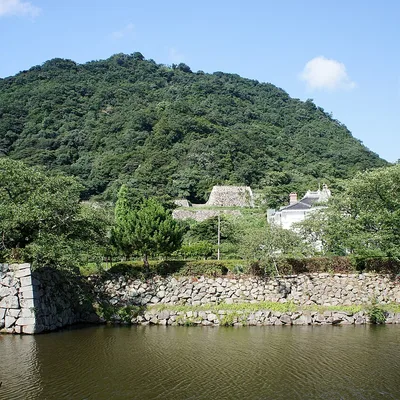
The surviving honmaru walls were built in the early Keicho era from dacite blocks 80-120 cm long, set at a gentle 56-65 degree batter. From the cliff edge visitors face Mount Unzen across the bay and the Amakusa Islands — the panorama the rebels saw during their final siege.
Shoot in late-afternoon raking light from the southern edge of the honmaru.
2.Memorial cross and the relics of 37,000 martyrs
A weathered cross stands inside the honmaru as a memorial to the 37,000 rebels killed in 1638 and to the hidden Catholics afterward. The on-site museum shows lead bullets, rosaries and fleur-de-lis-cross roof tiles — evidence of a Christian daimyo's castle.
Frame the cross against a backlit sky over the Ariake Sea for a silhouette.
3.Sweeping view of Mount Unzen and Amakusa
From the western edge of the honmaru, Mount Unzen rises across the bay while the Amakusa Islands stretch south. The geography explains how the ruin resisted 120,000 shogunate troops for three months, and the 90-by-80-metre main gate platform conveys the siege scale.
Compose a vertical shot from the western parapet with Mount Unzen as backdrop.
Stories & Legends
Recommended For
Insider Tips
- 1.The Honekami Jizo, a small stone shrine near the honmaru, was raised in 1766 by a local priest and village headmen to mourn rebels and shogunate soldiers together — a rare reconciliation gesture. Day visitors miss it, but locals still leave fresh flowers.
- 2.Open Minamishimabara City's free 'Hara Castle VR' app at the honmaru to overlay the lost tenshu, yagura turrets and walls in augmented reality. Guidance facility staff help with setup, dramatically lifting the experience of a site stripped to its foundations.
- 3.The annual Hara Castle Ikki Festival each April stages a memorial service, samurai procession and student-led drama on the honmaru. On a weekday in that window you see the rebellion re-enacted by local high schoolers — memory no guidebook can match.
Visit Information
- Access
- From Shimabara Port Station on the Shimabara Railway, take the Shimatetsu bus about 40 minutes to 'Harajo-mae', then 15 minutes on foot. By car: about 90 minutes from Nagasaki city, or two hours via the Kumamoto Port ferry to Shimabara Port.
- Time Required
- Allow 2-3 hours for the honmaru and guidance facility; half a day including nearby sites.
- Budget Guide
- Site admission is free, as is the guidance facility. Budget about 3,000 yen for return transport from Nagasaki and 1,500-2,500 yen for a meal (2024).
Nearby Attractions
Hinoe Castle ruins, the Arima clan's main stronghold, lie 15 minutes by car and pair with Hara as a one-day Arima-Christian itinerary. Shimabara city offers Shimabara Castle, a samurai-quarter street and a spring-water townscape. A 30-minute ferry from Kuchinotsu Port reaches Amakusa and the Sakitsu Village UNESCO component.
Go Deeper
Deeper details for those with the time to read on.
Timeline
- 1496
Founding by Arima Takazumi
Arima Takazumi built Hara as a subsidiary of Hinoe Castle on the bluff above the Ariake Sea — a modest medieval fort exploiting the natural promontory.
- 1599-1604
Christian daimyo's rebuilding
Arima Harunobu transformed Hara into an Azuchi-Momoyama-style tile-roofed castle, and Jesuit priests consecrated the completed structure in 1604.
- 1616
Decommissioning
After Matsukura Shigemasa built the new Shimabara Castle, the 'one castle per province' law forced Hara's decommissioning, though much of its stonework remained intact.
- October 1637
Shimabara Rebellion erupts
Matsukura Katsuie's tax oppression and Christian persecution ignited the rebellion; some 37,000 rebels led by Amakusa Shiro occupied the abandoned ruin.
- April 1638
Final assault and annihilation
On 11-12 April the shogunate's 120,000-strong army stormed Hara; all but the informant Yamada Emosaku were killed, including women and children.
- Post-1638
Razing and burial
The shogunate dismantled the walls to prevent reuse and buried the 37,000 rebel dead in mass graves within the site.
- 1766
Honekami Jizo erected
On 15 July 1766 a local priest and village headmen raised the Honekami Jizo to mourn rebels and shogunate soldiers without distinction.
- 1938
National Historic Site
The Hara Castle ruins were designated a National Historic Site of Japan, putting protection and systematic study on a formal footing.
- 1992
Excavations begin in earnest
Annual archaeology on the honmaru began, recovering human remains, lead bullets, rosaries and the first fleur-de-lis-cross roof tiles known from a Japanese castle.
- 2017
Continued Top 100 Castles, no. 188
On 6 April 2017 Hara Castle was selected as number 188 of the Continued Top 100 Japanese Castles, reaffirming its standing within castle scholarship.
- 2018
UNESCO World Heritage inscription
On 30 June 2018 the ruin was inscribed as one of the 12 components of the Hidden Christian Sites of the Nagasaki Region.
Detailed History
Hara Castle was first built in 1496 (Meio 5, Sengoku) by Arima Takazumi as a subsidiary of Hinoe Castle, perched on a hill jutting into the Ariake Sea on the southern Shimabara Peninsula. The original was a medieval fort exploiting the natural terrain, but at the end of the 16th century Arima Harunobu — drawing on castle-building knowledge from the Japanese invasions of Korea (1592-1598) and from Hizen Nagoya Castle — undertook a major rebuilding between roughly 1599 and 1604. The Azuchi-Momoyama-style result featured tiled roofs and a layered plan of main, second, third, Amakusa and outer baileys. Excavations at the main gate in 2004 uncovered eight massive foundation stones, evidence of cutting-edge Kinai engineering. Jesuit records (the 1604 Annual Letter of the Japan Vice-Province) confirm that the principal structures were consecrated by Christian priests upon completion in 1604, giving the castle a sacred character unique in Japanese feudal architecture. In 1616 (Genna 2), after the Arima clan was transferred to Nobeoka, Matsukura Shigemasa entered Hinoe Castle but soon built the new Shimabara Castle, and under the 'one castle per province' law Hara was decommissioned. Much of its stonework was left in place. In 1637 (Kan'ei 14) tax oppression and Christian persecution by Matsukura Katsuie ignited the Shimabara Rebellion. About 37,000 farmers, ronin and Catholics led by the teenage Amakusa Shiro fortified the ruin with new ditches and earthworks, turning the honmaru into a virtual island. They withstood three months of siege by a 120,000-strong shogunate army. The final assault on 27-28 Kan'ei 15 (11-12 April 1638) annihilated the rebels: only the informant Yamada Emosaku was spared. The shogunate then razed the walls and buried the dead on site. In 1766 (Meiwa 3) the Honekami Jizo was erected to mourn both sides together. The ruin was designated a National Historic Site in 1938. Sustained excavation began in 1992 (Heisei 4) on the honmaru, recovering human remains, lead bullets, rosaries and fragments of fleur-de-lis-cross roof tiles — the first Christian-themed tiles ever excavated from a daimyo castle. On 6 April 2017 Hara was added to the Continued Top 100 Japanese Castles list as number 188, and on 30 June 2018 it was inscribed on the UNESCO World Heritage List as one of the 12 components of the Hidden Christian Sites of the Nagasaki Region.
Cultural Significance
In its 2018 UNESCO inscription, Hara Castle is positioned as the catalytic event that produced Japan's hidden Christian tradition — the moment after which open Catholic practice became impossible and faith went underground for two and a half centuries. The Shimabara Rebellion that ended here was more than a peasant uprising: it hardened the Tokugawa shogunate's anti-Christian policy, accelerated the sakoku closed-country edicts, and shaped the 1644-1873 hidden period of clandestine worship in Nagasaki, Goto and Amakusa. The site therefore matters at three layers — as a 1938-designated National Historic Site, as castle ruin number 188 on the Continued Top 100 list, and as the only UNESCO component that is itself a battlefield rather than a surviving village. The fleur-de-lis-cross tile shards excavated here are a landmark find, the first physical confirmation of European Christian motifs being mass-produced at a daimyo castle. The ruin is also a primary geopoint of the 2009-designated Shimabara Peninsula Geopark, layering geological and historical heritage on a single hilltop. Each April the city stages the Hara Castle Ikki Festival, with memorial services and a samurai procession that keep the rebels' memory in active circulation. Beyond Japan, the site is recognised as a spiritual backdrop for Shusaku Endo's novel Silence and Martin Scorsese's 2016 film adaptation.
Architectural Details
Hara Castle is a renkaku-style hilltop sea castle on a roughly 30-metre coastal bluff, with main, second, third, Amakusa and outer baileys arrayed along the promontory above the Ariake Sea. The full enclosure originally extended about 700 metres east-west and 1,300 metres north-south, far larger than today's exposed core. The main gate platform — almost square at 90 metres by 80 metres — is one of the largest castle entrances ever built in Japan. The masonry is dominated by dacite ashlar 80-120 cm on axis, backed with basaltic gravel and battered to a gentle 56-65 degree slope; corner stones often carry tell-tale 'arrow' splitting marks, a clear marker of late-16th-century Toyotomi-influenced Keicho stonework. The tenshu base reveals a tile-roofed Azuchi-Momoyama keep platform, and the recovered roof tiles include rare fleur-de-lis-cross motifs that identify the castle as a Christian daimyo's project — exceptional in the Japanese corpus. Gravel-paved primary axes have been confirmed inside the bailey, and on the west side of the honmaru excavators have mapped a cluster of square pit-dwellings 2-3 metres on a side, most likely built by the rebels to house family units during the 1637-38 siege. Post-rebellion demolition reduced every superstructure to rubble, but the buried stonework, gate foundations and pit dwellings have been progressively unearthed since 1992.