Kiyosu Castle
清洲城
清須市 · JP
Where Nobunaga launched his bid for the realm before Okehazama
Kiyosu Castle in Aichi, founded in the early 15th century as the Owari seat, served roughly a decade as Oda Nobunaga's home base. From here he rode to Okehazama in 1560, and after his death the 1582 Kiyosu Conference reshaped Japan within these walls.
Best Season & Time
Cherry blossoms set off the vermilion donjon; nighttime sakura illuminations mark the year's peak
★★★★★
Fresh greenery along the Gojo River pairs with the scarlet bridge; arrive early for cooler temperatures
★★★☆☆
Autumn foliage with red bridge and white keep makes a three-color composition, quieter than cherry season
★★★★☆
Projection mapping and seasonal illuminations turn the donjon into a fantastical night scene
★★★★☆
Top 3 Highlights
1.Vermilion-railed replica donjon over the Gojo River
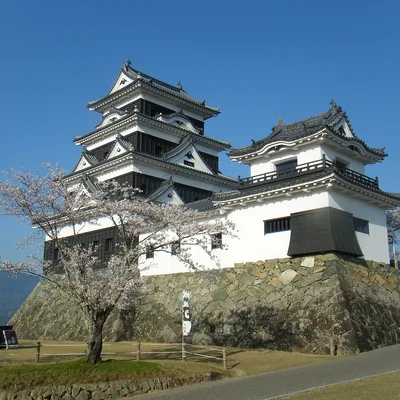
Rebuilt in 1989 for Kiyosu's centennial, the concrete donjon imagines a Momoyama-era castle in vermilion and white plaster. Viewed across the Gojo River, the keep and scarlet Otebashi Bridge mirror on the water to compose the signature Sengoku-mood shot of the site.
From the riverside promenade on the south bank, frame the keep beyond the bridge
2.Otebashi Bridge, the Spirited Away lookalike
The vermilion arched Otebashi Bridge across the Gojo River, linking the donjon to the former main bailey, has gone viral for resembling the bathhouse in Studio Ghibli's Spirited Away. Photographers flock here at dusk when the bridge is illuminated and the scarlet pylons glow.
Around 5 pm, shoot the bridge and donjon together in a horizontal frame
3.Young Nobunaga statue on the eve of Okehazama
Just south of the ruins, a 1936 bronze in Kiyosu Park shows a youthful Oda Nobunaga on the eve of Okehazama, captured mid-stride after he danced 'Atsumori' and rode to victory. Pilgrims from across Japan touch the pedestal as a charm for career success and battlefield wins.
Shoot from the southwest with backlight from the morning sun for a silhouette
Stories & Legends
Recommended For
Insider Tips
- 1.The view of the keep from Otebashi Bridge has gone viral as a 'Spirited Away bathhouse' lookalike. The magic-hour window between sunset and dusk is the most cinematic, with around 5 pm the quietest time when lighting peaks
- 2.Nagoya Castle's Ofukemaru northwest turret, an Important Cultural Property, was built from materials of Kiyosu's original donjon and is nicknamed the 'Kiyosu Yagura.' Pairing both castles retraces the 1610-1613 'Kiyosu transfer'
- 3.Since 2010, figure skater Nobunari Oda, who claims Nobunaga descent, has served as honorary castle lord. Souvenirs themed on the Oda mokko family crest are the donjon shop's signature item, and the crest goshuincho stamp book is a meaningful keepsake
Visit Information
- Access
- About a 15-minute walk from Shin-Kiyosu Station on the Meitetsu Nagoya Main Line, or 15 minutes on foot from Kiyosu Station on the JR Tokaido Main Line. From Nagoya Station the train takes around 20 minutes, and the Nagoya Expressway 'Kiyosu' exit is a 5-minute drive away.
- Time Required
- 1.5-2 hours for donjon and parks; half a day with Nagoya Castle.
- Budget Guide
- Donjon admission JPY 300 adults, JPY 150 students. Train from Nagoya about JPY 330 one way. (As of 2024; check official site.)
Nearby Attractions
Nagoya Castle is 20 minutes by train, and its Ofukemaru northwest turret (the 'Kiyosu Yagura,' Important Cultural Property) reused materials from Kiyosu's donjon. Kiyosu Park and the old castle ruins park are within walking distance, and a 30-minute drive reaches Inuyama and Komakiyama Castles, letting visitors trace Nobunaga's home bases in a day.
Go Deeper
Deeper details for those with the time to read on.
Timeline
- 1405
Founding
In the Muromachi period (Oei 12), Shiba Yoshishige, shogunal deputy (kanrei) and shugo of Owari, Totomi and Echizen, builds the castle as an auxiliary fortress to Shimotsu Castle; some sources date the works to 1375
- 1478
Owari government seat moves to Kiyosu
After Shimotsu Castle burns in 1476 amid an Oda-clan civil war, the provincial government relocates to Kiyosu, making it the political heart of Owari
- 1555
Nobunaga seizes the castle
In Koji 1, Oda Nobunaga conspires with his uncle Oda Nobumitsu to eliminate the shugodai Oda Nobutomo and shifts his base here from Nagoya Castle
- 1560
Departure for Okehazama
In Eiroku 3, Nobunaga rides out from Kiyosu to ambush and rout Imagawa Yoshimoto's force, ten times his own, laying the foundation for the unification of Japan
- 1562
Kiyosu Alliance
In Eiroku 5, Nobunaga and Tokugawa Ieyasu seal their decades-long alliance at this castle, securing his eastern flank
- 1563
Move to Komakiyama Castle
In Eiroku 6, Nobunaga relocates his base to Komakiyama Castle to prepare for war with the Saito of Mino; Kiyosu remains a subsidiary garrison
- 1582
Kiyosu Conference
In Tensho 10, after Nobunaga is killed at Honno-ji, his senior retainers convene the famed Kiyosu Conference here to decide his succession
- 1586
Nobukatsu's great renovation
In Tensho 14, Oda Nobukatsu carries out massive works including a double ring of moats and a great donjon, likely as recovery from the previous year's Tensho earthquake
- 1595
Fukushima Masanori takes the castle
In Bunroku 4, after Nobukatsu is dispossessed for defying Hideyoshi, Fukushima Masanori is installed as castellan
- 1600
Eastern Army rear base at Sekigahara
In Keicho 5, Kiyosu serves as a rear-area base for the Eastern Army during the decisive Battle of Sekigahara
- 1610-1613
Kiyosu transfer and abolition
By order of Tokugawa Ieyasu the entire castle town, buildings, stones and timbers are relocated to Nagoya to build the new provincial seat; Kiyosu Castle is formally abolished on completion in 1613
- 1989
Replica donjon rebuilt
In Heisei 1, a reinforced-concrete replica donjon is built to mark the centennial of the modern town of Kiyosu, imagining a Momoyama-era castle
Detailed History
Kiyosu Castle was founded in 1405 by Shiba Yoshishige, shugo (military governor) of Owari, Totomi and Echizen and shogunal deputy (kanrei), though some sources date the works to 1375. It was conceived as an auxiliary stronghold for Orizu Castle, then the seat of Owari's provincial government, guarding the junction where the Kyo-Kamakura highway and the Ise Kaido met and connected with the Nakasendo. After Orizu Castle was destroyed in battle in 1478 during a civil war between factions of the Oda clan, the provincial government shifted to Kiyosu under Oda Nobuhide, making it the political heart of Owari and the seat of the Oda Yamato-no-kami line (Kiyosu Oda), shugodai of the four lower counties. In 1555, Oda Nobunaga, then based at Nagoya Castle, conspired with his uncle Oda Nobumitsu to eliminate the shugodai Oda Nobutomo and seized Kiyosu. He renovated the keep and made it his home base for roughly a decade. From these gates in 1560 he rode to the Battle of Okehazama, routing Imagawa Yoshimoto's force ten times his own and laying the foundation for the unification of Japan. In 1562 he sealed the Kiyosu Alliance with Tokugawa Ieyasu here, and in 1563 he moved his base to Iwakura Castle to prepare for war with the Saito of Mino, leaving Kiyosu as a subsidiary garrison. After Nobunaga's death at Honno-ji in 1582, his senior retainers convened the Kiyosu Conference here to settle the succession, and the keep passed to his second son Oda Nobukatsu. In 1586 Nobukatsu carried out massive works including a double ring of moats and a great donjon, small donjon and shoin halls; archaeology suggests this was recovery from the Tensho earthquake of January 1586. After Nobukatsu defied Hideyoshi's reassignment orders and was dispossessed, Fukushima Masanori took the castle in 1595. At Sekigahara in 1600 it served as an Eastern Army rear base; after Fukushima was transferred to Hiroshima, Ieyasu's fourth son Matsudaira Tadayoshi was installed, followed by his ninth son Tokugawa Yoshinao, who made Kiyosu the seat of the Kiyosu Domain. In 1609 Ieyasu ordered the seat moved from Kiyosu to Nagoya, and from 1609 to 1613 the entire castle town was relocated in the famous 'Kiyosu transfer,' with the castle's buildings, stones and timbers repurposed to build Nagoya Castle. With the move complete in 1613, Kiyosu Castle was formally abolished.
Cultural Significance
Kiyosu endures in Japanese popular memory as the launching pad of Nobunaga's bid for the realm, and pilgrims come here to absorb the energy of a power spot for career success and decisive victory. The northwest turret of Nagoya Castle's Ofukemaru bailey was built from materials salvaged from the Kiyosu donjon and is officially called the 'Kiyosu Yagura,' an Important Cultural Property. The 1610-1613 'Kiyosu transfer' (Kiyosu-goshi), in which an entire castle town was moved to Nagoya, is unparalleled in Japanese urban history and laid the foundation of modern Nagoya. Surviving wall paintings are kept at Soken-ji temple as Aichi Prefecture Tangible Cultural Property, and the castle's back gate at Ryofuku-ji in Owari-Asahi is a municipal cultural property. The present donjon is a reinforced-concrete replica built in 1989 for the centennial of modern Kiyosu; with no original drawings surviving, the design imagines a Momoyama-era castle in colorful Sengoku style. Since 2010, Olympic figure skater Nobunari Oda, who claims Nobunaga descent, has served as honorary castle lord. The view from Otebashi Bridge has gone viral as a 'Spirited Away bathhouse' lookalike, drawing international visitors.
Architectural Details
The present donjon is a reinforced-concrete reconstruction built in 1989 to mark the centennial of modern Kiyosu, erected adjacent to the original ruins within the Kiyosu Regional Cultural Plaza. Because no original drawings of the medieval keep survive, neither its scale nor structure is known, and the replica's exterior is an imaginative design. The keep stands about 19 meters high in a four-tier, four-story layout, evoking Momoyama-era flamboyance with vermilion railings, gilded shachi-hoko and decorated gables, distinct from white-plastered Edo-period castles. Inside, a local history museum displays Sengoku arms and armor and offers a samurai armor try-on experience. The vermilion arched Otebashi Bridge spans the Gojo River to connect the donjon to the former main bailey, forming the castle's signature landmark. The original castle that Oda Nobukatsu built up in 1586 had a double ring of moats, a great donjon, small donjon and shoin halls, with a castle town stretching roughly 1.6 km east-west and 2.8 km north-south. In 1613, as part of the move to Nagoya, virtually every structure was dismantled and repurposed to build Nagoya Castle. Excavations during Gojo River improvement works have uncovered Heian-period settlement traces, Sengoku castle-town remains and Edo-period post-town structures, and a section of stone wall has been reconstructed in the park.