Shimabara Castle
島原城
島原市 · JP
The white castle that lit the Shimabara Rebellion — a five-story keep that ruined its own domain
Standing on Ariake Bay below the slopes of Mount Unzen in Nagasaki, Shimabara Castle is the white five-story keep that Matsukura Shigemasa built far beyond his 40,000-koku means — over-construction that crushed the peasantry and ignited Japan's largest Christian uprising in 1637.
Best Season & Time
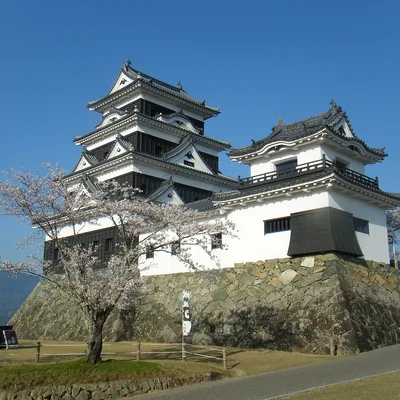
Cherry blossoms along the main bailey stone walls with the white keep — peak season for moat-reflection shots
★★★★★
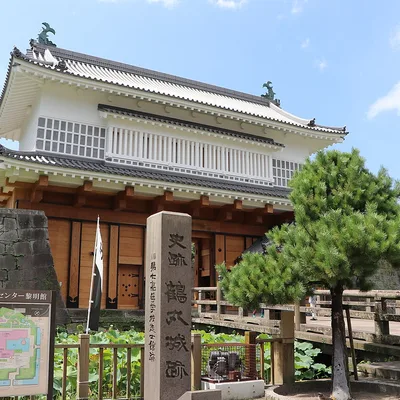
Lotus leaves in the moats and fresh greenery around the bailey — early-morning visits stay coolest
★★★☆☆
Shimabara Castle Noh and the Shiranui Festival in October pair foliage with traditional-arts evenings
★★★★☆
Snow-capped Mount Unzen behind the white keep makes a striking contrast for cold-tolerant photographers
★★★☆☆
Top 3 Highlights
1.Reconstructed Keep with White Karazukuri Elegance
Reconstructed in reinforced concrete in 1964, the gabled-less five-story keep rises 33 m in a karazukuri (Tang-style) silhouette, the top balcony enclosed by wooden panels. White plaster walls reflected in the moat project a grandeur far beyond a 40,000-koku lord.
Frame the keep head-on across the inner moat from the southwest corner in morning light
2.Folding-Screen Stone Walls and 15-Meter Moats
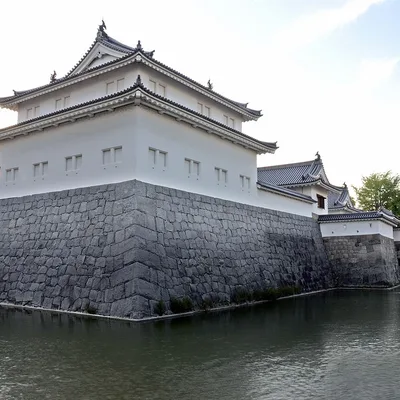
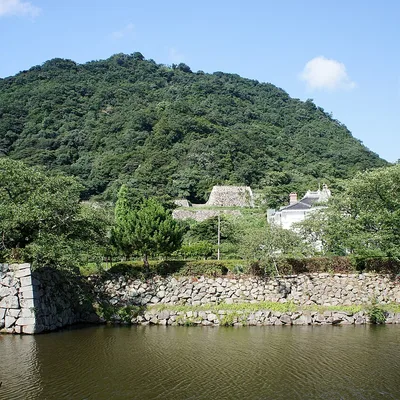
Outer moats run 15 m deep and 30-50 m wide, 360 m east-west by 1260 m north-south. Stone walls bend repeatedly in a byobu-ori (folding-screen) pattern, exposing attackers to multi-angle fire — masonry over volcanic ash that bears witness to the brutal build that drove revolt.
Capture the folding-screen angles from the second bailey moat's north side in raking afternoon light
3.The Keep, Tatsumi Yagura, and Kirishitan Museum
The keep's four floors house a Kirishitan museum displaying relics of the Shimabara Rebellion, Amakusa Shiro, and hidden Christians who survived 250 years. The 1972 Tatsumi Yagura is now the Seibo Kitamura Memorial for the locally-born sculptor of the Nagasaki Peace Statue.
From the main bailey center, frame the keep and Tatsumi Yagura together on a 45-degree diagonal
Stories & Legends
Recommended For
Insider Tips
- 1.The keep's four floors present three rotating themes — Kirishitan, regional history, and folk crafts — but the real reward is the top-floor observation deck offering panoramic views across Ariake Bay all the way to the mountains of Kumamoto.
- 2.The Shimabara Castle Noh held in October on the main bailey grounds, lit by bonfires, coincides with the Shiranui Festival the same month and weekends fill local inns fast — book at least two months in advance to secure accommodation.
- 3.A 10-minute walk delivers you to Shimabara's samurai-house quarter, with three nationally-registered residences open free along the water channels — gems missed by most guidebooks but signature to the local heritage.
Visit Information
- Access
- About 10 minutes on foot from Shimabara Station on the Shimabara Railway, or 10 minutes by car from Shimabara Port. Approximately 1 hour 20 minutes by Shimabara Railway from Isahaya Station, or roughly 3 hours from Fukuoka Airport via highway bus and the Shimabara Railway.
- Time Required
- About 2 hours for the keep and turret museums, half a day with the samurai-house quarter.
- Budget Guide
- Combined keep+turret-museums ticket: JPY 700 adults, JPY 350 children. Parking outside the main bailey JPY 350/day. (As of 2024; confirm on the official site.)
Nearby Attractions
Ten minutes on foot brings you to Shimabara's samurai-house quarter, a quiet streetscape of water channels and three nationally-registered residences. Moritake Shopping Street preserves the Aoi Rihatsukan barbershop. Thirty minutes by car reaches Unzen Onsen with its volcanic 'hells'; an hour reaches Hara Castle, where the Rebellion met its end.
Go Deeper
Deeper details for those with the time to read on.
Timeline
- 1616
Matsukura Shigemasa Enters
Arima Naozumi is transferred to Nobeoka, and Matsukura Shigemasa replaces him as lord of Shimabara with 40,000 koku, taking up residence at Hinoe Castle.
- 1618
Construction Begins
Shigemasa begins building Shimabara Castle, citing a break from Arima-era politics and enforcement of the shogunate's Christianity ban.
- 1624
Castle Completed
After seven years a fully stone-clad fortress with a five-story keep and 16 turrets stands — wildly disproportionate to the 40,000-koku domain.
- 1637-1638
Shimabara Rebellion
Katsuie's harsh taxes and Christian persecution drive 37,000 rebels to barricade at Hara Castle, broken only by 120,000 shogunate troops.
- 1638
Matsukura Stripped, Koriki Enter
Katsuie is beheaded in Edo for inciting the revolt, the Matsukura are dispossessed, and Koriki Tadafusa enters with 40,000 koku.
- 1874
Castle Abolition
Under the Meiji government's castle abolition order, Shimabara Castle is decommissioned and its grounds auctioned off to private owners.
- 1876
Keep Demolished
The keep and major structures are pulled down, the main bailey turned to farmland and the third bailey converted to school grounds.
- 1960
West Yagura Rebuilt
Postwar cultural-property revival sees the West Yagura reconstructed in reinforced concrete as the first restoration on the site.
- 1964
Keep Reconstructed
The five-story keep is rebuilt in reinforced concrete, opening as a history museum displaying Kirishitan and feudal-period materials.
- 1972
Tatsumi Yagura Rebuilt
The Tatsumi (southeast) Yagura is restored and becomes the Seibo Kitamura Memorial Museum, exhibiting the local-born sculptor's works.
- 1980
Ushitora Yagura and Long Wall Rebuilt
The Ushitora (northeast) Yagura and long wall are reconstructed in reinforced concrete, the yagura housing a folk-crafts museum.
- 1996
Volcanic Disaster Hall Opens
The Tourism Revival Memorial Hall opens inside the castle precinct to commemorate the 1991 Mount Unzen-Fugen volcanic disaster.
- 2006
100 Fine Castles Listing
The Japan Castle Foundation selects Shimabara as No. 91 among Japan's 100 Fine Castles list.
- 2016
Nagasaki Prefecture Historic Site
The castle ruins are designated a historic site by Nagasaki Prefecture, formally positioning Shimabara among the region's recognized cultural properties.
- 2024
400th Anniversary
Four centuries after the 1624 completion, the city of Shimabara marks the milestone with commemorative events and exhibitions.
Detailed History
Shimabara Castle's history begins in 1616, when Arima Naozumi left for Nobeoka in Hyuga Province. Matsukura Shigemasa replaced him on the strength of his Siege of Osaka service, gaining the shogunate's trust as Tokugawa policy hardened into outright suppression of Christianity after the 1614 ban. From 1618 Shigemasa abandoned the Arima clan's old seat at Hinoe Castle and broke ground on Shimabara, driven by a political break from his Christian-friendly predecessors and personal ambition to project shogunate authority through an over-built fortress. The seven-year construction, completed in 1624, produced a castle radically disproportionate to the domain's 40,000 koku — fully stone-clad walls, a five-story keep, 16 turrets, scaled like a 100,000-koku house. Building on volcanic ash and lava soil presented severe engineering challenges, and the cost in forced labor and corvee taxes ruined the peasantry. Shigemasa's son Katsuie layered systematic Christian persecution onto already crushing levies. In October 1637 some 37,000 farmers, masterless samurai, and Kirishitan rose in the Shimabara Rebellion, barricaded at Hara Castle until February 1638, when the shogunate's 120,000-man army wiped them out almost to the last man. The castle itself never fell, but Katsuie was beheaded in Edo for misgoverning his domain into civil war, and the Matsukura lost their fief. The Koriki clan took over with 40,000 koku in 1638, followed by alternating tenures of the Matsudaira (Fukozu), Toda, and Matsudaira lines until the Meiji Restoration. After the 1871 abolition of domains, Shimabara was folded into Nagasaki Prefecture. The Meiji 1874 castle abolition order condemned Shimabara, and by 1876 the keep and most major structures had been torn down, the main bailey turned to farmland and the third bailey converted to school grounds. Reconstruction began with the West Yagura in 1960, the keep in 1964, the Tatsumi Yagura in 1972, and the Ushitora Yagura plus long wall in 1980. In 1996 the Tourism Revival Memorial Hall opened to commemorate the 1991 Mount Unzen-Fugen disaster. Listed as No. 91 of Japan's 100 Fine Castles in 2006 and designated a Nagasaki Prefecture Historic Site in 2016 and upgraded to a National Historic Site in 2025, the castle marked its 400th anniversary in 2024 (counted from the 1624 completion).
Cultural Significance
Shimabara Castle occupies a cautionary place in Japanese castle history: the canonical case of over-construction beyond a domain's means triggering peasant revolt and dynastic ruin. That a 40,000-koku house built a fortress at 100,000-koku scale became, for later castle scholars, the textbook example of the 'unsuitable castle that destroyed the domain'. The 1637 Rebellion the construction directly precipitated was no ordinary peasant rising — it was Japan's largest religious revolt, fusing Christian faith and tax grievance, with the messianic Amakusa Shiro Tokisada leading 37,000 followers in a siege at Hara Castle that the shogunate broke only with 120,000 troops. The political consequences proved decisive: the lockdown that completed sakoku isolation, the centuries-long survival of 'hidden Christians', and the later Amakusa-kuzure persecution waves all flowed from Shimabara's building burden. The Kirishitan museum in the rebuilt keep holds one of Japan's finest collections of Maria-Kannon icons, fumi-e plates, and underground-period devotional objects — essential context for the UNESCO-inscribed 'Hidden Christian Sites in the Nagasaki Region' (2018). The Seibo Kitamura Memorial in the Tatsumi Yagura showcases the local-born sculptor of the Nagasaki Peace Statue, marking the castle as more than a martial relic — a cultural anchor for the region.
Architectural Details
Shimabara Castle is a renkaku-shiki (linked-bailey) flatland castle on low-lying coastal land facing Ariake Bay, with three rectangular baileys — main, second, and third — strung north to south. The outer moats measure 15 meters deep and 30-50 meters wide, extending 360 m east-west by 1260 m north-south, with curtain walls running 3900 meters and 16 turrets guarding key points. The main bailey is encircled by water moats and reaches the second bailey only by one wooden corridor bridge — a layout that lets the main bailey be isolated by destroying that span, but at the cost of trapping defenders inside, a duality found only here and at Takamatsu Castle's main keep. The keep itself is a freestanding layered keep of five stories (or four stories and five floors counting the first roof as an eave) reaching 33 meters, distinctively gabled-less and with the top-floor balcony later enclosed in wooden panels to produce a karazukuri (Tang-style) facade. The stone walls embody a defense-oriented philosophy through byobu-ori (folding-screen) construction, where the masonry zigzags to expose attackers to fire from multiple angles. Local volcanic stones formed the principal material, and engineering the foundations on volcanic ash and lava-flow substrate demanded custom techniques that mark the castle's distinctive masonry.