Fushimi Castle
伏見城
伏見区 · JP
The retirement castle that named an era — Hideyoshi's lost stronghold on Momoyama hill
On the peach-tree hill of Fushimi Ward in southern Kyoto, Fushimi Castle was built in 1594 as Toyotomi Hideyoshi's retirement seat and later named the entire Azuchi-Momoyama era. Felled by the 1596 earthquake, stormed in 1600, rebuilt by the Tokugawa and razed in 1623.
Best Season & Time
Cherry blossoms on Momoyama hill pair with the white keep — a quieter alternative to central Kyoto
★★★★★
Maples on the hill set off the keep, a less-crowded counterpoint to Kyoto's famous foliage spots
★★★★☆
White walls and green canopy against blue summer skies; arrive early to beat the heat on the wooded approach
★★★☆☆
Lowest visitor numbers of the year give you the hill to yourself, and a rare snow dusting transforms the keep
★★★☆☆
Top 3 Highlights
1.The 1964 Replica Keep on Momoyama Hill
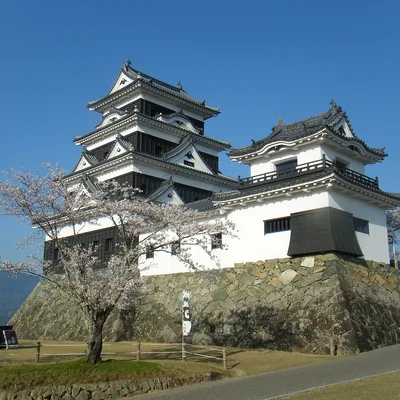
Built in 1964 as the centerpiece of Fushimi-Momoyama Castle Land, this five-tier connected donjon is a concrete reconstruction. Chidori and kara gables and gold-leaf-style detailing channel the lavish Momoyama style, white walls rising over wooded southern Kyoto.
Look up at the keep from the southwest approach through the trees as you climb the path
2.Blood-Stained Ceilings in Kyoto Temples — Yogen-in
Floorboards stained with the blood of Torii Mototada's garrison, who committed seppuku when the castle fell in 1600, were enshrined as ceiling panels in Kyoto temples — Yogen-in, Genko-an, Hosen-in. A temple circuit lets you trace the tragedy in physical relics.
Photograph the Yogen-in or Genko-an ceiling beams looking up (check each temple's photo rules)
3.Emperor Meiji's Misasagi on the Old Honmaru
In 1912 the imperial mausoleum (Misasagi) of Emperor Meiji was built on the former main bailey. The upper-round-lower-square mound is reached by a 230-step staircase that opens onto a panorama of central Kyoto — a sanctuary of state on the old castle core.
Shoot the Fushimi Momoyama Misasagi mound directly, or capture central Kyoto from the summit
Stories & Legends
Recommended For
Insider Tips
- 1.The keep has been closed to the public since the theme park shut in 2003 and remains exterior-only. Treat it as a 1964 evocation of Momoyama-style rather than an authentic ruin and the free outer walk and photo angles satisfy.
- 2.Pairing Fushimi with the blood-ceiling temples of Yogen-in, Genko-an and Hosen-in is the connoisseur's way to study the 1600 siege — a back-route circuit that almost no English guidebook describes but Japanese history buffs swap.
- 3.Climb the 230-step staircase to Emperor Meiji's mausoleum for the highest viewpoint on Momoyama hill, looking out over central Kyoto. Late afternoon light is especially good and the path is rarely crowded outside New Year.
Visit Information
- Access
- About 15 minutes on foot from JR Nara Line's Momoyama Station, or 25 minutes from Keihan's Fushimi-Momoyama or Kintetsu's Momoyama-Goryomae. Kyoto Station is roughly 10 minutes by JR train.
- Time Required
- Two hours for the castle exterior and the imperial mausoleum, half a day with the temples.
- Budget Guide
- Exterior viewing of the castle and the imperial mausoleum is free. Round-trip rail from Kyoto Station runs about 500 JPY; Yogen-in admission is roughly 600 JPY (as of 2024).
Nearby Attractions
About 2 km southeast lies Fushimi Inari Taisha with its world-famous vermilion torii tunnel; 1.5 km southwest is the Fushimi sake-brewing district of Gekkeikan and Matsumoto, one of Japan's three great sake regions. North of the castle the temples of Yogen-in and Genko-an preserve the Fushimi blood-ceiling boards, supporting a castle-and-temple circuit.
Go Deeper
Deeper details for those with the time to read on.
Timeline
- 1591
Retirement villa begun
Toyotomi Hideyoshi yields the regency and Jurakudai to his nephew Hidetsugu and begins a retirement villa at Shigetsu in Fushimi.
- 1594
Hideyoshi enters Shigetsu-Fushimi
Major civil works including the rerouting of the Uji River accompany the build; Hideyoshi formally takes residence in the new castle complex.
- Aug 1596
Keicho-Fushimi earthquake
Newly completed Shigetsu-Fushimi Castle is wrecked; the upper two stories of the keep collapse and 73 ladies-in-waiting and 500 attendants are killed.
- 1597
Kohatayama keep completed
The replacement Kohatayama Fushimi Castle one kilometer northeast is finished in the 5th month and Hideyoshi moves in.
- 1598
Hideyoshi dies at Fushimi
Toyotomi Hideyoshi dies in the keep on the 18th day of the 8th month; per his will Hideyori moves to Osaka and Ieyasu takes residence at Fushimi.
- 1600
Siege of Fushimi
Ishida Mitsunari's coalition of 40,000 storms the castle; castellan Torii Mototada and ~1,800 defenders hold for eleven days before committing seppuku.
- 1602
Tokugawa rebuild
After Sekigahara, Ieyasu rebuilds Fushimi on the Kohatayama plan with Todo Takatora as works commissioner; the works finish in late 1602.
- 1603
Ieyasu's shogunal investiture
Tokugawa Ieyasu receives the seii-taishogun title at Fushimi, the first of three Tokugawa shogun investitures hosted here through 1623.
- 1619
Demolition ordered
Decommissioning is decreed in Genna 5; dismantling begins the next year and parts are reused at Nijo, Yodo, Fukuyama and other castles.
- Genroku era
Hill renamed Momoyama
Peach trees are planted on the former castle site; the hill comes to be called Momoyama, the source of the Azuchi-Momoyama era name.
- 1912
Emperor Meiji's tomb built
The imperial mausoleum of Emperor Meiji is constructed on the former main bailey, turning the castle core into a state sanctuary.
- 1964
Replica keep erected
A reinforced-concrete connected-donjon replica is built as the centerpiece of the Fushimi-Momoyama Castle Land theme park.
- 2003
Theme park closes
Fushimi-Momoyama Castle Land shuts down; the replica keep is closed internally and remains accessible only as exterior viewing.
- 2007
Grounds reopened
The castle grounds reopen for public outer-circuit walking with the keep interior still closed, the configuration in place today.
Detailed History
The origins of Fushimi Castle trace back to 1591, when Toyotomi Hideyoshi handed his regency and the Jurakudai palace to his nephew Hidetsugu and began a retirement villa at Shigetsu on the Fushimi peninsula. Full-scale construction began in 1592 during the Bunroku-era Korean campaign, with workers diverting the Uji River to create the moat in a massive tenka-bushin (national levy) public works campaign. Hideyoshi entered the new Shigetsu-Fushimi Castle in 1594 and it was formally completed in 1596 — only to be wrecked weeks later when the Keicho-Fushimi earthquake collapsed the upper two stories of the keep and killed 73 ladies-in-waiting and 500 attendants. Hideyoshi shifted the castle one kilometer northeast onto Kohata hill, with a new keep completed in 1597 — the so-called Kohatayama Fushimi Castle. He died there in the 8th month of 1598. Per his deathbed instructions Toyotomi Hideyori moved to Osaka Castle and Tokugawa Ieyasu, senior elder of the regency council, took residence at Fushimi and governed in Hideyori's stead. When Ieyasu marched on Aizu in 1600, an Ishida Mitsunari coalition led by Kobayakawa Hideaki and Shimazu Yoshihiro attacked Fushimi with 40,000 troops; castellan Torii Mototada held the keep for eleven days with about 1,800 defenders before all committed seppuku, and the buildings burned. The blood-soaked floorboards are traditionally said to have been enshrined as ceiling boards in Kyoto's Yogen-in, Genko-an and Hosen-in temples. After Sekigahara, Ieyasu rebuilt Fushimi in 1601-1602 under works commissioner Todo Takatora and used it for his own investiture as shogun in 1603 — the first of three Tokugawa shogun investitures (Ieyasu 1603, Hidetada 1605, Iemitsu 1623) staged at Fushimi. The castle was demolished from 1619, its dismantled buildings and timbers redistributed to Nijo Castle, Yodo Castle and Fukuyama Castle. Peach trees planted on the former site in the Genroku era gave the hill the name Momoyama, in turn naming the entire Azuchi-Momoyama era of late-sixteenth-century Japan. In 1912 the mausoleum of Emperor Meiji was built on the old main bailey, and in 1964 a reinforced-concrete replica keep was erected nearby as the centerpiece of Fushimi-Momoyama Castle Land, which closed in 2003 leaving the keep an exterior-only landmark.
Cultural Significance
Fushimi Castle is the literal source of the era name Azuchi-Momoyama — peach-mountain derives from the trees planted on the castle's ruined hill in the late seventeenth century, and now denotes the entire age of Oda Nobunaga and Toyotomi Hideyoshi from roughly 1568 to 1603. Few castles can claim such etymological weight in periodization. The site also concentrates an unusual trio of dramatic endings: collapse in the 1596 earthquake, destruction by fire in the 1600 siege, and bureaucratic demolition in 1623. The blood-ceiling tradition (chi-tenjo) preserves the 1600 garrison's seppuku in temple ceilings across Kyoto — Yogen-in, Genko-an and Hosen-in — an almost unique case in which battlefield relics survive scattered through nearby religious architecture. The 1912 imperial mausoleum on the former honmaru converted the central castle ground into a state-managed sanctuary closed to visitors — a rare case of an entire castle core becoming a place of imperial cult. The 1964 replica keep holds no cultural-property designation and has been closed internally since 2003. Genuine surviving Fushimi-era structures are dispersed as relocated buildings — the karamon of Nijo Castle and the National Treasure karamon of Nishi Hongan-ji.
Architectural Details
Hideyoshi's Kohatayama Fushimi Castle placed a five-tier keep at the northwest corner of the main bailey, with the second bailey to the west, the Matsu-no-maru to the northeast and the Nagoya-maru to the southeast; together with the third bailey, the Yamazato-maru and exterior outworks the plan included twelve enclosures, in a concentric layout commentators noted resembled Hideyoshi's own Nagoya Castle in Hizen. The Tokugawa rebuild followed the same plan but abandoned the northwestern Danjo-maru, Okura-maru, Tokuzen-maru and Ohanabata-sanso enclosures with their moats, rebuilt the stone walls afresh and shifted the keep base to the northern part of the main bailey. Excavated roof tiles confirm the Tokugawa keep still bore the Toyotomi paulownia crest. The 1964 reinforced-concrete replica built as the centerpiece of Fushimi-Momoyama Castle Land is a connected-donjon design — a five-tier six-story main keep paired with a three-tier four-story small keep — reproducing Momoyama flourishes of chidori-hafu and kara-hafu gables, plastered white walls and gold-leaf-style shibi finials. Its location sits 400 meters northeast of the historical keep base, and its scale and materials do not match the original. The most significant surviving Fushimi-era fabric is found in relocated form: the Karamon at Nijo Castle and the National Treasure Karamon at Nishi Hongan-ji.