Inuyama Castle
犬山城
犬山 · JP
Inuyama Castle: leading candidate for oldest of Japan's 12 surviving tenshu, on a Kiso-River bluff
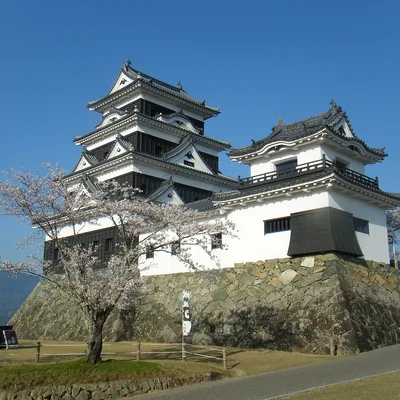
Perched on an 88-metre bluff above the Kiso River in Inuyama, Aichi Prefecture, Inuyama Castle is a hirayama-style fortress whose National Treasure tenshu is widely cited as the oldest survivor among Japan's 12 pre-modern keeps, and was the only privately owned castle in Japan until 2004.
Best Season & Time
Honmaru cherry trees and Kiso-River bank rows bloom together, framing the white keep in pale pink
★★★★★
Kiso-River cormorant fishing runs nightly, with bonfires below and the keep illuminated above
★★★★☆
Honmaru maples turn red against the castle town's tiled roofs, with thinner crowds than at peak hanami
★★★★☆
Clear winter air reveals the distant Ontake and Ibuki ranges; fresh snow over the tenshu is a rare sight
★★★☆☆
Top 3 Highlights
1.National Treasure keep tower with open balcony
Three external storeys and four floors form a watchtower-style (boro) tenshu of 19 metres on an irimoya base. Inuyama is the only of Japan's five National Treasure keeps where visitors walk 360 degrees around the top-floor balcony, with views of the Kiso River and Nobi plain.
Frame the tower head-on from the honmaru approach path in morning light
2.The 'Hakuteijo' silhouette seen across the Kiso River
The byname Hakuteijo (White Emperor Castle) was coined by Edo scholar Ogyu Sorai, who likened the clifftop fortress to the namesake in Li Bai's poem. The view from the Gifu bank, where the tenshu floats above the river atop natural-faced stonework, brings the image to life.
Shoot from the Kakamigahara-Unuma bank with a telephoto, compressing keep and river
3.Clifftop fortress from a Kiso River pleasure boat
Viewed from a Kiso-gawa sightseeing or ukai cormorant boat, Inuyama reveals an angle invisible from land: the keep crowning a near-vertical 88-metre cliff. In the cormorant-fishing season (June to October), boat bonfires illuminate the tenshu above for a scene unique in Japan.
Board near Inuyama-Yuen Station pier and shoot starboard as the route nears the bluff
Stories & Legends
Recommended For
Insider Tips
- 1.The top-floor balcony is open on all four sides and unusually low to the floor. Inuyama is the only National Treasure keep where visitors walk a full 360 degrees, but on windy days the railing sways visibly, so keep to the wall side if uneasy with heights.
- 2.The Kuromon-ato stone wall on the path up to the honmaru preserves natural-faced (nozurazumi) jointing from the pre-Edo phase, having survived the Meiji-era demolition that flattened most outbuildings. It lies right beside the climbing route from the town.
- 3.Honmachi Street's Donden-kan displays four of the wheeled floats (yama) used in the Inuyama Festival, five minutes on foot from the main gate. Visiting during the festival on the first Saturday and Sunday of April adds the live procession to the route.
Visit Information
- Access
- From Meitetsu Inuyama-Yuen Station it is about a 15-minute walk, or 20 minutes from Inuyama Station; both stations sit 25 minutes from Nagoya by Meitetsu limited express. By car, exit Chuo Expressway at Komaki-Higashi IC and drive 20 minutes to paid lots in the castle town.
- Time Required
- 1.5 to 2 hours for the keep and main bailey, or half a day with the castle town below.
- Budget Guide
- Admission around JPY 550 adults, JPY 110 elementary and junior-high students (2024 reference; verify on the official site). Combined tickets with the City and Castle Museum exist.
Nearby Attractions
Honmachi Street below preserves the Edo block plan; within walking distance are Donden-kan (displaying four Inuyama Festival floats), the City and Castle Museum, and the Karakuri Hall. Sanko Inari Shrine is 15 minutes on foot, and Meiji-mura, the open-air museum of early modern Japanese architecture, is one Meitetsu stop away.
Go Deeper
Deeper details for those with the time to read on.
Timeline
- 1469
Founding stronghold
During the Onin War, Oda Hirochika - younger brother of the Iwakura branch head Oda Toshihiro - is said to have raised a stronghold near the present site, traditionally counted as Inuyama's origin
- 1537
Move to present site
Oda Nobuyasu, younger brother of the Kiyosu magistrate Oda Nobuhide, abandoned the Kinoshita stronghold and built a fortress on the bluff above the Kiso River
- 1584
Komaki-Nagakute campaign
Ikeda Tsuneoki seized Inuyama by surprise and Toyotomi Hideyoshi made it his field headquarters, facing Tokugawa Ieyasu's Komaki Hill across the Kiso River as the western forward bastion
- 1600
Sekigahara stronghold
Inuyama served as a western-army base alongside Gifu and Takehana, but after Gifu fell most defenders defected to the east and Ishikawa Sadakiyo abandoned the keep to fight at Sekigahara
- 1617
Naruse clan takes over
Naruse Masanari, attendant elder of the Owari Tokugawa domain, was made castellan and added the karahafu bay window; nine generations of the family held Inuyama until Meiji
- 1871
Abolition of domains
With the abolition of feudal domains the castle was decommissioned, and every turret and gate except the tenshu was demolished
- 1891
Nobi earthquake damage
The Nobi earthquake struck the region and the south-east attached turret of the keep was destroyed, threatening the survival of the structure
- 1895
Return to the Naruse family
Aichi Prefecture transferred the castle without charge to former lord Naruse Masamitsu on condition of restoration, beginning a private-ownership chapter unique in Japan
- 1952
National Treasure designation
The keep was designated a National Treasure under the post-war Cultural Properties Protection Law, joining Himeji, Matsumoto, Hikone and Matsue among five National Treasure tenshu
- 1961-1965
Showa-era dismantling restoration
A full dismantling restoration was completed, during which the long-held tradition that the keep had been moved from Kanayama Castle in 1599 was disproved by the absence of structural evidence
- 2004
Transfer to foundation
Ownership passed from the Naruse family to the Inuyama-jo Hakutei Bunko foundation, ending the only case of a pre-modern Japanese keep held in private hands into the twenty-first century
- 2017
Lightning strike on shachi
A lightning strike on 12 July destroyed the upper shachi finial from body to tail; replacement ceramic finials were installed in February 2018
- 2018
National Historic Site
On 13 February the wider castle site was designated a National Historic Site, extending heritage protection from the keep alone to the surrounding fortifications
Detailed History
Inuyama Castle's origins are traced to 1469 when, during the Onin War, Oda Hirochika - brother of the Iwakura branch head Oda Toshihiro - raised a stronghold near the present site. Full-scale castle construction is dated to 1537, when Oda Nobuyasu abandoned his Kinoshita base and built a fortress on the bluff above the Kiso River. The lower two storeys of the present keep were long thought to date from this phase, but a 2019 dendrochronology study by Nagoya Institute of Technology researchers found that the principal pillars and beams come from timber felled in a tight 1585-1587 window, suggesting the four storeys may have been built as a unit in the late sixteenth century. In 1544 Nobuyasu fell at the Battle of Kanoguchi and his son Nobukiyo succeeded him; Nobukiyo broke with Oda Nobunaga in 1564 and fled to Kai, after which Ikeda Tsuneoki and Oda Nobufusa held the castle in turn. After the 1582 Honnoji Incident Nakagawa Sadanari took the castle under Oda Nobukatsu, but in 1584 Ikeda Tsuneoki seized Inuyama by surprise; Toyotomi Hideyoshi then made it his field headquarters, facing Tokugawa Ieyasu's Komaki Hill across the river. In 1596 Ishikawa Sadakiyo undertook a reconstruction that shaped today's enceinte. At the 1600 Battle of Sekigahara Inuyama formed part of the western coalition; once Gifu fell, most defenders defected to the east and Sadakiyo abandoned the keep to fight - and lose - at Sekigahara, though his earlier release of pro-Tokugawa Kiso allies later spared his life. In 1617 Naruse Masanari, attendant elder to the Owari Tokugawa domain, was made castellan and added the karahafu bay window; his clan held Inuyama for nine generations until Meiji. The 1871 abolition of domains brought demolition of every turret and gate except the tenshu, and the 1891 Nobi earthquake damaged the keep's southeastern turret. In 1895 Aichi Prefecture returned the castle to former lord Naruse Masamitsu on condition of restoration, an arrangement unique among Japanese castles. The keep was designated under the pre-war National Treasure Preservation Law in 1935, redesignated under the post-war Cultural Properties Protection Law in 1952, and in 2004 ownership passed from the Naruse family to the Inuyama-jo Hakutei Bunko foundation. The wider site became a National Historic Site in 2018.
Cultural Significance
Inuyama Castle's tenshu was designated a National Treasure under the post-war Cultural Properties Protection Law on 29 March 1952, joining Himeji, Matsumoto, Hikone and Matsue among the five National Treasure keeps. Within the dozen pre-Edo tenshu that survive, Inuyama is the leading candidate for the oldest, and it stands as a textbook watchtower-style (boro) tenshu - a watchtower placed atop a two-tiered residential base - that defines an early phase of Japanese castle architecture. The byname Hakuteijo (White Emperor Castle) was coined in the eighteenth century by Confucian scholar Ogyu Sorai, who saw in the bluff-top silhouette an echo of the White Emperor Castle on the upper Yangtze made famous by Li Bai's poem Early Departure from Baidi - a rare instance of a Japanese castle taking its literary identity from Chinese classical poetry. Inuyama was selected as castle No. 43 of the 100 Famous Japanese Castles in 2006, and on 13 February 2018 the wider site joined the national register of Historic Sites. The most distinctive thread in Inuyama's cultural biography is its ownership: from 1895 to 2004 it was held by the Naruse family in person, the only pre-modern keep in Japan to remain in private hands into the twenty-first century. Since 2004 the Inuyama-jo Hakutei Bunko, now a public-interest foundation, has managed the site.
Architectural Details
Inuyama Castle is a watchtower-style (boro) tenshu with three external storeys, four interior floors and a two-level basement. A two-tiered irimoya-roofed residential base supports a 3-by-4-bay watchtower, with single-storey attached turrets extending from the south and west faces to give the keep an L-shaped plan. Total floor area including the basement is 698.775 square metres and the tenshu rises 19 metres above its stone base, with the natural-faced (nozurazumi) tenshu-dai standing roughly 5 metres tall; counting the bluff itself, the top floor lies about 88 metres above the Kiso River. Floor allocations from the post-war designation are: first floor Nando-no-ma, 9 by 8 bays, 282.752 square metres for storage; second Bugu-no-ma, same plan, 246.006 square metres for arms; third Hafu-no-ma, 3 by 4 bays, 81.936 square metres, named for dormer gables; fourth Koran-no-ma, same plan, 49.835 square metres, named for the balcony that wraps it. Windows combine tsukiage shutters, katomado cusped openings and dual-leaf types; the top floor is encircled by an open mawari-en gallery, the feature for which Inuyama is uniquely recognised among the five National Treasure keeps. Karahafu bay windows were added in Naruse Masanari's 1617 occupancy. Roofs are hongawara tile; the shachi finials lost to a 2017 strike were rebuilt in ceramic and reinstalled in February 2018.