Maruoka Castle
丸岡城
坂井市 · JP
Hokuriku's only surviving keep — an archaic watchtower reborn after the 1948 earthquake
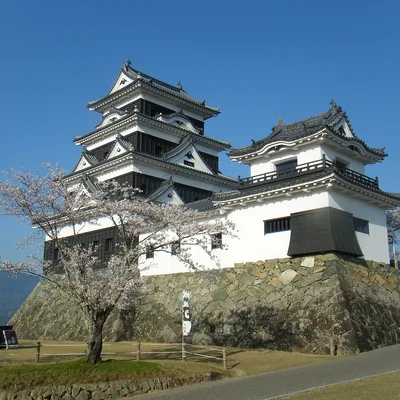
Crowning an isolated hill in Sakai, Fukui Prefecture, Maruoka Castle is one of Japan's twelve surviving original keeps, built in the early Edo Kan'ei era. Toppled by the 1948 Fukui earthquake and rebuilt in 1955 reusing 70 percent of the original pillars and 60 percent of the beams, it is also called Kasumi-ga-jo (Mist Castle).
Best Season & Time
400 cherry trees frame the archaic keep — peak season is the Cherry Festival, one of Japan's Top 100 sites
★★★★★
Fresh greens contrast beautifully with the stone-tile keep — visit at dawn for cooler air and quieter grounds
★★★☆☆
Autumn foliage and the Maruoka Old Castle Festival in October — quieter than spring, ideal for history walks
★★★★☆
A snow-dusted archaic keep is a quintessential Hokuriku scene — popular with cold-tolerant photographers
★★★☆☆
Top 3 Highlights
1.Archaic Watchtower-Style Two-Story Keep
A two-story, three-floor watchtower (boro-gata) keep crowned with a railed balcony on a great hip-gable roof, built in the Kan'ei era (1624-1644) and designated an Important Cultural Property. Stone roof tiles of local Shakudani stone preserve the Sengoku-period aesthetic.
Shoot from the southeast base of the stone platform, framing the stone tiles and watchtower together
2.Kasumi-ga-jo Park and the Top 100 Cherry Blossom Sites
Selected in 1990 as one of Japan's Top 100 Cherry Blossom Sites, Kasumi-ga-jo Park hosts about 400 cherry trees that bloom in early April for the Maruoka Castle Cherry Festival. The keep framed by clouds of pink blossoms echoes the legend of the mist-veiled Kasumi-ga-jo name.
Early April at dawn, frame the keep through the cherry blossoms from the former inner moat side
3.Steep Stairs with Climbing Rope
The keep's interior stairs slope at over 65 degrees from the floor, among the steepest of all twelve surviving keeps. A thick climbing rope is hung for visitors — a visceral taste of the defensive ingenuity of samurai-era architecture not replicable elsewhere.
Shoot vertically from the second floor down to the first to capture the rope and the steep descent
Stories & Legends
Recommended For
Insider Tips
- 1.The interior stairs slope at over 65 degrees from the floor, the steepest of Japan's twelve surviving keeps. Climbing while grasping the hanging rope offers a visceral feel for samurai-era defensive design unavailable at other castles.
- 2.The Ippitsu Keijo Chaya teahouse below the castle holds the Japan 100 Famous Castles stamp station, with a Shibata Katsuie statue for photos. The nearby Ippitsu Keijo Museum on Japan's shortest letter tradition is a fine paired visit.
- 3.During the April Cherry Festival the keep is illuminated for evening viewing, creating a dreamlike scene of archaic architecture wreathed in cherry mist. The former inner moat side offers quieter angles for photographers.
Visit Information
- Access
- About 20 minutes by Keifuku Bus routes 86 or 87 from Awara-Onsen Hokuriku Shinkansen Station to the Maruoka Castle stop. Around 2 km from the Maruoka IC (ETC only) on the Hokuriku Expressway. Three bus routes also run from Fukui Station.
- Time Required
- About 1.5 to 2 hours for the keep and park, half a day with the Ippitsu Keijo Museum.
- Budget Guide
- Adult admission JPY 450; elementary and junior high JPY 150 (combined with the Ippitsu Keijo Museum). (Prices as of 2024.)
Nearby Attractions
The Ippitsu Keijo Museum, dedicated to Japan's shortest letter contest tradition, is five minutes on foot. Eiheiji Temple, head temple of the Soto Zen school, is 30 minutes by car. Echizen Railway connects the castle area to Awara Onsen hot springs and the Tojinbo cliffs. Fukui Castle ruins in Fukui City pair as a 40-minute drive option.
Go Deeper
Deeper details for those with the time to read on.
Timeline
- 1576
Shibata Katsutoyo's Founding
Following Nobunaga's suppression of the Ikko-ikki, Katsuie's nephew Katsutoyo left Toyohara and built the castle on an isolated hill in the eastern Sakai plain.
- 1582
Katsutoyo's Transfer
After the Honno-ji Incident and the Kiyosu Conference, Katsutoyo was reassigned to Nagahama Castle in Omi and Yasui Iekiyo entered Maruoka.
- 1600
Post-Sekigahara Dispossession
Aoyama Munekatsu was dispossessed for siding with the Western Army at Sekigahara; Imamura Moritsugu, retainer of Yuki Hideyasu, took the castle with 26,000 koku.
- 1624
Maruoka Domain and Current Keep
Honda Narishige's Maruoka Domain split from Fukui at 43,000 koku, and the current keep is dated to this Kan'ei era construction phase.
- 1695
Maruoka Soudou and Arima Entry
An O-Ie Soudou under the fourth lord Honda Shigemasu led to Honda's dispossession; Arima Kiyosumi entered from Itoigawa in Echigo at 50,000 koku.
- 1871
Abolition of Domains
Maruoka Domain became Maruoka Prefecture and the castle a prefectural office; all structures except the keep were dismantled or relocated.
- 1901
Bought Back by Maruoka Town
The remaining keep was bought back by the town of Maruoka and the grounds were laid out as Kasumi-ga-jo Park.
- 1934
Prewar National Treasure
The keep was designated a National Treasure under the prewar National Treasure Preservation Law and brought under cultural property protection.
- 1948
Toppled by the Fukui Earthquake
The M7.1 Fukui earthquake on 28 June toppled the keep entirely, becoming a touchstone case for postwar cultural property recovery.
- 1950
Important Cultural Property
Under the new Cultural Properties Protection Law the toppled keep was redesignated as an Important Cultural Property.
- 1955
Reconstruction Completed
A full dismantling rebuild reusing about 70 percent of the original pillars and 60 percent of the beams was completed, and the archaic keep stood again.
- 1990
Top 100 Cherry Blossom Site
Kasumi-ga-jo Park was selected as one of Japan's Top 100 Cherry Blossom Sites, recognized for its 400 trees framing the keep.
- 2006
Top 100 Castles Designation
Selected as No. 36 on the Japan Top 100 Castles list, drawing castle enthusiasts from across the country.
- 2019
Construction Date Confirmed
The Maruoka Castle Investigation Committee announced that the current keep dates to the Kan'ei era (1624-1644).
- 2025
Castle Hill Master Plan
A 30-year master plan for the comprehensive restoration of the 13,000-square-meter Honmaru-Matsunomaru area was launched.
Detailed History
Maruoka Castle's history begins in 1576 (Tensho 4), the year after Oda Nobunaga suppressed the Ikko-ikki, when Shibata Katsutoyo, nephew of Shibata Katsuie, left Toyohara and built a fortress on an isolated hill in the eastern Sakai plain. In 1582, following Nobunaga's death at the Honno-ji Incident and the Kiyosu Conference, Katsutoyo was reassigned to Nagahama Castle and Yasui Iekiyo entered Maruoka. In 1583 Shibata Katsuie was destroyed by Toyotomi Hideyoshi at Kita-no-sho, and Echizen passed to Niwa Nagahide, who installed Aoyama Munekatsu as castellan. In 1585 Nagahide died and his successor Niwa Nagashige had his domain confiscated; Aoyama then became an independent lord with 20,000 koku. In 1600, having sided with the Western Army at Sekigahara, the Aoyama were dispossessed. Echizen was awarded to Yuki Hideyasu, second son of Tokugawa Ieyasu, whose retainer Imamura Moritsugu received Maruoka with 26,000 koku. Imamura fell in the 1612 Echizen Disturbance. The bakufu then attached Honda Narishige to Fukui Domain at 43,000 koku, and in 1624 Maruoka Domain became independent at 46,300 koku. The 2019 Investigation Committee dated the current keep to the Kan'ei era (1624-1644). In 1695 an O-Ie Soudou under the fourth lord Honda Shigemasu led to Honda's dispossession, and Arima Kiyosumi entered from Itoigawa at 50,000 koku. The Arima ruled Maruoka for six generations until the Meiji restoration. The 1871 abolition of domains turned Maruoka Domain into a prefecture and the castle into an office; subsequent abolition laws saw every structure except the keep dismantled or relocated. In 1901 the keep was bought back by the town of Maruoka and the grounds became a park. The keep was designated a National Treasure under prewar law on 30 January 1934, but the 28 June 1948 Fukui earthquake (M7.1) toppled it. Under the 1950 Cultural Properties Protection Law it was redesignated an Important Cultural Property, and in 1955 a full reconstruction reusing 70 percent of the original pillars and about 60 percent of the original beams was completed. Kasumi-ga-jo Park joined Japan's Top 100 Cherry Blossom Sites in 1990, and the castle joined the Top 100 Castles list (No. 36) on 6 April 2006. Sakai City has run a National Treasure designation campaign since 2013, and in 2025 a 30-year master plan for the castle hill restoration was launched.
Cultural Significance
Maruoka Castle is one of Japan's twelve surviving original Edo-period keeps and the only such keep in the Hokuriku region, giving it exceptional rarity value. Its silhouette — a two-story, three-floor independent watchtower (boro-gata) keep with a railed balcony atop a great hip-gable roof — preserves the archaic Sengoku-period form, and for years it was the subject of a debate with Inuyama and Matsumoto over which held the oldest surviving keep. The 2019 Sakai City investigation concluded the current structure dates from Kan'ei 1 (1624), but the rarity of the archaic design is undiminished and the keep remains an Important Cultural Property. The alternative name Kasumi-ga-jo (Mist Castle) derives from a legend in which a giant serpent appeared in battle, breathing mist that hid the castle from attackers — a touch unique to Hokuriku castle lore. The 1948 earthquake collapse and 1955 rebuild reusing 70 percent of the original pillars and 60 percent of the original beams became an emblematic case of postwar cultural property recovery. Maruoka was selected as a Top 100 Cherry Blossom Site in 1990 and a Top 100 Castle in 2006, and Sakai City has pursued National Treasure designation since 2013. The castle is also known through a sister-castle agreement with Marksburg Castle in Germany, and Akira Kurosawa's Ran used Maruoka as the model for the burning Third Castle.
Architectural Details
Maruoka Castle is a hilltop (hirayama) castle on an isolated hill rising about 27 meters above the Sakai plain, originally surrounded by a pentagonal inner moat — long since filled in but the subject of a current restoration plan. The keep is an independent watchtower (boro-gata) form rising two stories and three floors, with the first floor built wider than the stone base so that an enclosing skirt-roof (koshi-yane) caps the platform. Originally the roof used shingled wooden tiles (kokera-buki) with a lacquered shachihoko inlaid with gold leaf, but it was later re-tiled with stone tiles of Shakudani stone, a greenish tuff quarried in Echizen. The 1941 repair and 1955 rebuild used Takigahara stone from Komatsu in Ishikawa. The stone tiles approach 120 tons in total, resistant to freeze-thaw damage critical in the snowy Hokuriku winter. After the 1948 collapse, the 1955 reconstruction reused 70 percent of the original pillars and about 60 percent of the original beams; the top floor windows were converted from sliding doors to hinged shutters (shitomido). Interior stairs slope at over 65 degrees, with a climbing rope hung for visitors. The stone walls are mostly uncoursed nozura-zumi, preserving the rough early-Sengoku style. Compared with the other surviving Edo keeps, Maruoka's archaic ornamentation stands out as a uniquely valuable example.