Oshi Castle
忍城
行田市 · JP
The Floating Castle that defied Ishida Mitsunari's siege and survived the great Sengoku flood
Built by the Narita clan on swampland in Gyoda, Saitama Prefecture, Oshi Castle held off Toyotomi Hideyoshi's 23,000-strong army in the famed 1590 siege — earning the nickname 'Floating Castle'. Today its reconstructed three-story tower and surviving Ishida Levee evoke the great water siege.
Best Season & Time
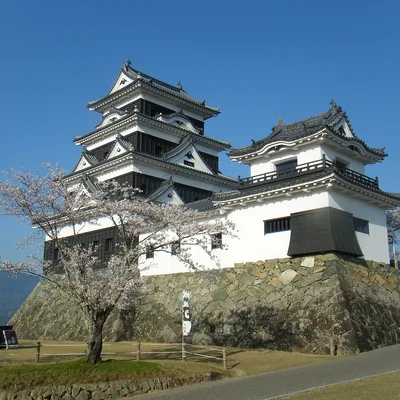
Cherry blossoms frame the reconstructed tower — busiest week of the year for local hanami
★★★★★
Lotus and water lilies bloom in Suijo Park; evening waterside is pleasant — go early to stay cool
★★★☆☆
The Oshi Period Festival on the second Sunday brings samurai processions and matchlock firing
★★★★★
Clear skies and high sunny-day rate make this ideal for photography — far fewer visitors than spring
★★★☆☆
Top 3 Highlights
1.Reconstructed Three-Story Tower on the Main Bailey
Rebuilt in 1988 in reinforced concrete, the san-gai yagura's white plaster walls and dark board cladding capture the elegant aesthetic of the lost original. The tower houses the Gyoda History Museum, and its top floor commands a sweeping view over the Kanto Plain.
Head-on from the main bailey square; cherry blossoms in early April frame it best
2.Mitsunari's HQ at Maruhakayama and the Levee Site
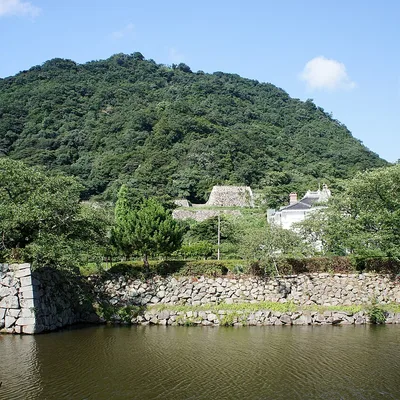
Ishida Mitsunari commanded the 1590 water siege from atop Maruhakayama, the largest round burial mound in the Sakitama group, which still affords a clear view toward Oshi. Nearby a fragment of the 28-kilometer Ishida Levee survives with an interpretive panel.
From the Maruhakayama summit shoot north-east toward the castle; early summer is best
3.Suijo Park — Surviving Waters of the Floating Castle
South of the castle, Suijo Park preserves part of the vast marshland that once surrounded Oshi. Its wetlands and water moats convey the origin of the 'Floating Castle' nickname; today the park is a quiet retreat for local anglers and walkers.
Shoot the late-afternoon backlight to silhouette trees on water for the old marsh mood
Stories & Legends
Recommended For
Insider Tips
- 1.The reconstructed three-story tower differs from the original in both position and scale — it sits on the museum site, not the historic keep. Compare the 'Oshi-jo bird's-eye view' inside the museum with the on-site layout to grasp the original castle.
- 2.JR Gyoda and Chichibu Railway Gyoda-shi are two different stations, more than 2 kilometers apart — easy to confuse. The fastest route is a 15-minute walk from Gyoda-shi Station; from JR Gyoda you must catch the city circular bus.
- 3.Oshi Castle and the Sakitama Tumuli — including Maruhakayama and Inariyama kofun — lie within a 30-minute walk and make an ideal half-day pairing. The summit of Maruhakayama, Mitsunari's command post, is the must-see distant view of Oshi.
Visit Information
- Access
- A 15-minute walk from Chichibu Railway's Gyoda-shi Station, or about 10 minutes by Asahi Bus from JR Takasaki Line Fukiage Station to the 'Oshi-jo' stop and a 5-minute walk. From Tokyo Station the JR Takasaki Line reaches Gyoda in about 90 minutes.
- Time Required
- About 90 minutes for tower and museum, or half a day with the Sakitama Tumuli.
- Budget Guide
- Combined admission to the museum and three-story tower is JPY 200 for adults, JPY 100 for students. (2024; check the official site.)
Nearby Attractions
The Sakitama Tumuli, a 20-minute walk away, is a national Special Historic Site of nine burial mounds — including Maruhakayama, Mitsunari's siege HQ in 1590. The Tabi Warehouse Museum is a 10-minute drive, and the Chichibu Railway extends to Nagatoro Gorge for an easy add-on.
Go Deeper
Deeper details for those with the time to read on.
Timeline
- Around 1478
Narita Founding
Narita Masakuni and his son Akiyasu overthrow the Oshi clan, vassals of the Ogigayatsu Uesugi, and build a fortress on the marshlands of Gyoda.
- 1479
Peace with Uesugi
Uesugi forces attack the new castle but a settlement is brokered by chief minister Ota Dokan, leaving Narita rule intact.
- 1574
Uesugi Kenshin's Siege
Uesugi Kenshin besieges the castle on a Kanto campaign and burns its town, but the marshland fortress refuses to fall.
- 1590
Siege of Oshi (Water Attack)
Ishida Mitsunari's 23,000 men attempt the famous water siege; the castle does not sink and surrenders only after Odawara falls, earning the 'Floating Castle' nickname.
- 1590
Matsudaira Tadayoshi Installed
After Tokugawa Ieyasu's transfer to the Kanto, his fourth son Matsudaira Tadayoshi takes the castle as seat of the 100,000-koku Oshi Domain.
- 1639
Abe Tadaaki's Expansion
Senior counselor Abe Tadaaki enters Oshi and begins the major Edo-era expansion that adds the three-story tower and a new layout.
- 1702
Layout Completed
By the Genroku 15th year the Abe complete the final castle layout and town planning of Oshi as a mature early-modern fortress and post town.
- 1871
Han Abolition, Oshi Prefecture
With the Meiji abolition of feudal domains the prefectural office of newly created Oshi Prefecture briefly occupies the second bailey before merging into Saitama.
- 1873
Decommissioning
Oshi Castle is decommissioned and most structures dismantled, leaving only part of the main bailey embankment.
- 1988
Museum and Tower Reconstruction
The Gyoda City Local History Museum opens on the main bailey site, with the three-story tower rebuilt in reinforced concrete as its centerpiece.
- 2012
Film 'Nobou no Shiro' Released
Wada Ryo's novel is adapted for cinema, dramatizing the 1590 water siege and giving Oshi Castle nationwide name recognition.
- 2017
Continuation 100 Castles and Heritage
Selected as Continuation 100 Famous Japanese Castles number 118 and added as a component of the Japan Heritage 'Tabi Warehouses of Gyoda' story.
Detailed History
Oshi Castle was completed around 1479 by Narita Akiyasu, who with his father Masakuni had overthrown the Oshi family, vassals of the Ogigayatsu Uesugi, and raised a fortress on marshland between the Tone and Ara rivers. The following year the Uesugi attacked, but chief minister Ota Dokan brokered peace and the Narita kept the area. Allegiances shifted as the Hojo grew dominant in the Kanto. In 1559 Uesugi Kenshin arrived from Echigo and the Narita briefly submitted; in 1561 lord Narita Nagayasu joined Kenshin's siege of Odawara, but defected after Kenshin's inauguration as Kanto Kanrei. In 1574 Kenshin himself besieged Oshi and burned its town, yet the marshland fortress would not fall. The legendary battle came in 1590, when Hideyoshi began his Kanto pacification. Lord Narita Ujinaga had moved to Odawara to fight under the Hojo banner, leaving uncle Suesue with about 619 samurai and 2,000 local conscripts. The Toyotomi force numbered 23,000 under Ishida Mitsunari, with Otani Yoshitsugu, Natsuka Masaie, and Sanada Masayuki at his side. Mitsunari set his HQ atop Maruhakayama Kofun and built a 28-kilometer dike — the Ishida Levee — to flood the castle from the Tone River. The castle refused to sink, and only when Odawara itself surrendered did the defenders capitulate, giving Oshi its lasting nickname, the 'Floating Castle'. After Tokugawa Ieyasu's transfer to the Kanto, his fourth son Matsudaira Tadayoshi took the castle, which became the seat of the 100,000-koku Oshi Domain. In 1639 senior counselor Abe Tadaaki entered and began a major expansion that produced the three-story tower and the final layout completed by 1702. The Abe were transferred to Shirakawa in 1823, and Matsudaira Tadataka of the Okudaira-Matsudaira line came from Kuwana. The Meiji abolition of feudal domains in 1871 briefly installed Oshi Prefecture's office in the second bailey, but the castle was decommissioned in 1873 and most structures dismantled. The site became Narita Park, then Oshi Park, and in 1949 a city baseball ground occupied the main bailey. After the ground relocated, the Gyoda City Local History Museum opened there on 17 February 1988, with the three-story tower rebuilt in reinforced concrete as its centerpiece. In 2017 Oshi joined the Continuation 100 Famous Japanese Castles as number 118, and on 28 April became part of Japan Heritage 'The City of Tabi Warehouses — Gyoda'.
Cultural Significance
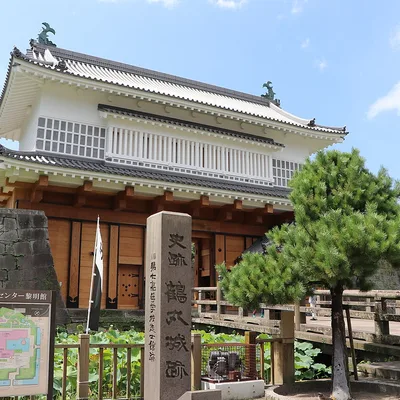
Oshi Castle is counted among the seven famous strongholds of the Kanto and is the only Hojo-allied castle to have withstood Hideyoshi's force to the end. The names 'Floating Castle' (Uki-jo) and 'Turtle Castle' (Kame-jo) derive from its wetland setting and its legendary refusal to sink. Through the Edo period the castle was the seat of fudai and shinpan daimyo, and under four generations of the Abe family the castle town flourished as a back-route stage of the Nakasendo and a Tone River logistics hub. From the late Edo era Gyoda established itself as a center of tabi-sock production, an industry that continued into modern times and led to the 2017 Japan Heritage inscription of 'The City of Tabi Warehouses — Gyoda', of which the castle is a component. Wada Ryo's bestselling novel Nobou no Shiro and its 2012 film adaptation starring Nomura Mansai dramatized the water siege and brought Oshi to a national audience far beyond Sengoku enthusiasts. The castle ruins are a Saitama Prefectural Historic Site, with earthworks of the main bailey embankment still in place. The Kitaya-mon gate was relocated to Soganji temple in Kazo, and the gate of the domain school Shinshukan stands south of the museum. Every November the Oshi Castle Period Festival, on the second Sunday, recreates the era with a samurai procession and matchlock firing in the castle moat.
Architectural Details
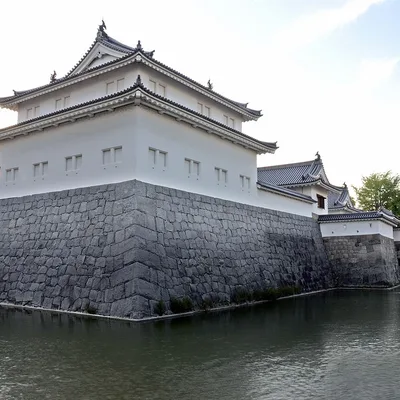
Oshi was a flat castle that exploited its marshland setting to the fullest. The local terrain was originally a vast swamp dotted with islands of dry ground formed by natural levees, and the castle's builders left the swamp in place — turning each island into a bailey linked to the next by bridges. The earliest layout dispensed with a keep entirely, leaving the main bailey as open ground while the lord lived in the second bailey, producing a fortress that was 'hard to attack and easy to defend'. The Edo-period senior counselor Abe Tadaaki carried out the great expansion, organizing the main, second, third, and Suwa baileys into a coherent layout girded by water moats, and built the three-story tower as the castle's symbol. Equivalent to a keep, the original tower rose three stories with white shikkui lime plaster walls contrasting against the dark board cladding of its base — a hallmark of the Edo-castle aesthetic. The current tower, rebuilt in 1988, is a reinforced-concrete exterior reconstruction set in a different position and scale from the historic original, though its design follows the 'Oshi-jo bird's-eye view' and other sources. The castle town's defenses ingeniously used the surrounding swamp and waterways in place of conventional moats, and the original marshland survives in part as Suijo Park to the south.