Hagi Castle
萩城
萩市 · JP
260 years of the Mori clan — stone walls and moats hold the memory of Meiji Japan
At the foot of Mount Shigetsu in Hagi, Yamaguchi, Hagi Castle was built in 1604 by Mori Terumoto after Sekigahara and served as Choshu Domain's seat for 250 years. Demolished in 1874, its stonework was inscribed by UNESCO in 2015 as Meiji Industrial Revolution heritage.
Best Season & Time
Six hundred cherry trees in Shizuki Park frame stone walls and moat at Hagi Castle Town Festival peak
★★★★★
Wisteria on the honmaru and sea breezes make summer weekday strolls comfortable
★★★☆☆
Autumn leaves on Mount Shigetsu contrast with the stonework, ideal for castle-town walks
★★★★☆
Snow on the inner moat creates a still mirror of the walls and keep base — a photographer's prize
★★★☆☆
Top 3 Highlights
1.Tenshu Foundation and Inner Moat
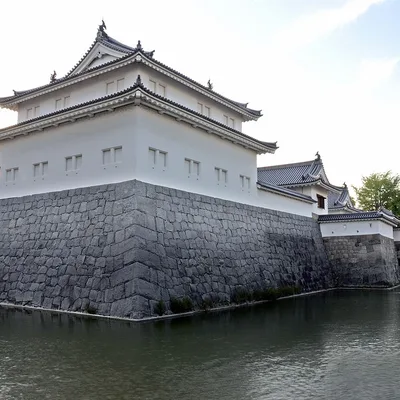
The five-story whitewashed keep vanished in 1874, but its imposing eleven-meter stone base with the outward-flaring 'fan slope' curve and the water-filled inner moat remain. The gentle widening to a steep rise shows how Keicho-era engineers spread load across soft delta ground.
From Gokuraku Bridge at the honmaru entrance, frame the keep base across the inner moat head-on
2.Old Photograph of the Lost Hagi Castle Keep
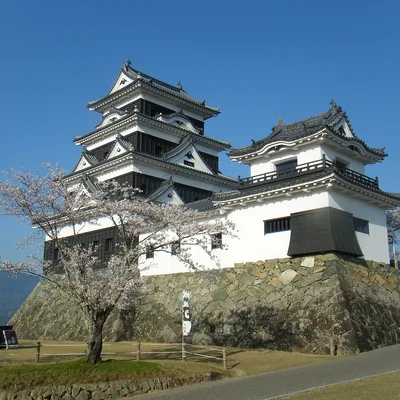
A photograph taken before the 1874 demolition preserves the lost five-story, twenty-one-meter keep with its red-tiled roof — a downsized Hiroshima Castle. Locals later refused to undo the loss, calling the absence itself the truest monument of the Meiji Restoration.
Visit the on-site exhibit panel, where a full-size reproduction is available for indoor photography
3.Honmaru Earthworks and Stone Walls
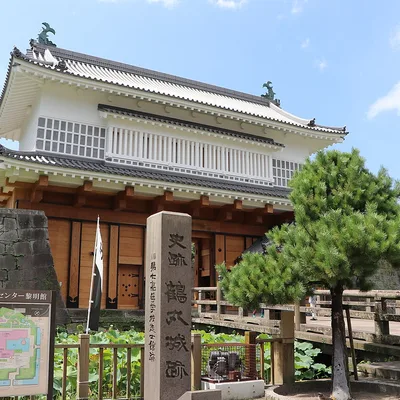
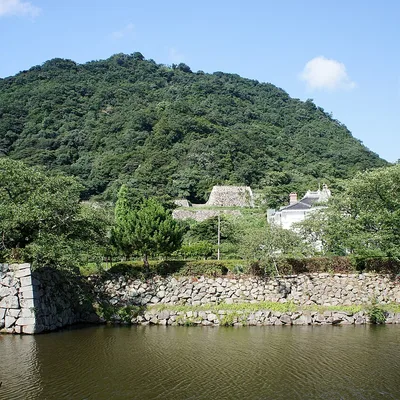
At the foot of Mount Shigetsu, honmaru ruins reveal Edo stone walls layered with Showa-restored earthworks. With the Ninomaru wall rebuilt in 1965 and Kita-no-somon gate in 2004, visitors read samurai military thinking in three dimensions.
Shoot the southwest corner of the honmaru wall in morning side-light with Mount Shigetsu behind
Stories & Legends
Recommended For
Insider Tips
- 1.The tsumenomaru ruins at the summit of Mount Shigetsu are reached via a thirty-minute trail from the honmaru and reward visitors with hilltop stone walls and sweeping views of the Sea of Japan and Hagi city. Bring sturdy shoes and water for the steep climb.
- 2.The Asa Mori family longhouse, an Important Cultural Property near the ninomaru entrance, is one of the largest surviving Edo-period longhouses in western Japan at fifty-one meters. The castle ticket includes entry, and most visitors miss it entirely.
- 3.Some years the castle hosts a special night illumination during the Hagi Bakumatsu Restoration Festival in June. The mirror-still inner moat reflects walls and keep base in a way you cannot see during daytime visits, so check the official schedule first.
Visit Information
- Access
- From JR Higashi-Hagi Station, take the city bus seven minutes to 'Hagi Castle Ruins / Shizuki Park Entrance' then walk five minutes. From Shin-Yamaguchi Shinkansen station, the Hagi-Meirin bus takes about 75 minutes.
- Time Required
- Plan 1.5 hours for the honmaru and Shizuki Park, or half a day to include the summit hike.
- Budget Guide
- Admission JPY 220 adults, JPY 100 children. Castle Town combination ticket JPY 800. (As of 2024 — confirm on the official site.)
Nearby Attractions
The sannomaru samurai district, a Preservation District, lies within walking distance and holds the former homes of Kido Takayoshi and Takasugi Shinsaku. Shoin Shrine and Shokason-juku, both World Heritage components, are ten minutes away by car, and the restored Meirin Gakusha former domain school sits about twenty minutes from the castle.
Go Deeper
Deeper details for those with the time to read on.
Timeline
- 1600
Sekigahara and Mori Demotion
Defeated as nominal commander of the Western Army at Sekigahara, Mori Terumoto loses most of his domain and is reduced from 1.2 million to roughly 298,000 koku across Suo and Nagato.
- 1604
Construction Begins
On shogunate orders, Terumoto begins reclaiming the delta at the foot of Mount Shigetsu, moving in by November even though only part of the honmaru palace was complete.
- 1605
Gorota-ishi Incident
A bitter dispute over construction stone breaks out among senior retainers, leading to punishments and exposing tensions inside the new Mori headquarters.
- 1608
Castle Completed
After four years the castle is completed, with the tsumenomaru citadel on Mount Shigetsu's summit forming a defensive backbone that still reflected wartime thinking.
- 1613
Choshu Domain Confirmed
The shogunate officially recognizes Choshu at a face value of 369,000 koku, a figure that would remain unchanged through later branch-domain divisions.
- 1768
Meiwa Keep Repairs
An overhaul during the Meiwa era replaces the keep's roof tiles with a red glaze, altering the elegant Momoyama-style silhouette the castle had carried since 1608.
- 1863
Move to Yamaguchi
Fearing foreign naval bombardment, lord Mori Takachika moves the domain government to Yamaguchi Castle without shogunate permission, ending Hagi Castle's role as administrative seat.
- 1874
Demolition Order
Among the very first sites affected by the Meiji government's castle abolition decree, Hagi's keep, turrets and most buildings are demolished, leaving only stone walls and moats.
- 1951
National Historic Site
The ruins are designated a National Historic Site under Japan's postwar Cultural Properties Protection Law, securing long-term preservation of the surviving stonework.
- 1967
Castle Town Designated
Hagi Castle Town is added to the designation, and the sannomaru samurai district becomes an Important Preservation District for Groups of Traditional Buildings.
- 1971
Mount Shigetsu Designated
All of Mount Shigetsu is declared a National Natural Monument, integrating the summit tsumenomaru ruins with the protected natural environment of the headland.
- 1996-2011
Outer Moat Conservation
A fifteen-year conservation project restores moats and stone walls and reconstructs the Kita-no-somon gate in 2004 as part of a sustained Heisei-era preservation effort.
- 2006
Top 100 Castle Selection
The Japan Castle Foundation selects Hagi as the 75th of Japan's Top 100 Castles, raising the site's profile within national castle tourism and study.
- July 2015
UNESCO Inscription
Hagi Castle is inscribed as a component of the UNESCO World Heritage 'Sites of Japan's Meiji Industrial Revolution: Iron and Steel, Shipbuilding and Coal Mining'.
Detailed History
Hagi Castle's history begins with the 1600 Battle of Sekigahara. Mori Terumoto, the nominal commander of the Western Army, had ruled Aki and seven other provinces totaling 1.2 million koku. After defeat he was forced into retirement, ordered to transfer his headship to his young heir Hidenari, and his domain was cut to just Suo and Nagato at 298,000 koku. In 1603 Terumoto, acting as regent, petitioned the shogunate to build a new headquarters at Hagi, Yamaguchi or Mitajiri. The shogunate selected Hagi as a 'coastal, defensible site', though the conventional reading is that the Tokugawa wanted to push the powerful tozama Mori clan into a remote corner of San'in. Construction began in 1604 on reclaimed tidal flats at the foot of Mount Shigetsu, and Terumoto moved in by November despite only part of the honmaru palace being complete. In 1605 a violent dispute over construction stone — the Gorota-ishi Incident — broke out among senior retainers. The castle was completed in 1608, with the tsumenomaru citadel on Mount Shigetsu reflecting lingering wartime thinking. In 1613 the shogunate officially recognized Choshu Domain at a face value of 369,000 koku, unchanged through later branch-domain divisions. The castle served as Choshu's seat for over 250 years until 1863, when lord Mori Takachika moved the government to Yamaguchi Castle without shogunate permission, fearing foreign naval bombardment after the Shimonoseki incident. After the Meiji Restoration, in 1874 the new government's castle abolition order led to the demolition of keep, turrets, and most major structures, with Hagi among the very first sites destroyed. Locals later rejected a 1932 proposal to rebuild the keep, arguing the demolition itself represented the symbolic break from feudalism that the Meiji Restoration had achieved. The ruins became a National Historic Site in 1951, Hagi Castle Town was added in 1967, and Mount Shigetsu was declared a National Natural Monument in 1971. A fifteen-year project from 1996 to 2011 restored moats, stone walls, and reconstructed the Kita-no-somon gate in 2004. Hagi was selected as one of Japan's Top 100 Castles in 2006, and on July 5, 2015 it was inscribed as a component of the UNESCO World Heritage 'Sites of Japan's Meiji Industrial Revolution: Iron and Steel, Shipbuilding and Coal Mining'.
Cultural Significance
Hagi Castle occupies a singular place in Japanese castle history as a site whose meaning derives precisely from its demolition. The 1874 abolition order was carried out at Hagi earlier than at almost any other major castle, and a 1932 proposal to rebuild the keep was rejected by local citizens on the grounds that 'we were the first to dismantle our keep — the remaining stone walls themselves are the true monument of the Meiji Restoration'. This stance marks a turning point in Japanese attitudes toward heritage and reconstruction. The site became a National Historic Site in 1951, was expanded with the castle town in 1967, and Mount Shigetsu was made a National Natural Monument in 1971. The Asa Mori longhouse is an Important Cultural Property, and the sannomaru samurai district is a Preservation District for Groups of Traditional Buildings, offering a layered view of samurai society. The 2015 UNESCO inscription placed Hagi within the international narrative of non-Western industrialization that made Meiji Japan the fastest-modernizing society outside the West. Hagi's spiritual weight also rests on its role as home to Yoshida Shoin and the Shokason-juku school, which trained Takasugi Shinsaku, Ito Hirobumi and Yamagata Aritomo.
Architectural Details
Hagi Castle combined a hilltop citadel — the tsumenomaru on the 150-meter summit of Mount Shigetsu — with a hillfoot complex of honmaru, ninomaru and sannomaru arranged in a stepped 'teikaku-shiki' configuration ringed by three moats. Because the summit citadel itself contained an inner honmaru and ninomaru independent of the lower complex, the layout has been variously called a hilltop-plus-flatland castle or, given its peninsular position, a 'sea castle'. The lower honmaru measured roughly 200 by 145 meters, with the keep at the southwest corner and turrets at the southeast and northeast. The five-story keep was a complex bogyo-style structure roughly 21 meters tall: a two-story hip-and-gable base supporting a three-story watch turret with a tsukeyagura adjunct on the north. Outer walls were finished in white plaster, windows were copper-clad lift shutters, and a 1768 restoration replaced the roof tiles with a distinctive red glaze. The stone platform itself, six ken or about 11 meters high, presents the celebrated 'ogi no kobai' fan slope that flares outward at the base and steepens upward to spread the load across soft delta ground. The ninomaru held twelve turrets, 34 wells, administrative offices, two temples and the strolling garden Toen.