Kinkaku-ji Temple
鹿苑寺
北区 · JP
A golden pavilion mirrored on a pond — Muromachi Zen culture distilled in one icon
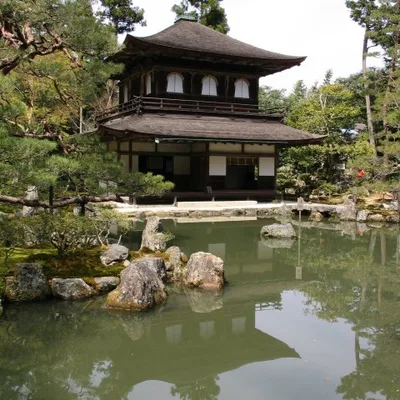
In Kyoto's northern hills stands Rokuon-ji, the Rinzai Zen temple founded in 1397 on shogun Ashikaga Yoshimitsu's Kitayama villa estate. Its gold-leafed reliquary hall, the Kinkaku, mirrored in Kyokochi Pond, is one of the most photographed images of Japan.
Best Season & Time
Fresh greens on the pines against the gold pavilion — not a cherry site but visitor numbers peak
★★★★☆
Deep emerald pines set off the gold leaf brilliantly — visit just after the 9:00 opening for cool air
★★★☆☆
The maples along Kyokochi Pond turn crimson against the gold — one of Kyoto's finest autumn views
★★★★★
The snow-dusted Kinkaku is a vision of just a few days — photographers queue before opening
★★★★★
Top 3 Highlights
1.The Water Mirror of Kinkaku on Kyokochi Pond
The Kinkaku is a three-story pavilion with about 20 kg of pure gold leaf coating its upper two floors. When Kyokochi Pond falls still at dawn, an inverted golden silhouette appears on the water — the single most iconic view of Muromachi-period Japan.
Aim for the first front viewpoint along the route in still air just after the 9:00 opening
2.Snow-Dusted Kinkaku — A Few-Days Winter Vision
Heavy snow falls on central Kyoto only two or three days a winter, and the gold pavilion under white snow is praised as the year's most beautiful sight. Snow, gold, and dark pines embody the classical aesthetic of setsugekka — snow, moon, and flowers.
Arrive at the 9:00 opening on the morning after a snowfall and aim for the pond's edge front row
3.Rokuon-ji Garden — A Special Place of Scenic Beauty
The stroll-style pond garden centered on Kyokochi preserves Yoshimitsu's Kitayama villa landscape, doubly designated a Special Historic Site and Special Place of Scenic Beauty. Moss paths past Anmin-taku, Ryumon waterfall, and Sekka-tei model the Muromachi Zen garden.
Visit the Anmin-taku area on a soft afternoon after rain for vivid moss greens
Stories & Legends
Recommended For
Insider Tips
- 1.The first thirty minutes after the 9:00 opening offers the only window for a still water mirror with light crowds; from 11:00 onward, organized tour groups fill the pond-side front row, so the prime shot demands an early arrival as a rule.
- 2.The admission ticket issued at the reception is a rare washi-paper amulet stamped in red — a format unique to Rokuon-ji among major Kyoto temples. Many visitors keep theirs as a travel keepsake or personal charm rather than discarding it.
- 3.Behind the Fudo Hall near the Sekka-tei tea hut at the end of the route, a tea seating offers proper matcha and sweets with a view of the Kinkaku for around 500 yen — a quiet rest stop overlooked by most visitors yet open to all.
Visit Information
- Access
- About 40 minutes by Kyoto City Bus 101 or 205 from Kyoto Station to 'Kinkakuji-michi' stop, then a 5-minute walk. From Kitaoji subway station, take bus 101, 102, 204, or 205 for about 15 minutes. From Hankyu Karasuma a taxi takes about 20 minutes.
- Time Required
- About 60 minutes for the one-way garden route; allow half a day including nearby temples.
- Budget Guide
- Admission JPY 500 adult / JPY 300 student. City bus JPY 230 each way from Kyoto Station, or JPY 700 day pass for Ryoan-ji and Ninna-ji. (As of 2024; check the official site.)
Nearby Attractions
Twenty minutes on foot, the rock-garden temple Ryoan-ji is another World Heritage site and an essential pairing. One more bus stop west, Ninna-ji on Mount Omuro is likewise World Heritage — the three form the 'Kinukake-no-michi' (Path of the Silken Veil) circuit. Northward, Kitano Tenmangu, Daitoku-ji, and Ginkaku-ji are easy add-ons by bus.
Go Deeper
Deeper details for those with the time to read on.
Timeline
- c. 1220
Saionji Kintsune Acquires the Land
Around the second year of the Joukyu era, the courtier Saionji Kintsune exchanges his estate in Owari Province with the Hakuo royal house to acquire the Kitayama site.
- 1224
Kitayama-dai Villa Built
Kintsune builds the Saion-ji temple and the lavish Kitayama-dai mountain villa with formal gardens; his Saionji descendants hold the land for generations.
- 1397
Yoshimitsu Builds Kitayama-dono
Ashikaga Yoshimitsu trades estates in Kawachi for the Saionji property and rebuilds it as the Kitayama-dono, moving the seat of his political power to the villa.
- 1399
Kinkaku Reliquary Completed
The first three-story pavilion — direct prototype of today's Kinkaku — is completed and, with the Shokoku-ji seven-story pagoda finished the same year, symbolizes the Kitayama culture.
- 1420
Renamed Rokuon-ji
Following Yoshimitsu's will, his son Yoshimochi converts the villa into a Zen temple and renames it Rokuon-ji after Yoshimitsu's posthumous title Rokuon-in-dono.
- 1467-1477
Onin War Damage
The temple becomes the Western Army camp during the Onin War; most halls burn, but the Kinkaku itself miraculously survives the flames.
- 1649
Edo-Era Major Repair
Under Saisho Jotai's abbacy and Tokugawa patronage, principal halls are rebuilt and the Kinkaku receives a major Edo-period repair in Keian 2.
- 1929
Old National Treasure Designation
Under the new National Treasure Preservation Law, the Kinkaku is designated an (old) National Treasure and placed under formal cultural property protection.
- July 1950
Kinkaku-ji Arson Incident
A 21-year-old novice monk, Hayashi Yoken, sets fire to the pavilion; it burns entirely along with ten Buddhist images, later inspiring Yukio Mishima's novel.
- 1955
Kinkaku Rebuilt
Construction begins in 1952 and the dedication ceremony is held on 10 October 1955, restoring the pavilion to its founding-era form from prewar dismantling drawings.
- 1986-1987
Showa Restoration
The pavilion is re-leafed with roughly 20 kg of 0.5-micrometer gold leaf — the brilliance visitors see today dates from this restoration.
- December 1994
UNESCO World Heritage Inscription
Inscribed as one of the seventeen constituent properties of the UNESCO World Cultural Heritage Site 'Historic Monuments of Ancient Kyoto'.
Detailed History
Rokuon-ji's history reaches back to the Kamakura period. Around 1220 Saionji Kintsune acquired the site, and in 1224 he built the Saion-ji temple and the lavish Kitayama-dai villa here. The Saionji served the court as kanto-moshitsugi, intermediaries between the imperial court and the Kamakura bakufu, holding the land for generations. In 1335 the head of the house Saionji Kinmune was found plotting Emperor Go-Daigo's assassination and executed; the estate was confiscated and the villa decayed. In 1397, the third Ashikaga shogun Yoshimitsu traded estates in Kawachi for the Kitayama site and raised his new mountain villa, the Kitayama-dono. Though he had passed the shogunate to his son Yoshimochi in 1394, Yoshimitsu retained real power and ruled from this villa on a scale said to rival the imperial palace. The Kinkaku was completed around 1399, and with the Shokoku-ji seven-story pagoda finished the same year — at roughly 109 m the tallest Buddhist pagoda in Japanese history — formed the architectural emblem of Kitayama culture. After Yoshimitsu's death in 1408, Yoshimochi followed his father's will and in 1420 converted the villa into a Zen temple, naming it Rokuon-ji and making it a satellite of Shokoku-ji in the Rinzai school, with Muso Soseki nominally as founding abbot. During the Onin War (1467-77) the temple was the Western Army camp and most halls burned, but the Kinkaku escaped. In the Edo period Saisho Jotai was installed as abbot under Ieyasu, halls were rebuilt, and the Kinkaku received a major repair in 1649. The Meiji haibutsu kishaku stripped most of the land, but the twelfth abbot Kanshu Joichi began charging admission in 1894 to secure income. The pavilion was designated a Specially Protected Building in 1897 and elevated to old National Treasure in 1929. On the predawn of 2 July 1950, a 21-year-old monk Hayashi Yoken set fire to the Kinkaku, destroying it with ten Buddhist images. Hayashi survived a suicide attempt while his mother took her own life next day at Hozukyo Gorge — events that became Mishima's novel (1956). Reconstruction began 1952 and was dedicated on 10 October 1955 from the 1904-06 drawings. The 1986-87 Showa restoration re-leafed the pavilion, Sekka-tei was restored in 1997, and the Hojo in 2005-07. In December 1994 the temple was inscribed under the UNESCO World Heritage 'Historic Monuments of Ancient Kyoto'.
Cultural Significance
Rokuon-ji, popularly Kinkaku-ji, is one of the seventeen constituent properties of the UNESCO World Heritage Site 'Historic Monuments of Ancient Kyoto', inscribed in December 1994. Its gardens were designated Historic Site and Place of Scenic Beauty on 8 October 1925, and elevated to Special Historic Site and Special Place of Scenic Beauty on 19 July 1956. The garden preserves Kamakura-era Saionji landscape elements and is internationally regarded as a model Muromachi Zen pond garden. The popular name Kinkaku-ji comes from the reliquary's gold-leaf cladding, while the formal name Rokuon-ji (Hokuzan Rokuon Zen-ji) derives from the posthumous title of the founder Yoshimitsu. As the heart of Kitayama culture the villa served as Yoshimitsu's political seat, patron of Zeami and the rise of Noh and Kyogen, and a hub for Ming-trade — a cultural high point of the Muromachi bakufu. The 1950 arson left a deep mark on postwar Japanese letters: Mishima's 1956 novel has been translated into many languages as a classic of world literature. With Kawabata Ryushi's painting Kinkaku in Flames and Mizukami's two novels, the fire drew one of the largest artistic responses to a single postwar event. Today around four million visitors come each year, and with Ginkaku-ji the Silver Pavilion the two form the gold-and-silver pairing of Kyoto Zen-temple tourism.
Architectural Details
The reliquary hall Kinkaku is a three-story wooden tower facing south on Kyokochi Pond. Its roof is hokkei-zukuri (pyramidal) in kokera-buki cypress shingles topped by a bronze phoenix; with no eaves between the first and second floors, it is formally 'two-tiered, three-story'. The first floor is bare timber, while the second and third are sheathed in gold leaf on outer faces and railings; the third floor interior is also gilded except for the boards. The first two floors share a five-by-four plan; the third is a smaller three-by-three square. Each floor shows a distinct style: the first, Hosui-in ('Chamber of Dharma Waters'), is shinden-zukuri of Heian aristocracy; the second, Choon-do ('Tower of Sound Waves'), is buke-zukuri of the Kamakura warrior class; the third, Kukkyo-cho ('Cosmic Summit'), is karayo Zen-hall style — a rare integration of three traditions, considered a culmination of early Muromachi building. The Kukkyo-cho tablet was first by Emperor Go-Komatsu (today's is a copy). The 1955 rebuild used the 1904-06 drawings plus a surviving gold-leafed second-floor corner timber preserved as a vase — that fragment justified re-gilding the second floor, though Miyaue Shigetaka argues it was never originally gilded. The 1986-87 Showa restoration applied around 20 kg of 0.5-micrometer gold leaf, five times traditional thickness.