Karlštejn Castle
カルルシュテイン城
Karlštejn · CZ
The Gothic mountain stronghold Holy Roman Emperor Charles IV built to guard the Imperial Regalia
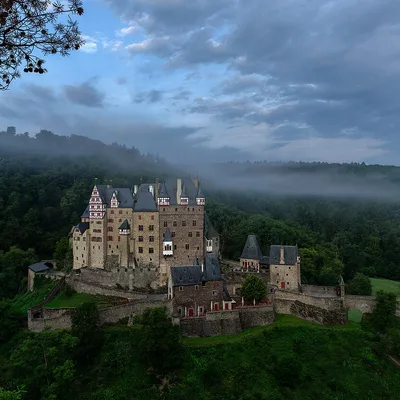
Rising on a forested hill 30 km southwest of Prague, Karlštejn Castle was founded in 1348 by Emperor Charles IV as the safehold for the Imperial Regalia, Bohemian Crown Jewels and holy relics — a three-terrace stronghold drawing 200,000 visitors a year.
Best Season & Time
Fresh green along the Berounka contrasts with the Gothic walls; the Holy Cross Chapel reopens for the year
★★★★★
Peak season — book months ahead; late-afternoon sun turns the Great Tower golden over the market town
★★★★☆
The Bohemian forests around the castle turn crimson and gold, replaying Charles IV's hunting landscape
★★★★★
Snow and morning fog wrap the Gothic towers in a fairy-tale haze; only the short tour route runs
★★★☆☆
Top 3 Highlights
1.Imperial Palace, Marian Tower, Great Tower
The castle climbs the promontory in three stepped terraces: Imperial Palace at the base, Marian Tower above it, and the 60-metre Great Tower crowning the summit. Each level codes a hierarchy — sovereign, Virgin, the relics of Christ — a layout almost unique in medieval Europe.
Shoot from across the Berounka river on the southeast slope for the three-tier silhouette
2.Chapel of the Holy Cross and 129 sacred panels
Consecrated in 1365 atop the Great Tower, the Chapel of the Holy Cross is sheathed in gold leaf, semiprecious stones and 129 panel paintings by Master Theodoric. It once held the Imperial Regalia themselves; the protected chapel admits only small guided groups.
Photography is restricted inside; shoot the gilded outer doorway during the guided tour
3.Josef Mocker's 1899 Neo-Gothic resurrection
The skyline today — pointed roofs, crenellations, soaring profile — is the result of an 1887-1899 Neo-Gothic rebuild led by architect Josef Mocker. Karlštejn is less a faithful medieval ruin than the late-Romantic dream of what a Bohemian castle should look like.
Compare a circa-1920 photograph with today's silhouette to read Mocker's reshaping
Stories & Legends
Recommended For
Insider Tips
- 1.The Chapel of the Holy Cross is reachable only via the pricier Route II, and English slots sell out months ahead. Book directly through the Czech National Heritage Institute portal up to 90 days ahead — third-party agencies cannot guarantee chapel access.
- 2.From Karlštejn station it is a 25-30 minute uphill walk to the gate. In high season horse-drawn carriages run from the village; an uphill carriage with downhill walk balances stamina with photo angles for about the price of a sit-down lunch in town.
- 3.Two free viewpoints across the valley — the Haštal hill and the Plešivec lookout — give panoramic shots of the entire castle rising from the woods. Local photographers climb before dawn for the morning fog when the towers seem to float above the mist.
Visit Information
- Access
- Direct S7 commuter trains from Prague Main Station (Praha hl.n.) reach Karlštejn in about 40 minutes, followed by a 25-30 minute uphill walk to the gate. By car, the D5 motorway brings you in roughly 30 minutes, with paid parking in the village below.
- Time Required
- Two hours inside the castle; plan on half a day including the village and viewpoints.
- Budget Guide
- Route I tickets are around 270 CZK; Route II with the Holy Cross Chapel about 520 CZK; return train fare roughly 120 CZK. (As of 2024 — confirm on the official site.)
Nearby Attractions
The village of Karlštejn beneath the castle preserves its medieval street plan, with restaurants and crafts shops along the climb. A 15-minute train ride reaches the Koněprusy limestone caves, while a 30-minute drive leads to Křivoklát Castle, another royal Bohemian stronghold worth pairing with the visit.
Go Deeper
Deeper details for those with the time to read on.
Timeline
- 1348
Founding
Holy Roman Emperor Charles IV orders construction of a stronghold above the Berounka river to house the Imperial Regalia, Bohemian Crown Jewels and his collection of relics
- 1352
Death of Matthias of Arras
Matthias of Arras, possibly consulted on the design, dies; Charles IV himself supervises the remaining seventeen years of work in person
- 1365
Holy Cross Chapel consecrated
The Chapel of the Holy Cross at the summit of the Great Tower is consecrated, completing the treasury's spiritual heart and the castle's symbolic apex
- 1421
Regalia evacuated
With the Hussite Wars erupting, the Imperial Regalia are evacuated from the castle and dispatched via Hungary to Nuremberg for safekeeping
- 1422
Hussite siege
Prince Sigismund Korybut catapults dead bodies and 2,000 carriage-loads of dung over the walls in an early biological-warfare experiment, but the castle holds
- after 1480
Late-Gothic remodelling
The castle is remodelled in late-Gothic style, followed in the final quarter of the 16th century by a campaign of Renaissance additions
- 1487
Great Tower fire
Fire damages the Great Tower and triggers further adaptations across the 16th century
- 1619
Jewels moved to Prague
During the Thirty Years' War the coronation jewels and the castle archive are evacuated to Prague; in 1620 the castle passes to Emperor Ferdinand II
- 1648
Swedish capture
Swedish troops storm and loot the castle near the close of the Thirty Years' War, after which Karlštejn slips into prolonged disrepair
- 1887-1899
Mocker restoration
Architect Josef Mocker leads a sweeping Neo-Gothic reconstruction that defines the soaring towers and crenellated profile visible today
- 1902
Private sale
The castle and estate are sold by the Austrian politician Ludwig von Oppenheimer to the industrialist Wilhelm von Medinger
- 1962
National Cultural Monument
Karlštejn is declared a Czech National Cultural Monument (Národní kulturní památka), the highest tier of heritage protection in the country
- 2019
Fifth most-visited castle
Karlštejn is recorded as the fifth most-visited castle in the Czech Republic, drawing more than 200,000 visitors annually
Detailed History
The history of Karlštejn Castle begins in 1348, when Charles IV — Holy Roman Emperor and King of Bohemia (reigning 1346-1378) — ordered the construction of a stronghold to safeguard the Imperial Regalia, the Bohemian Crown Jewels and an extensive collection of Christian relics. Construction was directed by Vitus of Bítov, who would later become burgrave of Karlštejn; Matthias of Arras, the architect of Prague's St Vitus Cathedral, may have advised on the design but died in 1352, leaving Charles IV to supervise the work in person for seventeen more years. In 1365 the Chapel of the Holy Cross at the summit of the Great Tower was consecrated, completing the spiritual heart of the imperial treasury. The outbreak of the Hussite Wars in 1421 prompted the evacuation of the Imperial Regalia, which were dispatched via Hungary to Nuremberg. In 1422 a Hussite force under Prince Sigismund Korybut besieged the castle and is recorded to have catapulted dead bodies — apparently not plague-infected — together with 2,000 carriage-loads of dung over the walls, an early documented instance of biological warfare, yet the fortress did not fall. The Bohemian Crown Jewels were later returned and kept here for almost two centuries. Karlštejn underwent successive remodellings: late-Gothic alterations after 1480, Renaissance additions in the last quarter of the 16th century, and reconstruction after a tower fire in 1487. During the Thirty Years' War the coronation jewels and the archive were evacuated to Prague in 1619, and in 1620 the castle passed to Emperor Ferdinand II. Swedish troops captured and looted it in 1648, after which the fortress slid into ruin. A sweeping Neo-Gothic restoration was carried out between 1887 and 1899 under architect Josef Mocker, giving the castle its present silhouette. In 1902 the castle and its estate were sold by the Austrian politician Ludwig von Oppenheimer to the industrialist Wilhelm von Medinger. After the Second World War the property was nationalised, and today it is managed by the Czech National Heritage Institute, drawing more than 200,000 visitors a year — by 2019 the fifth most visited castle in the country.
Cultural Significance
Karlštejn was the first castle ever designed as a permanent vault for the Imperial Regalia of the Holy Roman Empire, an architectural argument for sacred kingship rendered in stone. Its three stepped terraces — Imperial Palace, Marian Tower and Great Tower — translate a theological hierarchy into topography: temporal rule at the base, Marian devotion at the middle, the relics of Christ's Passion at the summit. The Chapel of the Holy Cross at the apex of the Great Tower remains one of medieval Europe's most extraordinary sacred interiors: walls clad in gold leaf and semiprecious stones, frame after frame of 129 panel paintings by Master Theodoric depicting a celestial army of saints. The chapel is protected by strict conservation rules and accessible only on the upper guided tour. In 1962 Karlštejn was inscribed as a Czech National Cultural Monument (Národní kulturní památka), the highest tier of heritage protection in the country, administered directly by the Czech National Heritage Institute. Josef Mocker's Neo-Gothic restoration aligned the castle with the Czech National Revival, recasting the half-ruined stronghold as the visible memory of a 'lost medieval kingdom' — a politically charged act of restoration as much as an architectural one. The castle remains one of the most photographed silhouettes in Central Europe.
Architectural Details
Karlštejn is laid out as a linked-keep mountain castle along a promontory descending south from Kněží Hora hill. A square, two-storey gatehouse capped by a tall hipped roof stands above the moat on the western slope, joined to the rampart traverse by a small portal. The second gate opens onto the Burgrave House courtyard, where a third gate, set into a two-metre-thick rampart, controls entry to the inner castle. The heart of Karlštejn unfolds on three differentiated terraces. The Imperial Palace occupies the lowest level: a single-tract building about 12.5 metres wide and 46 metres long, closed at the east by a semi-cylindrical tower. Beneath the rock-cut cellar sits a ground floor and two stone-built upper floors, with a half-timbered third storey under the roof. The central first-floor chamber is the Knight Hall, while the emperor's apartments occupy the second floor, split into four rooms by self-supporting partitions. The Marian Tower rises on the middle terrace, and at the summit the Great Tower (Velká věž) climbs to roughly 60 metres, its walls seven metres thick at the base — dual-purpose as defensive bastion and reliquary vault. Local limestone from the Berounka valley forms the principal masonry, while roofs and upper galleries combine timber and half-timber. Mocker's 1887-1899 campaign reinstated steep gables and soaring tower caps.