Edinburgh Castle
エディンバラ城
シティ・オブ・エディンバラ・カウンシル · GB
Edinburgh's volcanic crown - the Scottish royal fortress that survived 26 sieges
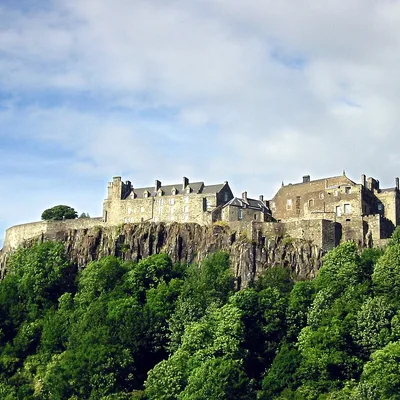
Perched on Castle Rock, a 350-million-year-old volcanic plug in the heart of Edinburgh, this Scottish stronghold has been royal residence, military garrison, and national symbol since the 11th century - and counts 26 sieges in its 1,100-year history.
Best Season & Time
Military Tattoo and Edinburgh Fringe turn the Old Town into festival, with castle floodlights at peak drama
★★★★★
Quieter shoulder season before the summer rush, with cherry blossoms in Princes Street Gardens framing cliffs
★★★★☆
Crowds thin after the festivals, and autumn colour in Holyrood Park pairs with a cool comfortable visit
★★★★☆
Christmas Market and Hogmanay fill the city, and a dusting of snow on basalt cliffs feels atmospheric
★★★☆☆
Top 3 Highlights
1.Castle Rock seen from the Grassmarket below
The basalt plug rises 130 metres above sea level with sheer cliffs on three sides, and the castle wall grows straight out of the rock. Looking up from the Grassmarket, you immediately see why the site has been fortified since the Iron Age.
Grassmarket or Victoria Street in late afternoon light, when sun rakes the cliff face
2.St Margaret's Chapel, the oldest building in Edinburgh
Built in the early 12th century by King David I and dedicated to his mother Saint Margaret of Scotland, this tiny Romanesque chapel is the oldest surviving building in the whole city. Its rounded chancel arch has witnessed 900 years.
Arrive at 9:30 am opening to photograph the chapel interior without crowds and morning light
3.The Royal Edinburgh Military Tattoo on the Esplanade
Each August during the Edinburgh International Festival, the Esplanade in front of the castle becomes an open-air theatre for massed pipes, drums, international bands, and fireworks - turning the floodlit castle wall into a three-week ceremonial backdrop.
Centre-rear grandstand seats frame the castle silhouette with the fireworks finale; bring wide lens
Stories & Legends
Recommended For
Insider Tips
- 1.The One O'Clock Gun fires from the ramparts every day except Sunday at 1:00 pm, a tradition begun in 1861 as a time signal for ships in the Firth of Forth. Soldiers appear about five minutes before; Princes Street Gardens is a quieter listening spot.
- 2.Military Tattoo tickets are sold separately from castle admission and routinely sell out months in advance. Buy the moment sales open in early January for August performances. Open-air back-row seats are cheaper, and staff hand out rain ponchos at night.
- 3.Standard castle admission is timed entry booked online. The earliest 9:30 am slot has the fewest coach groups, so you can usually walk straight into the Great Hall, Royal Palace, and Crown Room and see the Honours of Scotland with almost no queue.
Visit Information
- Access
- About 15 minutes on foot from Edinburgh Waverley railway station, walking uphill along the Royal Mile to the castle gates. From Edinburgh Airport, the tram reaches St Andrew Square in roughly 35 minutes, then a 15-minute walk to the entrance.
- Time Required
- Two and a half to three hours for the main precincts, or half a day with museums
- Budget Guide
- Standard admission was around GBP 21.50 in 2024; budget about GBP 30 with transport, or GBP 50-70 including a Royal Mile meal - confirm pricing on the official site
Nearby Attractions
From the castle gate the Royal Mile drops east through St Giles' Cathedral, the old Scottish Parliament, and John Knox House to Holyroodhouse, the monarch's Scottish residence. Beyond it lies Holyrood Park with Arthur's Seat, an extinct volcano offering panoramic city views. North stretches the Georgian New Town, part of the same World Heritage Site.
Go Deeper
Deeper details for those with the time to read on.
Timeline
- Early 12th century
St Margaret's Chapel built
King David I builds a small Romanesque chapel dedicated to his mother Saint Margaret of Scotland. It survives as the oldest building in the city of Edinburgh.
- 1296
English seizure under Edward I
During the First War of Scottish Independence, Edward I of England seizes the castle, opening a 1,100-year record researchers count as 26 sieges.
- 1314
Night assault retakes the rock
Thomas Randolph, Earl of Moray, leads a small Scottish detachment up the north cliff under cover of darkness and retakes the castle for Robert the Bruce.
- 1376
David's Tower built
King David II commissions a great residential keep, David's Tower, which dominates the east side of the rock until destroyed in 1573.
- 1511
Great Hall completed
James IV completes a late-Gothic banqueting hall used by the Scottish Parliament. Its hammerbeam timber roof survives as one of the finest in Scotland.
- 1566
Birth of James VI
Mary Queen of Scots gives birth to the future James VI in the Royal Palace; in 1603 he will inherit the English crown and unite the two kingdoms.
- 1571-1573
The Lang Siege
Supporters of Mary make the castle their last stand. Artillery brings down David's Tower, the garrison surrenders, and William Kirkcaldy of Grange is hanged.
- 1633
End of royal residence
Charles I is crowned at nearby Holyrood. After this date the castle's role as a royal residence ends and the site becomes a permanent military garrison.
- 1745
Jacobite siege resisted
During the rising led by Bonnie Prince Charlie, Jacobite forces lay siege but fail to take the castle. It is the last serious military action against the walls.
- 1818
Honours of Scotland rediscovered
Sir Walter Scott leads the search that finds the crown, sword, and sceptre forgotten in a locked chest. They go on public display, beginning the symbolic revival.
- 1927
Scottish National War Memorial
Sir Robert Lorimer's Scottish National War Memorial is inaugurated inside Crown Square, commemorating Scottish dead of the First World War.
- 1995
World Heritage inscription
The castle is inscribed as part of the Old and New Towns of Edinburgh UNESCO World Heritage Site, recognising its place in the city's urban evolution.
- 1996
Stone of Destiny returned
The coronation stone of the Scottish monarchs, taken to Westminster in 1296, is finally returned to Scotland and placed beside the Honours in the Crown Room.
Detailed History
Castle Rock has been occupied since at least the Iron Age, and the Welsh epic Y Gododdin from around 600 AD describes a stronghold called Din Eidyn on this site, suggesting an early Brittonic hillfort. The first documented royal use comes in the 11th century under King Malcolm III, whose queen Margaret died here in 1093. Their son David I built the small Romanesque chapel dedicated to his mother in the early 12th century; St Margaret's Chapel remains the oldest surviving building in the whole city of Edinburgh. The Wars of Scottish Independence dominate the 14th century. In 1296 Edward I of England seized the castle, and in 1314 a Scottish detachment under Thomas Randolph scaled the north cliff at night to retake it - after which Robert the Bruce ordered the defences slighted. The English rebuilt the castle in the Burnt Candlemas raid of 1356, and the rock changed hands repeatedly. In 1376 David II commissioned David's Tower, a large keep that dominated the rock for the next two centuries. The 15th and 16th centuries brought the castle's golden royal age. James IV completed the Great Hall in 1511, a late-Gothic timber-roofed chamber that hosted parliaments. On 19 June 1566 Mary Queen of Scots gave birth to the future James VI in the Royal Palace, the man who in 1603 would inherit the English crown and bind both kingdoms under one monarch. The Lang Siege of 1571-1573 ended this royal phase: artillery brought down David's Tower, the queen's garrison surrendered, and the Half Moon Battery was raised on the rubble. From 1633, when Charles I was crowned at Holyrood, the residential role faded and the castle became principally a military garrison, arsenal, treasury, mint, and state prison. The Jacobite rising of 1745 brought the last serious siege under Bonnie Prince Charlie, which the castle resisted. In the 19th century the romantic revival led by Sir Walter Scott turned the castle into a national symbol. The Honours of Scotland - crown, sword, and sceptre - were rediscovered in a locked chest in 1818, and the Scottish National War Memorial was inaugurated in 1927. In 1996 the Stone of Destiny, used to crown English kings at Westminster since 1296, was returned to Scotland and placed beside the Honours. Today the castle is managed by Historic Environment Scotland and remains a working military headquarters.
Cultural Significance
Edinburgh Castle is unique in the British Isles as a fortress continuously involved in national life for over a thousand years. It houses the Honours of Scotland - the crown, sword, and sceptre of the Kingdom of Scotland and the oldest set of royal regalia in the British Isles - together with the Stone of Destiny, on which Scottish monarchs were crowned for centuries and which only returned to Scotland in 1996 after seven hundred years in Westminster Abbey. The castle therefore functions as both an open-air history museum and a working repository of Scottish sovereignty. In 1995 the castle was inscribed by UNESCO as part of the Old and New Towns of Edinburgh World Heritage Site, recognising its place in the wider story of the Scottish capital's urban evolution. A 2014 research project counted 26 documented sieges in the castle's history, prompting the often-cited claim that this is the most besieged place in Great Britain. Culturally the castle is the backdrop to the Royal Edinburgh Military Tattoo, one of the largest annual military music festivals in the world, broadcast since 1950 and attended by over 200,000 visitors each August. Together with the daily One O'Clock Gun, these living rituals make Edinburgh Castle a rare example of a medieval fortress still in active ceremonial use.
Architectural Details
Edinburgh Castle is not a single-style building but a layered complex shaped by the volcanic geology of Castle Rock and by nine centuries of repair. The oldest fabric is St Margaret's Chapel from the early 12th century, a tiny Romanesque oratory with a rounded chancel arch and minimal carved decoration. James IV's Great Hall, completed in 1511, is a late-Gothic timber-roofed banqueting chamber with one of the finest surviving hammerbeam roofs in Scotland. The Royal Palace on the east side of Crown Square was developed through the 16th century and contains the small birth chamber of James VI and the Crown Room. The defensive architecture is dominated by the Half Moon Battery, a curving artillery platform built between 1573 and 1588 on the wreckage of David's Tower after the Lang Siege. Its curved face deflected incoming shot and let defenders sweep the eastern approach with cannon. Mons Meg, a six-tonne medieval bombard cast in 1449 and given to James II in 1457, sits on the northern terrace and could throw a 175-kilogram stone ball more than three kilometres. Sir Robert Lorimer's Scottish National War Memorial, completed in 1927, integrates Arts and Crafts stonework with stained glass by Douglas Strachan to create one of the most admired commemorative interiors of the inter-war period.