Itsukushima Shrine
厳島神社
廿日市市 · JP
The vermilion shrine that floats on the sea — the Seto Inland Sea's oldest UNESCO sanctuary
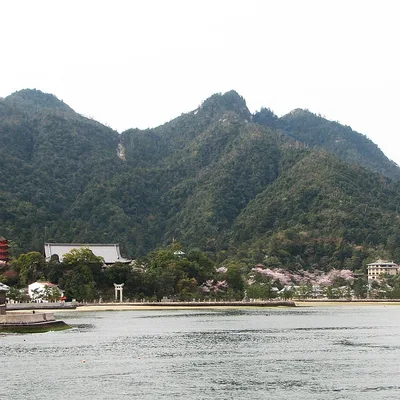
Cradled on the island of Miyajima in Hatsukaichi, Hiroshima Prefecture, Itsukushima Shrine was raised on the tide by Taira no Kiyomori in the late Heian period. It crowns Japan's three great views with a 16-meter floating torii and six National Treasures, listed by UNESCO in 1996.
Best Season & Time
Cherry blossoms with the vermilion shrine, fresh greens on Mount Misen — the year's busiest peak week
★★★★★
The Kangen-sai festival on August 17 brings a court-music procession of boats — a genuine Heian spectacle
★★★★☆
Maple foliage along Momijidani brook plays against vermilion lacquer — quieter than spring
★★★★★
A snow-dusted vermilion shrine is rare; oyster season and fewer visitors make midweek trips ideal
★★★★☆
Top 3 Highlights
1.The Floating National-Treasure Torii Gate
The 16-meter-tall, 6-meter-girth torii gate set in the sea is one of the Three Great Torii of Japan. Carved from a single camphor tree, the present (eighth) gate has stood since 1875. It floats at high tide; at low tide visitors walk to its very foot.
Frame the gate from directly beneath at low tide, or against the sunset from the far shore
2.The Six National-Treasure Halls Above the Sea
The honden, heiden and haiden form one of six National Treasure structures, joined by the Marodo subordinate shrine and the long corridors. The shinden-zukuri complex appears to float at high tide — a uniquely Japanese landscape that holds the Heike Sutras nearby.
Frame the cypress-bark roofs of the main hall and offering hall together at an oblique angle
3.The Hira-butai Stage and the Three Great Stages
The hira-butai, listed as an attached National Treasure, ranks among Japan's Three Great Stages, framing the seaward hitasaki and the higher takabutai used for bugaku dance. The August Kangen-sai makes it the centrepiece for the deities' evening boat procession.
Look from the haraidono purification hall along the takabutai and hira-butai stages out to sea
Stories & Legends
Recommended For
Insider Tips
- 1.Tide level changes the entire experience: at low tide you walk to the torii; at high tide it floats. Check the Miyajima Tourist Association tide chart before you go and plan a window that catches both extremes within the same visit.
- 2.From the upper station of the Mount Misen ropeway, a 30-minute climb leads to a summit observatory where the entire shrine and torii sit far below against the multi-island Seto Inland Sea — an aerial framing few day-trippers bother to find.
- 3.Approach the East Corridor at the 7 a.m. opening rather than the front of the main hall and you trade the crowds for a hush, framing the honden through vermilion railings — a window known to local photographers but largely missed by tour groups.
Visit Information
- Access
- From JR Miyajimaguchi Station on the Sanyo Main Line, walk 5 minutes to the ferry terminal, then 10 minutes by JR West Miyajima Ferry to Miyajima pier; the shrine is a 12-minute walk from the pier. Roughly one hour from Hiroshima Station including the tram leg.
- Time Required
- 1.5 hours for the main hall; half a day with Mount Misen and the town.
- Budget Guide
- Adult admission JPY 300; high school JPY 200; primary/junior JPY 100. Round-trip ferry about JPY 400. (Prices as of 2024.)
Nearby Attractions
Senjokaku (Toyokuni Shrine), the great Daikyo-do hall commissioned by Hideyoshi, lies a 10-minute walk away and pairs with the adjoining five-story pagoda. A 30-minute ropeway-and-trail climb reaches the summit of Mount Misen for the multi-island Seto Inland Sea view; the Miyajima Aquarium and Omotesando shopping street round out a half-day visit.
Go Deeper
Deeper details for those with the time to read on.
Timeline
- 593
Founding
In the first year of Empress Suiko's reign, the chieftain Saeki Kuramoto receives an oracle and builds a hall at Mikasa-no-hama dedicated to Ichikishimahime no mikoto.
- 811
Listed as Myojin
The shrine appears for the first time in court records as 'Itsukishima-no-kami', formally recognised by the imperial court as a great myojin shrine.
- 1168
Kiyomori's Reconstruction
Taira no Kiyomori, governor of Aki, expands the precinct with priest Saeki Kagehiro into the sea-borne form known today, making it the Heike clan's shrine.
- 1207
Ken'ei Fire
A great fire destroys the entire complex in the Ken'ei era, marking the beginning of a long decline after the fall of the Heike.
- 1241
Ninji Reconstruction
Reconstruction following the second fire of 1223 is completed; the principal extant buildings stem directly from this Ninji-era effort.
- 1555
Battle of Miyajima
Mori Motonari defeats Sue Harukata in the Battle of Miyajima and takes the island, restoring the shrine and ushering in renewed patronage.
- 1571
Honden Rebuilt
Mori Motonari rebuilds the honden in the Genki era after the Wachi brothers' killing of 1569 ritually pollutes the hall, retaining Heian-period proportions.
- 1875
Present Torii Built
The current eighth-generation torii, hewn from a single camphor tree and standing about 16 meters tall, is erected and becomes the shrine's signature.
- 1952
National Treasure Designation
Six structures including the honden, heiden, haiden and Marodo Shrine are designated National Treasures under the postwar cultural-property system.
- 1991
Typhoon 19 Damage
The Important Cultural Property Noh stage collapses and bark roofs are torn open by Typhoon Mireille, exposing the vulnerability of the sea-borne complex.
- December 1996
World Heritage Inscription
Itsukushima is inscribed as a UNESCO World Cultural Heritage site, recognising its singular fusion of sea, mountain and architecture as a sacred whole.
Detailed History
Itsukushima Shrine traces its founding to the first year of Empress Suiko's reign (593 CE), when the local chieftain Saeki Kuramoto built a hall at Mikasa-no-hama for the deity Ichikishimahime no mikoto. The shrine appears in the historical record in 811 CE as 'Itsukishima-no-kami', and the Heian-era Engishiki names it among the great myojin shrines of Aki Province; it became the ichinomiya (foremost shrine) of Aki, with the Saeki clan as hereditary priests. In 1168, while Taira no Kiyomori was governor of Aki, the priest Saeki Kagehiro and Kiyomori jointly raised the precinct to the scale that survives today, and the Heike clan adopted the shrine as their tutelary site. After the Heike's fall, fires in 1207 and 1223 burned the complex twice; the principal halls were rebuilt in 1241 and form the core of the present buildings. From the late Kamakura period priests and monks took up residence on what had been forbidden land. In 1555, Mori Motonari defeated Sue Harukata at the Battle of Miyajima and brought the island under Mori control, restoring the shrine; in 1571 the honden was rebuilt again — not after fire but to ritually purify the hall after the Wachi brothers were killed inside it during the conflict of 1569. Toyotomi Hideyoshi visited on his way west and commissioned the great Daikyo-do hall (today the Senjokaku). In the Edo period the Miyajima pilgrimage flourished. Under the Meiji shinbutsu-bunri policy the colorful lacquer was stripped down to plain wood and chigi finials added, but a personal appeal by the chief steward kept the buildings from being burned. The shrine was elevated to kokuhei chusha in 1871 and to kanpei chusha in 1911. In 1952 the honden, heiden, haiden and other halls (six in total) were designated National Treasures, and in December 1996, alongside the Horyu-ji area and Himeji Castle, Itsukushima joined Japan's first cultural sites on the UNESCO World Heritage List. Typhoons recur — 1991, 1999, 2004, 2012 each damaged outer halls — but the principal buildings, set on calculated foundations chosen by Kiyomori's generation, have not been submerged in 850 years.
Cultural Significance
Six halls are National Treasures, fourteen are Important Cultural Properties, and most of the precinct within the inner moat is a Special Historic Site — an unrivaled concentration for a complex built largely on the sea. The torii is among Japan's Three Great Torii, the hira-butai is among the Three Great Stages, and the chief priest is reckoned among the Three Great Daiguji. Miyajima itself joins Matsushima and Amanohashidate as one of Japan's Three Great Views, and the island has been worshiped as a kami in its own right since prehistory. The 1996 World Heritage inscription, paired with the Horyu-ji area and Himeji Castle, was Japan's first cultural listing; it cited the integration of mountain, sea and architecture as a singular expression of the 'island as god' belief. The shrine holds the Heike Nokyo (the Lotus Sutra dedicated by the Taira clan) and many other National Treasure objects, and stands at the heart of The Tale of the Heike. It has hosted productions for Akira Kurosawa films, served as the principal location for NHK's historical drama Taira no Kiyomori, and influenced Japanese literature for over a millennium.
Architectural Details
The main complex sits on the inland reach of the northwest-facing Arino-ura cove. The honden, heiden and haiden are joined as a single shed-roofed hall, fronted by a haraidono and the takabutai/hira-butai stages that extend on piers into the sea; the seaward tip, the hitasaki, lines up directly with the torii. The 260-meter East and West Corridors fold left and right from the haraidono and run to the Marodo subordinate shrine. Foundations are stone bases set on the shallow sea floor, with timber piles supporting the plank floors — the entire complex appears to float at high tide. Designs follow late-Heian shinden-zukuri precedent and although the present buildings are medieval rebuilds, scholars regard the scale and detailing as faithful to Kiyomori's era. Wooden piles are inspected and re-jointed periodically to handle saltwater rot. Roofs are entirely cypress-bark hiwadabuki: the honden uses a ryonagare style, the corridors a katanagare. According to architectural historian Masayuki Miura, the principal halls were placed on a position chosen to evade even a once-in-200-years storm tide.