Notre-Dame de Chartres
シャルトル大聖堂
シャルトル · FR
High Gothic perfected — the miracle cathedral where 152 medieval stained-glass windows still glow
Crowning a hilltop 87 km southwest of Paris, Notre-Dame de Chartres is the pinnacle of Classic Gothic, rebuilt in just 26 years after the fire of 1194. Holding the Virgin Mary's Sancta Camisia relic, it has anchored eight centuries of pilgrimage; UNESCO-inscribed in 1979.
Best Season & Time
Fresh greens and clearest stained-glass light; visitor numbers stay manageable for a calm interior tour
★★★★★
The 'Chartres en Lumieres' light-up festival illuminates the cathedral after sunset for a magical sight
★★★★★
Off-season quiet inside the nave gives photographers unhurried time with each medieval window
★★★★☆
Cold but uncrowded; pair the cathedral with the Christmas market for a quiet pilgrimage in stillness
★★★☆☆
Top 3 Highlights
1.The Contrasting Twin Spires of the West Front
The plain 105-meter 12th-century north spire stands beside the ornate 113-meter Flamboyant south spire of 1513. What looks at first like an asymmetric pair becomes a facade narrating four centuries of architectural evolution — a unique world-heritage silhouette.
Shoot from the west side of Place de la Cathedrale in late-afternoon side light
2.Chartres Blue Glowing in the South Rose Window
Of 176 stained-glass windows from the early 13th century, 152 survive as medieval originals, and the south rose window owns the world's reputation for the deep cobalt hue called 'Chartres Blue'. The entire collection was evacuated to the countryside during WWII to escape bombing.
Frame from the central aisle of the south transept; clear-afternoon backlight reveals the blue
3.Medieval Sculpture of the Royal Portal Tympanum
The 'Christ in Majesty' seated in the central tympanum of the west facade marks a pivotal moment in the transition from Romanesque to Gothic sculpture. With the column-statues of Old Testament kings below, this circa-1145 ensemble survived the great fire that consumed the rest.
Stand directly in front of the central west portal; soft morning light reveals the deep relief
Stories & Legends
Recommended For
Insider Tips
- 1.On select summer Fridays the chairs are cleared from the nave and the 12.9-meter floor labyrinth opens for walking. The medieval meditation path that pilgrims trod as a substitute for Jerusalem becomes accessible — normally hidden under seating.
- 2.English tours by official guide Malcolm Miller decode the iconography of each stained-glass window in turn — a two-hour walk renowned for the depth of knowledge built over five decades. Two sessions daily, no reservation required, donation-based.
- 3.You can climb the 113-meter Flamboyant north tower for a small fee, but the 300-plus steps and one-hour queue in peak season require commitment. Open April through September, the climb rewards you with a panoramic view over the Beauce plain.
Visit Information
- Access
- About 1 hour from Paris Montparnasse station on a regional TER train (roughly 16 euros one way), then a 10-minute walk from Chartres station to the cathedral. By car, take the A10/A11 motorways for about 1h15; paid parking is available around the cathedral.
- Time Required
- 1.5 to 2 hours inside, or half a day including a guided tour and the treasury.
- Budget Guide
- Entry to the cathedral is free; north tower climb around 7 euros; treasury around 4 euros. Paris TER round trip about 32 euros. (Prices as of 2024.)
Nearby Attractions
The Musee des Beaux-Arts de Chartres, the former bishop's palace just east of the cathedral, holds a strong medieval art collection. Wander the half-timbered streets of the old town toward the Eure river for a 30-minute walk. By car, the chateaux of Maintenon and Chateaudun are easy add-ons, and Paris-bound travelers can stop at Versailles on the return leg.
Go Deeper
Deeper details for those with the time to read on.
Timeline
- 4th c.
First Church
The earliest known church on the site is established at the foot of a Gallo-Roman wall as the Diocese of Chartres becomes an episcopal see.
- 743
Duke of Aquitaine's Fire
The first church is burned to the ground on orders of the Duke of Aquitaine, opening a long cycle of fires and rebuilds on the site.
- 858
Danish Viking Raid
Danish raiders set the church on fire and the site is again reconstructed and enlarged under Bishop Gislebert in the years that follow.
- 1020
Fulbert's Cathedral
After yet another major fire, Bishop Fulbert begins a large Romanesque cathedral funded by donations from royal houses across Europe including Cnut the Great.
- 1145
The Cult of Carts
More than a thousand penitents reportedly haul carts of stone and timber from quarries 8 kilometers away to the cathedral in a wave of religious enthusiasm.
- 1194
Great Fire and Rebuilding
Lightning ignites a fire on 10-11 June that destroys the town and the cathedral except the west towers, but the miraculous survival of the Sancta Camisia spurs immediate rebuilding.
- 1220
Main Structure Complete
The body of the cathedral is essentially complete after just 26 years, an astonishing pace that gives Classic Gothic architecture its definitive form.
- 1260
Consecration
On 24 October the new cathedral is formally consecrated under the royal house of Louis IX, sealing its status as a great Marian sanctuary.
- 1507-1513
Flamboyant North Spire
After the older wooden spire is lost, architect Jean de Beauce designs and builds the 113-meter Flamboyant stone spire on the north tower.
- 1594
Coronation of Henri IV
Henri IV holds his coronation ceremony at Chartres because the customary site of Reims lies under enemy control during the religious wars.
- 1862
Monument Historique
The cathedral is classified as a Monument Historique of France, placing it formally under state protection as a national patrimony.
- 1939-1945
Stained Glass Evacuation
The stained-glass windows are removed and dispersed to the countryside during World War II to protect them from German bombing and 1944 Allied artillery.
- 1979
World Heritage Inscription
UNESCO inscribes the cathedral on the World Heritage list in December under criteria i, ii, and iv, calling it 'the high point of French Gothic art'.
- 2009 onwards
Interior Restoration
A large-scale interior restoration program cleans masonry and recovers medieval frescoes and color schemes inside the building over the following decade.
Detailed History
Chartres Cathedral's history reaches back to the Gallo-Roman 4th century, when the earliest known church stood at the base of a Roman wall and the Diocese of Chartres was already an episcopal see. That first church was burned in 743 on orders of the Duke of Aquitaine, and a successor was set ablaze by Danish raiders in 858. Reconstruction under Bishop Gislebert was destroyed again by fire in 1020. Bishop Fulbert (1006-1028) then resolved to build a major Romanesque cathedral, appealing to the royal houses of Europe and receiving gifts including a donation from Cnut the Great. In 1134 another town fire damaged the facade; restoration produced a wooden spire on the north tower around 1142, and by 1165 the 105-meter south tower (the older surviving spire) was complete. In 1145 came the religious paroxysm known as the 'Cult of Carts', during which more than a thousand penitents reportedly dragged carts laden with stone from quarries 8 km away. The decisive turning point arrived on the night of 10-11 June 1194 when lightning ignited a fire that consumed the town and cathedral except for the west towers, facade, and crypt. Priests emerged three days later with the Sancta Camisia intact, and rebuilding was framed as the Virgin's own commission. The body of the cathedral was completed between 1194 and 1220 — an astonishing 26 years for a medieval project. The result was a cruciform plan 128 meters long with a nave 37 meters high, supported by flying buttresses that allowed unprecedented window apertures and 176 stained-glass windows defining Classic Gothic. On 24 October 1260 it was consecrated under Louis IX, and in 1594 Henri IV held his coronation rite here because Reims lay in enemy territory. Between 1507 and 1513 a new Flamboyant stone spire by Jean de Beauce was built on the north tower, rising to 113 meters and creating the contrasting twin spires we see today. The cathedral was spared the worst of the French Revolution's iconoclasm; a roof fire in 1836 left the structure itself untouched. During WWII the stained-glass windows were removed and dispersed to the countryside to protect them from German bombing and 1944 Allied artillery, then restored after the war. In December 1979 UNESCO inscribed it as a World Heritage Site, calling it 'the high point of French Gothic art'. From 2009 a restoration program has cleaned masonry and recovered medieval frescoes.
Cultural Significance
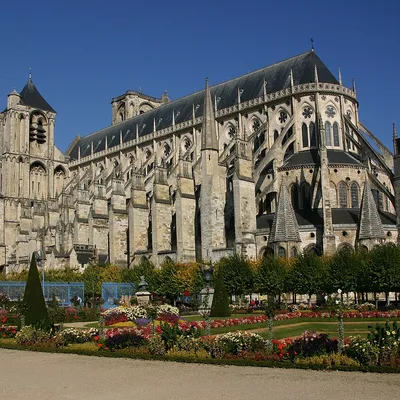
Chartres Cathedral is regarded as the completed form of French High Gothic, the first of the four great Gothic cathedrals of France alongside Reims, Amiens, and Bourges. The 1194 rebuild was the first to demonstrate at full scale the use of flying buttresses to liberate the wall for vast stained-glass windows — the template every later Gothic cathedral adapted. Classified as a Monument Historique in 1862 and inscribed on the UNESCO World Heritage list in December 1979 as 'the high point of French Gothic art'. Of 176 original stained-glass openings, 152 remain in their 13th-century state — the largest and best-preserved corpus of medieval stained glass in the world. The cobalt pigment dubbed 'Chartres Blue' has resisted modern scientific replication. As a pilgrimage site the cathedral holds the Sancta Camisia, by tradition the tunic worn by the Virgin Mary at Christ's birth; reportedly gifted by Charlemagne in 876, it made Chartres a key Marian pilgrimage center for eight centuries. The 12.9-meter stone labyrinth in the nave floor is the largest surviving medieval labyrinth, walked by pilgrims as a meditative substitute for Jerusalem. In 1855 Pius IX crowned the cathedral's Black Madonna. The Cathedral School of Chartres was a leading center of 11th-12th century European learning — the 'School of Chartres' where the quadrivium briefly surpassed Paris's rival schools.
Architectural Details
Chartres Cathedral is a Latin cross with its long axis aligned east-west, 128 meters in total length, with a nave 37 meters high and 16.4 meters wide; the transepts are short, and at the east end five semicircular radiating chapels form a curving ambulatory (chevet). Structurally it is the completed form of French High Gothic: roughly 1.5-meter exterior walls are supported by double-tiered flying buttresses that take the lateral thrust outward, freeing the wall surface for enormous stained-glass apertures impossible in the older Romanesque idiom. Each bay is covered by a rectangular four-part rib vault, an advance over the six-part vaults of the earlier Early Gothic cathedrals at Laon and Sens. The west front is composed of three doorways (the central is the famed Royal Portal), the great west rose window 12.9 meters in diameter, and the contrasting twin spires: the south spire is a plain pyramidal 105-meter tower from around 1142-1160, while the north spire is the 113-meter Flamboyant stone tower completed in 1507-1513. The roof was re-clad in copper during the 19th-century restoration, and oxidation has given it the soft pale-green patina now distinctive from afar. The principal stone is local Berchere limestone, transported by townspeople from a quarry 8 kilometers away during the 'Cult of Carts' of 1145.