Wartburg
ヴァルトブルク城
アイゼナハ · DE
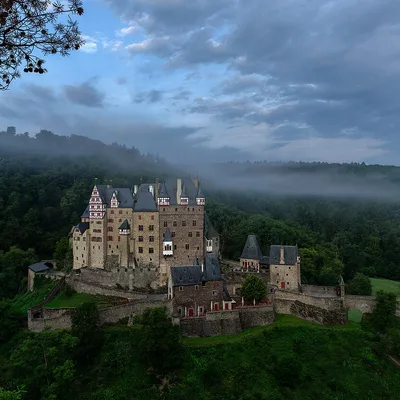
Where Luther translated the Bible — the World Heritage cliff-top castle that inspired Neuschwanstein
Perched on a 410-meter precipice southwest of Eisenach in Thuringia, Germany, Wartburg Castle is both the high-medieval German court culture's grandest stage and the sacred site where Martin Luther translated the New Testament into German in just ten weeks.
Best Season & Time
Fresh green Thuringian Forest, cool weather, few visitors — solitude on the precipice
★★★★☆
Peak season with courtyard concerts and full English tours — arrive at 7 a.m. opening to beat queues
★★★★★
Golden Thuringian Forest foliage against the stone fortress — a photographer's dream with valley views
★★★★★
Snow-dusted medieval walls and the Christmas market in the courtyard make for an atmospheric visit
★★★☆☆
Top 3 Highlights
1.The Cliff-top Medieval Fortress Silhouette
Standing on a 410-meter rock spur above the Thuringian Forest, Wartburg combines towers, palas, and wings preserved since the 12th century into the archetype of a German medieval castle. Ludwig II drew direct inspiration from here for Neuschwanstein.
Frame the castle from the south-east Marienthal viewpoint at sunrise with valley mist
2.The Gilded Festsaal of the Romanesque Palas
Occupying the entire third floor of the 12th-century Palas, the Festsaal was lavishly restored in the 19th century with gold leaf, mosaic, and woodwork. Wagner set the song contest of Tannhauser here, and the hall directly modeled Neuschwanstein's Singers' Hall.
Shoot vertically from the western windows toward the eastern stage for full depth
3.Luther's Study Where the German Bible Was Born
From May 1521 to March 1522, hidden here as 'Junker Jorg' after his excommunication, Martin Luther translated the New Testament from Greek into German in just ten weeks. The original desk, chair, and stove remain, alongside the legendary 'ink stain'.
Frame the desk against the back-lit window using only natural light
Stories & Legends
Recommended For
Insider Tips
- 1.The Wartburg-Express shuttle from Eisenach station runs only in summer. Off-season visitors must walk 40 minutes uphill or taxi to the lower parking lot, then walk the final 10 minutes up the 'donkey path' — physically demanding for older travelers.
- 2.Guided tours (German and English) are mandatory to enter the Palas and Luther's study. Book online in advance to skip queues that can exceed two hours in summer afternoons; the first 9 a.m. English tour slot is the prime time to secure both peace and access.
- 3.Stay at the Romantik Hotel auf der Wartburg inside the castle walls to have the fortress to yourself once day-trippers leave. The dawn view of the Thuringian Forest from your window is a privilege reserved for overnight guests.
Visit Information
- Access
- About 10 minutes by Wartburg-Express shuttle bus from Eisenach Station (ICE stop, summer only), or about 40 minutes on foot off-season — alternatively a 5-minute drive to the lower parking lot plus a 10-minute uphill walk. Frankfurt or Berlin by train in roughly 3 hours.
- Time Required
- About 1 hour for the guided tour plus museum — plan 2 to 3 hours total.
- Budget Guide
- Adult admission with guided tour EUR 13; concessions EUR 8. With rail and bus fare, plan EUR 30-60 for a day trip. (Prices as of 2024.)
Nearby Attractions
In Eisenach, the Bachhaus museum (J.S. Bach's birthplace, 30-minute walk) and the Lutherhaus (where young Luther boarded as a schoolboy, 25-minute walk) pair naturally with a Wartburg visit. A 30-minute drive reaches Erfurt, whose Augustinian monastery and Gothic cathedral mark Luther's monastic years before his stand at Worms.
Go Deeper
Deeper details for those with the time to read on.
Timeline
- 1067
Legendary Founding
Count Ludwig der Springer of Thuringia is said to have cried 'Wait, mountain — you shall bear my castle!' on first seeing the hill, founding Wartburg.
- 1080
First Documentary Mention
Bishop Bruno of Merseburg records the castle as 'Wartberg' in his De Bello Saxonico, confirming its existence in written sources.
- 1172-1211
Cultural Court Peak
Under Landgrave Hermann I, the castle becomes a leading princely court of the Empire, hosting Walther von der Vogelweide and Wolfram von Eschenbach.
- 1206/1207
Legendary Minstrels' Contest
The semi-legendary Sängerkrieg song contest is set at Wartburg, later supplying Richard Wagner with the plot of his opera Tannhauser.
- 1211-1228
Saint Elisabeth's Residence
Princess Elisabeth of Hungary is raised here from age four, marries Landgrave Ludwig IV in 1221, and becomes renowned for her charitable works.
- c. 1318
Lightning Fire and Reconstruction
A fire caused by lightning damages the castle; in 1320 a Gothic chapel is added to the Palas during the subsequent reconstruction.
- 1521-1522
Luther's Bible Translation
After the Diet of Worms, Martin Luther hides here as 'Junker Jörg' and translates the New Testament from Greek into German in ten weeks.
- 1817
Wartburg Festival
Some 500 Burschenschaft students gather to mark 300 years of Reformation and the fourth anniversary of Leipzig — a milestone of German nationalism.
- 1838-1890
Romantic Restoration
Grand Duke Carl Alexander and architect Hugo von Ritgen restore the ruinous castle, creating the lavish Festsaal and Sängersaal interiors.
- 1867
Ludwig II's Visit
King Ludwig II of Bavaria visits Wartburg; the impression he carries away directly inspires the interiors of Neuschwanstein Castle.
- 1999
World Heritage Inscription
UNESCO inscribes Wartburg on the World Heritage List under criteria (III) and (VI), citing its medieval architecture and Reformation legacy.
- 2017
Reformation 500th Anniversary
Germany marks 500 years since Luther's 95 Theses with a major national Reformation exhibition mounted within the castle walls.
Detailed History
Wartburg Castle's foundation is traditionally dated to 1067, when Ludwig der Springer, count of Schauenburg in Thuringia, is said to have established a fortress here. The earliest documented mention appears in 1080, when Bruno of Merseburg referred to it as 'Wartberg' in his De Bello Saxonico. After Ludwig's son Louis I was elevated to landgrave in 1131, Wartburg remained the seat of the Thuringian landgraves until 1440. From 1172 to 1211, under Landgrave Hermann I, the castle became one of the most important princely courts of the Empire, attracting minnesingers including Walther von der Vogelweide and Wolfram von Eschenbach — the latter writing part of his epic Parzival here in 1203. The legendary Sängerkrieg of around 1206/1207 was set here, later supplying Wagner with the central plot of Tannhauser. Princess Elisabeth of Hungary was sent at age four to be raised at Wartburg, married Landgrave Ludwig IV in 1221, and became renowned for her charitable work; she withdrew to Marburg after her husband's death on Crusade in 1227 and was canonized in 1235. A lightning fire of 1317-18 prompted extensive reconstruction, with a Gothic chapel added to the Palas. The castle's most transformative moment came between May 1521 and March 1522, when Martin Luther — excommunicated by Pope Leo X and outlawed at Worms — was secretly brought here by Elector Frederick the Wise. Disguised as 'Junker Jörg', Luther translated the entire New Testament from Greek into German in just ten weeks, a feat that decisively shaped modern Standard German. On October 18, 1817, around 500 Burschenschaft students gathered here for the Wartburg Festival, marking both the 300th anniversary of the Reformation and the fourth of the Battle of Leipzig — a symbolic moment of modern German nationalism. Between the 1830s and 1890s, Grand Duke Carl Alexander of Saxe-Weimar-Eisenach restored the dilapidated castle together with architect Hugo von Ritgen, creating the lavish Festsaal and Sängersaal interiors in High Romantic style. King Ludwig II of Bavaria visited in 1867, and the impression so moved him that the Singers' Hall and Throne Hall of Neuschwanstein were later modeled directly on Wartburg's. UNESCO inscribed Wartburg as a World Heritage Site in 1999 under criteria (III) and (VI).
Cultural Significance
Wartburg Castle was inscribed on the UNESCO World Heritage List in 1999 under criteria (III) — a unique or rare witness to a cultural tradition — and (VI) — direct association with events, ideas, or literary works of outstanding universal significance. Among medieval German castles it is the best-preserved example, retaining substantive 12th- to 15th-century structures alongside meticulous Romantic restoration. As the site of Luther's German New Testament translation, Wartburg stands as one of the holiest places of the Protestant Reformation, a pilgrimage destination for Lutheran Christians and Reformation scholars worldwide. Equally, the 1817 Wartburg Festival makes it a foundational site of modern German national consciousness — a duality of religious and political memory rare among European castles. The 19th-century restoration represents the pinnacle of architectural Romanticism: Ludwig II's youthful visit in 1867 made such an impression that Neuschwanstein Castle was conceived as a direct heir, with Wartburg's Singers' Hall and Festsaal becoming the exact templates for its Bavarian successor. Beyond Wagner's Tannhauser, Wartburg is woven into German literature through Goethe's letters praising the view, the Manesse Codex illustrations of the Sängerkrieg, and Moritz von Schwind's frescoes — making Wartburg a multilayered cultural memory site at the heart of German identity.
Architectural Details
Wartburg Castle is a composite mixing a 12th-century Romanesque core (the Palas), 13th- to 15th-century Gothic additions, and 19th-century Romantic restoration. The medieval site stretches roughly 180 meters along a narrow ridge, divided into a First Court and a Second Court. The central Palas, built around 1180 under Landgrave Hermann I, is a textbook Romanesque palace: three stories of red sandstone with rows of round-arched windows and carved columns. The ground floor housed service rooms, the first floor private quarters, and the entire third floor was given over to the Festsaal — one of the largest banqueting halls in 12th-century Germany. The Sängersaal features Moritz von Schwind's 1855 frescoes of the Minstrels' Contest. The circular keep (Bergfried), about 45 meters tall, was rebuilt in the 1850s and is crowned with a gilded cross. The outer perimeter consists of stone curtain walls, a drawbridge gate, north and south towers, the Vogtei (steward's wing), and residential buildings along the ridge. The 19th-century interior is dense with gold mosaics and woodcarving — the direct models for Neuschwanstein's Singers' Hall and Throne Hall. By contrast, Luther's study is an austere chamber four meters square containing the original wooden desk, chair, stove, and small window from the early 16th century.