Cave of Altamira
アルタミラ洞窟
サンティリャーナ・デル・マル · ES
Where 15,000-year-old bison gallop the ceiling — the cave that reset prehistory
Near Santillana del Mar in Cantabria, the 270-metre Cave of Altamira (Cuevas de Altamira) holds Upper Paleolithic paintings whose 1879 discovery by María Sanz de Sautuola, aged eight, forced modern archaeology to accept that humans had made masterpieces tens of thousands of years before history.
Best Season & Time
Cantabrian coast at its greenest, Santillana's cobbled streets at their best, mild 15-20 degrees Celsius.
★★★★★
Summer crowds gone, hills turning gold, an unhurried museum and a softer light over the medieval town.
★★★★☆
Pleasant temperatures but peak Spanish-holiday crowds; meaningful only with an original-cave lottery win.
★★★☆☆
Wet and overcast outside, but the museum's immersive Paleolithic plunge feels even stronger indoors.
★★★☆☆
Top 3 Highlights
1.The Polychrome Ceiling — bison painted in stone relief
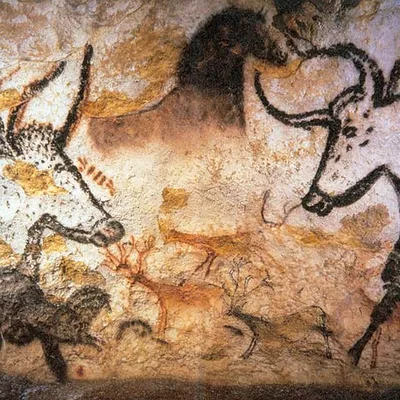
Reproduced full-scale inside the Neocueva replica, the famous Magdalenian ceiling teems with bison, horses and a doe. Artists turned natural bulges in the rock into anatomy, giving each animal a three-dimensional bulk that viewers still find unsettlingly alive.
Stand beneath the central panel in the Neocueva. Wait for the lighting to dim — the bison lift off.
2.Museo Nacional y Centro de Investigación de Altamira
Since the original cave was closed, this purpose-built national museum is the principal point of access. Galleries of excavated tools, pigments, faunal remains and dating science place the paintings within the daily life of the Paleolithic people who used the cave mouth.
Front facade exterior. The low curving roof blends into the hillside; best in late-morning light.
3.Entrance corridor of the Neocueva replica
The Neocueva reproduces the entire 270-metre cave at true scale: rock texture, ceiling height, and tunnel kinks all faithfully replicated. The entry corridor itself states the modern heritage philosophy — preserve the irreplaceable original by perfecting the visitable copy.
Frame the arched entrance from inside the corridor. Light is low; bring a wide-angle lens.
Stories & Legends
Recommended For
Insider Tips
- 1.The original cave was closed in 1977 and now allows only a handful of lottery-selected visitors per year. For nearly everyone, the visit is to the full-scale Neocueva replica inside the museum, where the painting experience is preserved essentially intact.
- 2.Admission is free on Saturday afternoons from 14:00 and on the first Sunday afternoon of each month, standard Spanish national-museum policy; a well-timed visit lets a family see the polychrome ceiling at no cost. Verify current rules on museodealtamira.es.
- 3.Pair the cave with Santillana del Mar's medieval centre two kilometres on foot — stone arcades, a Romanesque collegiate church, and seigneurial houses make it one of Spain's officially most beautiful villages and a perfect contrast to the dim cave interior.
Visit Information
- Access
- From Santander airport, roughly 40 minutes by car or about 45 minutes by ALSA regional bus to Santillana del Mar, plus a 30-minute walk uphill to the museum. A rental car is the most flexible option; ALSA buses are the practical public alternative.
- Time Required
- 2-3 hours for the museum and Neocueva; half a day combined with Santillana del Mar.
- Budget Guide
- Roughly 30-50 EUR per person all-in: 3 EUR admission (as of 2024, free in designated hours), local transit from Santander, and a regional lunch in Santillana del Mar.
Nearby Attractions
Santillana del Mar's medieval old town lies two kilometres on foot from the museum — stone arcades, a Romanesque collegiate church, and seigneurial houses make it one of Spain's officially most beautiful villages. Thirty minutes by car, Santander offers the Centro Botín art museum and Cantabrian Sea beaches.
Go Deeper
Deeper details for those with the time to read on.
Timeline
- c. 36,000 BP
First human use
Aurignacian-period human use of the cave begins, attested by charcoal and stone tools in the lowest archaeological layers, and a red claviform-like ceiling sign uranium-thorium dated to c. 36.16 ka.
- c. 18,500 BP
Solutrean paintings
First documented wave of paintings: horses, goats, and human handprints. The handprints were created as negatives — pigment was blown around a palm pressed to the wall.
- c. 16,590-14,000 BP
Polychrome ceiling
Lower Magdalenian artists complete the famous polychrome ceiling. Charcoal and red and yellow iron oxides are blended on the natural relief of the rock to give the steppe bison their three-dimensional bulk.
- c. 13,000 BP
Entrance sealed
A rockfall blocks the cave mouth, inadvertently isolating the paintings from outside air, humidity, and human contact for thirteen millennia.
- 1868
Modern rediscovery
Local hunter Modesto Cubillas stumbles on the cave entrance when a fallen tree shifts the blocking rocks; no one yet notices the paintings on the ceiling above.
- 1879
María's discovery
Amateur archaeologist Marcelino Sanz de Sautuola, surveying the cave floor, is alerted to the ceiling paintings when his daughter María, aged eight, shouts "Mira, papá, bueyes" — Look, father, oxen.
- 1880
Paleolithic thesis and rejection
Sautuola, supported by Juan de Vilanova y Piera, publishes his Paleolithic interpretation; the Lisbon Prehistorical Congress sides with French specialists who dismiss the paintings as recent forgeries.
- 1888
Sautuola dies discredited
Sautuola dies at fifty-seven, still rejected by the international establishment; his thesis will be vindicated only fourteen years after his death.
- 1902
Mea culpa and rehabilitation
After parallel cave-painting discoveries in France, Émile Cartailhac publishes "Mea culpa d'un sceptique" in L'Anthropologie, accepting the Paleolithic dating and rehabilitating Sautuola's reputation.
- 1977
Original cave first closed
Visitor breath and rising humidity have damaged the paintings; the original cave is completely closed. A three-year-waitlist limited reopening follows in 1982, but green mould forces renewed closure in 2002.
- 1985
World Heritage inscription
UNESCO inscribes Altamira on the World Heritage List under criteria (i) and (iii) as a unique masterpiece and an exceptional testimony to a vanished cultural tradition.
- 2001
Museum and Neocueva open
The Museo Nacional y Centro de Investigación de Altamira opens with the Neocueva, a full-scale reproduction by Manuel Franquelo and Sven Nebel enabling continued public access without endangering the original cave.
- 2008
Extended World Heritage listing
The listing is expanded to 17 additional Paleolithic caves in Cantabria, Asturias, and the Basque Country under the new name Cave of Altamira and Paleolithic Cave Art of Northern Spain.
Detailed History
Altamira's history unfolds across three layers. The first is artistic production. Human visits reach back roughly 36 millennia into the Aurignacian, attested by charcoal and tools in the lowest deposits; uranium-thorium dating anchored a red claviform sign on the Polychrome Ceiling to about 36.16 ka. Roughly 18.5 ka in the Upper Solutrean, artists produced the first painted layer — horses, goats, and stencilled handprints made by pressing a palm to the wall. The most celebrated phase came in the Lower Magdalenian, c. 16,590-14,000 BP, when the polychrome ceiling was completed with bison, horses, a doe and a probable boar. Around thirteen millennia later, a rockfall plugged the entrance, placing the paintings inside a thermo-hygrometric capsule for thirteen thousand years. The second layer is discovery and controversy. The cave mouth was rediscovered in 1868 when local hunter Modesto Cubillas noticed that a falling tree had dislodged the rocks; the paintings still went unnoticed. In 1879 Marcelino Sanz de Sautuola, working the floor, looked up after his daughter María, aged eight, pointed at the ceiling. Backed by Juan de Vilanova y Piera (Madrid), he published his Paleolithic interpretation in 1880. At the Lisbon Prehistorical Congress that year, a French faction with Gabriel de Mortillet and Émile Cartailhac rejected the claim — too sophisticated, no lamp soot — and Sautuola was effectively accused of forgery. He died unvindicated in 1888. By 1902, after further finds at La Mouthe and Font-de-Gaume could no longer be denied, Cartailhac issued his "Mea culpa d'un sceptique" in L'Anthropologie, restoring Sautuola's standing. The third layer is conservation. Visitor breath and humidity through the 1960s-70s damaged the pigments, forcing complete closure in 1977; a limited reopening followed in 1982, but green mould forced renewed closure in 2002. UNESCO inscribed Altamira in 1985. The Museo Nacional y Centro de Investigación de Altamira opened in 2001 together with the Neocueva, a full-scale reproduction by Manuel Franquelo with Sven Nebel; the public visit now passes through that replica while a capped lottery admits a few people each year. The inscription was widened in 2008 to seventeen further Paleolithic caves across Cantabria, Asturias and the Basque Country, under the name "Cave of Altamira and Paleolithic Cave Art of Northern Spain."
Cultural Significance
Altamira's place in cultural history is unique: more than any other single site, it is the cave that made modern archaeology accept the depth of human prehistory. At the time of its 1879 discovery, Darwinian evolution was establishing itself, but the idea that Upper Paleolithic humans had been capable of abstract symbolic thought and high-quality figurative art was not mainstream scholarship. The dismissal of Sautuola as a forger reflected that limit; the 1902 acceptance of Altamira pushed the chronology of human creativity back tens of thousands of years. UNESCO inscribed the site in 1985 under criterion (i) — a masterpiece of human creative genius — and (iii) — exceptional testimony to a vanished cultural tradition. With Lascaux and Chauvet in France, Altamira anchors the Franco-Cantabrian region, the densest concentration of Paleolithic figurative art in the world. Its cultural impact extends into popular culture: the regional government of Cantabria uses a stylised Altamira bison as its tourism logo, the Spanish cigarette brand Bisonte borrowed the same image, and the 2016 film Altamira, with Antonio Banderas as Sautuola, dramatised the controversy. Educational replicas of the polychrome ceiling exist in Madrid, Germany, and Japan (Parque España, Mie Prefecture), making Altamira a model case for protecting and sharing irreplaceable heritage.
Architectural Details
The Cave of Altamira is no built structure but a natural complex carved by ancient karst collapses inside the limestone of Mount Vispieres, inland from the Cantabrian coast. The cavity runs roughly 270 metres, with a main passage whose vault swings between two and six metres, opening into smaller chambers connected by sharp turns. Prehistoric people occupied only the cave mouth, yet they carried pigments deep inside to paint along its full length. The artists worked with charcoal and with iron oxides — ochre and hematite — often diluting each pigment to vary intensity, while the bulges and hollows of the walls were borrowed as built-in volumes, producing a chiaroscuro that makes the figures read as low relief. The most famous concentration is the Polychrome Ceiling, where extinct steppe bison appears in shifting postures, joined by horses, a doe and a probable boar. Adjacent to the original chamber, the Neocueva replica was finalised in 2001 under Manuel Franquelo with Sven Nebel: it copies every metre of texture, every change of ceiling height and every kink of the tunnel from precise digital measurements, and even slips in sculpted Paleolithic faces. The Museo Nacional y Centro de Investigación de Altamira itself sits as a low, curving modern building whose roof slips into the hillside above Santillana del Mar.